
- BGG rank
- BGG #1,685
- BGG rating
- 7.5
UBOOT: The Board Game
- 1–4 players
- 30–120 min
- Complexity 4.2/5
- 2019
Rules assistance for Victory at Sea: Akagi
Plain-language explanations of turns, card effects and disputed situations, with official source references and saved question history.
What would you like to know?
Answers come from the official rulebook, with the page to check.
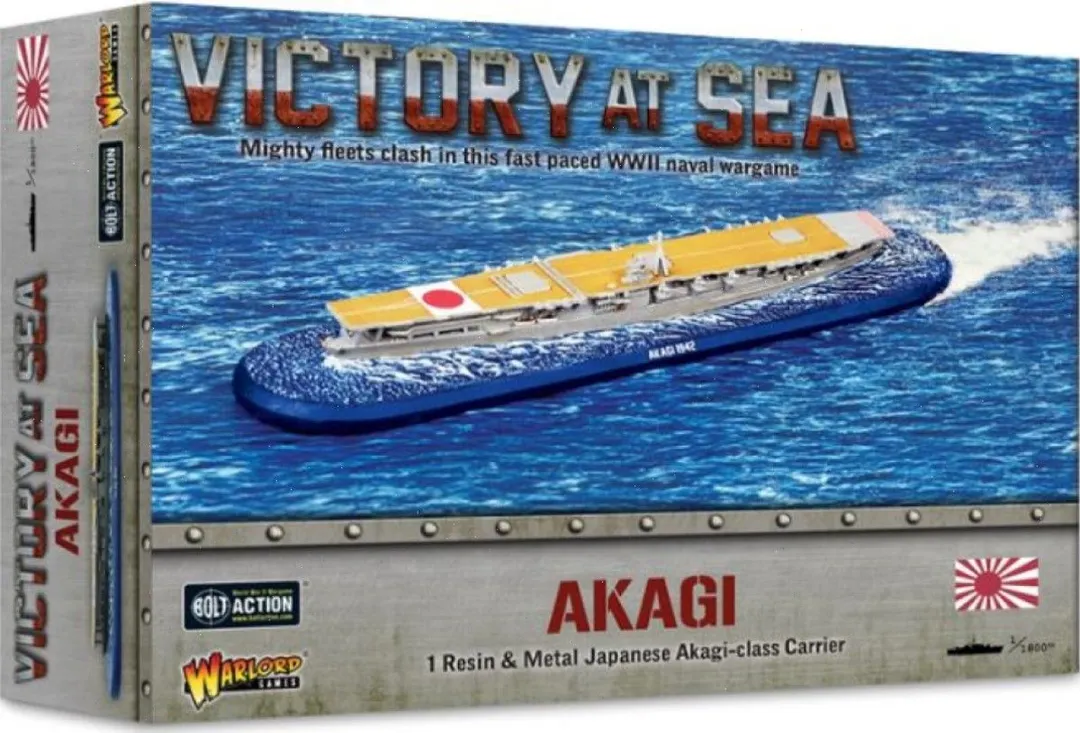
Victory at Sea: Akagi is an expansion for Victory at Sea: Battle for the Pacific released in 2021 for 2 players and ages 10 and up. Its main mechanics are Simulation.





Originally laid down as an Amagi-class battlecruiser, the stipulations of the Washington Treaty resulted in her conversion to an aircraft carrier. As a result, Akagi (赤城, "Red Castle") was one of Japan’s first large aircraft carriers. Akagi and her near-sister Kaga straddled the line between carrier and dreadnought. To keep both options open, the ships were designed to be quickly converted to capital ships. They carried turret barbettes, magazines and other equipment to support big gun turrets, and the wooden flight deck and hangar deck were designed to be quickly stripped off, making room for turrets to be mounted. However, by the mid-1930s, the admirals believed the aircraft carrier to be the equal of the capital ship and Akagi was extensively rebuilt to improve aircraft handling capacity, ending any possibility of later converting it to a capital ship. Her aircraft served in the Second Sino-Japanese War in the late 1930s. With the formation of the First Air Fleet in 1941, she became its flagship, and remained so until her sinking. Notable actions include the attack on Pearl Harbor, the invasion of Rabaul, bombing Darwin, Australia and the Indian Ocean Raid. In June 1942, she participated in the Battle of Midway, her aircraft bombarding the American-held atoll. However, US aircraft originating from Midway, and the US carriers Enterprise, Hornet and Yorktown attacked Akagi and three other Japanese fleet carriers. Dive bombers from USS Enterprise severely damaged Akagi, forcing friendly escorting destroyers to scuttle her to avoid her falling into US hands. The loss of four Japanese carriers at this engagement, including Akagi, was a key defeat for Japan, decisively shifting the balance of power in the Pacific theatre. —description from the publisher
Victory at Sea: Akagi supports 2 players according to the catalogue. This is the publisher’s listed player count, so the game is designed for exactly that number of participants. Variants for other group sizes, if any, are described in the rulebook of your edition, so check it before setting up a different configuration.
The catalogue lists Victory at Sea: Akagi for ages 10 and up. This is the publisher’s recommendation and reflects reading demands, rule complexity and small components rather than theme alone. Younger players can often join with help from an adult, so check the age guidance on your edition and consider your group’s experience with board games.
Victory at Sea: Akagi belongs to these categories: Wargame, Miniatures, and Nautical. Its main mechanics are Simulation. Categories describe the theme and setting of a game, while mechanics describe what players actually do on their turns. Each mechanic links to a catalogue hub with similar games, which helps when you want something comparable.
The catalogue lists Victory at Sea: Akagi as an expansion for Victory at Sea: Battle for the Pacific. Expansions add new content, rules or scenarios to the base game and usually cannot be played on their own, so you need Victory at Sea: Battle for the Pacific to use it. Check that your edition of Victory at Sea: Battle for the Pacific is compatible, as some expansions were revised between editions.