

- BGG rank
- BGG #12,472
- BGG rating
- 6.9
Victory at Sea: World War II Naval Combat Game
- 2 players
- 360 min
- Complexity 2.5/5
- 2006
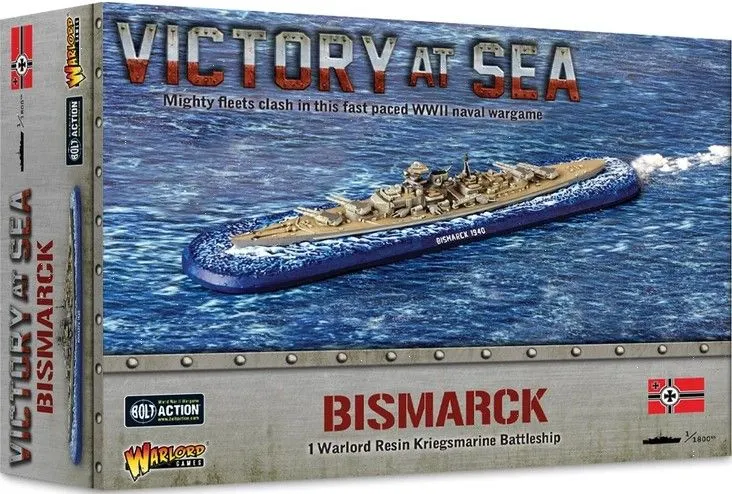
Rules assistance for Victory at Sea: Bismarck
Plain-language explanations of turns, card effects and disputed situations, with official source references and saved question history.
What would you like to know?
Answers come from the official rulebook, with the page to check.
Victory at Sea: Bismarck is an expansion for Victory at Sea: Battle for the Pacific released in 2020 for 2 players and ages 10 and up. Its main mechanics are Dice Rolling, Simulation, and Measurement Movement.



Two Bismarck-class battleships were built for the Kriegsmarine. Bismarck was the first, named for the Chancellor (Otto von Bismarck). The battleship was laid down in July 1936 and launched February 1939. She and her sister ship, Tirpitz, were two of the largest battleships built by any European power, and certainly the largest built by Germany. Whilst the physical power they held was tremendous, they also wreaked psychological havoc amongst the allies. Churchill was determined that the two battleships not be let loose upon the Atlantic. Bismarck's career, however, was woefully short, spanning just eight months under a single Captain, Ernst Lindeman. During this time, she only took part in a single offensive action that lasted just eight days in May 1941. This operation, codenamed Rheinübung, was to attempt what the Allies feared, a breakthrough to the Atlantic and raid allied shipping efforts between Britain and North America (along with the heavy cruiser Prinz Eugen). The two vessels were detected multiple times off Scandinavia, prompting Britain to initiate naval blocking maneuvers. The resultant battle, the Battle of the Denmark Strait, saw the British vessels HMS Hood and HMS Prince of Wales engage the two vessels. Hood was destroyed for her efforts and Prince of Wales suffered damage, forcing a retreat. However, Bismarck had suffered damage significant enough to put an end to her raiding mission. Limping for occupied France for repairs, Bismarck was pursued by a Royal Navy set on retribution for the sinking of HMS Hood. She was attacked by 16 Fairey Swordfish biplane torpedo bombers deployed by HMS Ark Royal. A direct hit rendered Bismarck's steering gear inoperable. The following morning, she suffered crippling damage in a battle against two British battleships and two cruisers. She was subsequently, on 27 May 1941, scuttled by her crew and sank with many lives lost. Contents: 1 Model Ship ‣ Bismarck 1 Ship Card Damage Sliders —description from the publisher
Victory at Sea: Bismarck supports 2 players according to the catalogue. This is the publisher’s listed player count, so the game is designed for exactly that number of participants. Variants for other group sizes, if any, are described in the rulebook of your edition, so check it before setting up a different configuration.
The catalogue lists Victory at Sea: Bismarck for ages 10 and up. This is the publisher’s recommendation and reflects reading demands, rule complexity and small components rather than theme alone. Younger players can often join with help from an adult, so check the age guidance on your edition and consider your group’s experience with board games.
Victory at Sea: Bismarck belongs to these categories: Wargame, Miniatures, and Nautical. Its main mechanics are Dice Rolling, Simulation, and Measurement Movement. Categories describe the theme and setting of a game, while mechanics describe what players actually do on their turns. Each mechanic links to a catalogue hub with similar games, which helps when you want something comparable.
The catalogue lists Victory at Sea: Bismarck as an expansion for Victory at Sea: Battle for the Pacific. Expansions add new content, rules or scenarios to the base game and usually cannot be played on their own, so you need Victory at Sea: Battle for the Pacific to use it. Check that your edition of Victory at Sea: Battle for the Pacific is compatible, as some expansions were revised between editions.