

- BGG rank
- BGG #11,796
- BGG rating
- 8.4
SEEKRIEG 5
- 2–10 players
- 120 min
- Complexity 4.1/5
- 2004
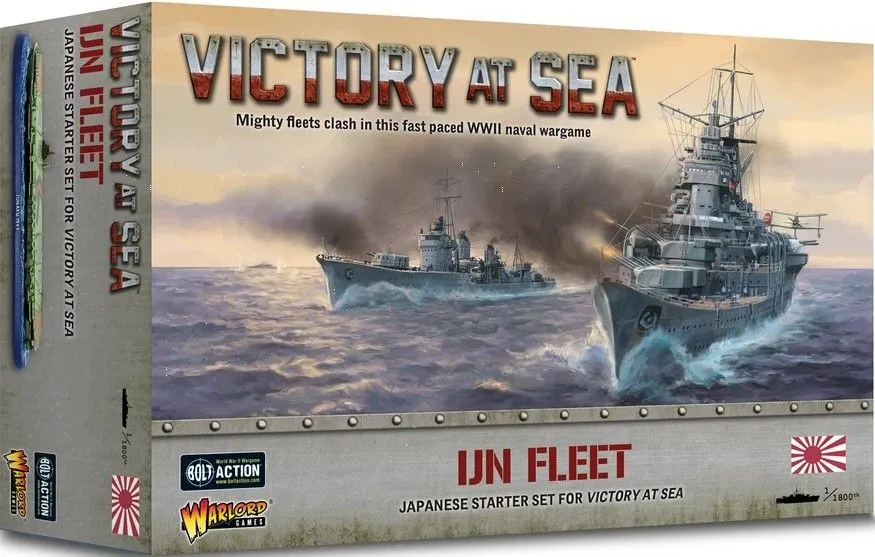
Rules assistance for Victory at Sea: IJN fleet
Plain-language explanations of turns, card effects and disputed situations, with official source references and saved question history.
What would you like to know?
Answers come from the official rulebook, with the page to check.
Victory at Sea: IJN fleet is an expansion for Victory at Sea: Battle for the Pacific released in 2020 for 2 players and ages 10 and up. Its main mechanics are Dice Rolling, Simulation, and Measurement Movement.



For centuries, Japan's policy of seclusion (sakoku) saw it concentrate on coastal defences in order to repel foreign vessels. However, with the advances other maritime nations were making, it eventually became obvious that no longer would Japan be able to ignore the rest of the world. As an island power, it needed a modern navy. Turning to Britain for assistance, Japan quickly created a powerful modern fleet. It was this capable and confident navy that came out to fight the American Pacific Fleet. The Japanese understood the potential of air power early and created an effective carrier arm. In addition to the carriers, the Imperial Japanese Navy possessed a powerful battleship force, which included the largest and most powerful battleships in the world, the Yamato and the Musashi. The Imperial Japanese Navy's potential was demonstrated in the attack on Pearl Harbor in 1941. Using armour-piercing bombs and torpedoes, Japanese aircraft inflicted tremendous damage on the American Pacific fleet as it lay at anchor. Midway was the turning point of naval war in the Pacific and, from then on, the Imperial Japanese Navy was unable to make any headway against the increasing carrier strength of the US Navy. With the victorious Allies pushing towards the Japanese islands, the Imperial Japanese Navy fought desperately to keep them at bay. Kamikaze aircraft and other suicide weapons were deployed, and eventually warships of the Imperial Japanese Navy made death-rides against US forces. Contents: 8 Model Ships ‣ 1 Kongō 1941 ‣ 1 Zuikaku 1944 ‣ 1 Suzuya 1944 ‣ 1 Mikuma 1942 ‣ 1 Yahagi 1943 ‣ 3 Kagerō-class Destroyers 4 Mitsubishi A6M2 Zero Flights Ship Cards Damage Sliders —description from the publisher
Victory at Sea: IJN fleet supports 2 players according to the catalogue. This is the publisher’s listed player count, so the game is designed for exactly that number of participants. Variants for other group sizes, if any, are described in the rulebook of your edition, so check it before setting up a different configuration.
The catalogue lists Victory at Sea: IJN fleet for ages 10 and up. This is the publisher’s recommendation and reflects reading demands, rule complexity and small components rather than theme alone. Younger players can often join with help from an adult, so check the age guidance on your edition and consider your group’s experience with board games.
Victory at Sea: IJN fleet belongs to these categories: Wargame, Miniatures, and Nautical. Its main mechanics are Dice Rolling, Simulation, and Measurement Movement. Categories describe the theme and setting of a game, while mechanics describe what players actually do on their turns. Each mechanic links to a catalogue hub with similar games, which helps when you want something comparable.
The catalogue lists Victory at Sea: IJN fleet as an expansion for Victory at Sea: Battle for the Pacific. Expansions add new content, rules or scenarios to the base game and usually cannot be played on their own, so you need Victory at Sea: Battle for the Pacific to use it. Check that your edition of Victory at Sea: Battle for the Pacific is compatible, as some expansions were revised between editions.