

- BGG rank
- BGG #11,796
- BGG rating
- 8.4
SEEKRIEG 5
- 2–10 players
- 120 min
- Complexity 4.1/5
- 2004
Rules assistance for Victory at Sea: Royal Navy fleet
Plain-language explanations of turns, card effects and disputed situations, with official source references and saved question history.
What would you like to know?
Answers come from the official rulebook, with the page to check.
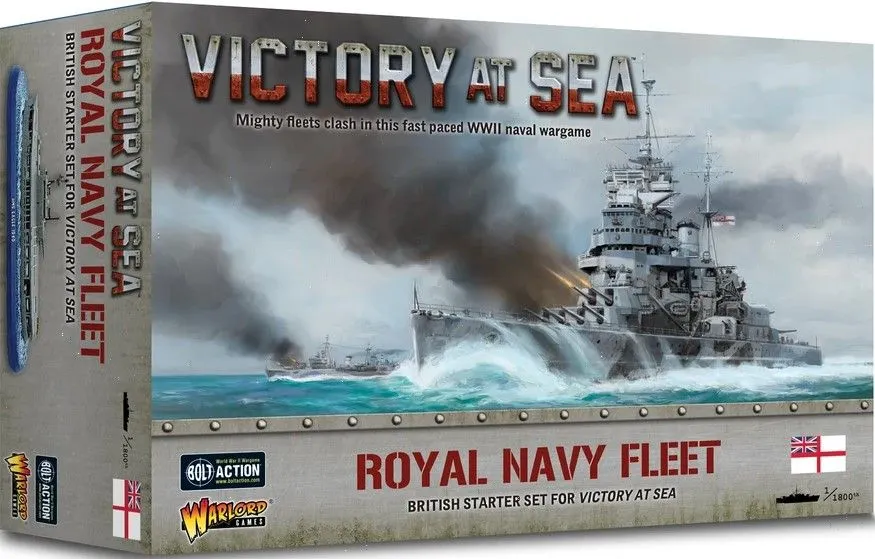
Victory at Sea: Royal Navy fleet is an expansion for Victory at Sea: Battle for the Pacific released in 2020 for 2 players and ages 10 and up. Its main mechanics are Dice Rolling, Simulation, and Measurement Movement.


The Royal Navy of Great Britain was the world’s greatest navy at the outbreak of the Second World War. However, Britain went to war with mainly First World War-vintage vessels. Since the Royal Navy already possessed many powerful units, construction of the most modern designs was limited. This meant that at the outbreak of World War Two Britain had far more battleships than most other nations, but they had smaller guns than those built to the most modern ships. Though the main battle force was kept concentrated in home waters, task forces were assigned to many distant areas, but the Royal Navy could not be strong everywhere. Although badly stretched, the Royal Navy lived up to its traditional ‘can do!’ ethos, fighting hard in all theatres. In addition to the battleship forces, the Royal Navy maintained a handful of fast battlecruisers – some of them quite old – and aircraft carriers. These were backed up by a strong cruiser force and light forces including destroyers, motor torpedo boats (MTBs) and motor gunboats (MGBs). As the war went on, aircraft carriers became increasingly important and air defences were steadily improved on all ships. Yet the big guns of the battleships and cruisers played a vital role in many theatres of war. British capital ships saw action in the Arctic and the Atlantic against German commerce raiders, in the Mediterranean against Italian forces, and ventured into the Pacific in an ill-fated attempt to stem the Japanese advance. Though the great fleet actions planned for and desired by the architects of the Royal Navy did not materialise during World War Two, the Royal Navy adapted well to the war it was destined to fight and emerged with great honour. Contents: 8 Model Ships ‣ 1 HMS Eagle 1940 ‣ 1 HMS Duke of York 1943 ‣ 1 HMS Neptune 1941 ‣ 1 HMS Belfast 1942 ‣ 1 HMS Dido 1940 ‣ 3 Tribal-class Destroyers 4 Fairey Swordfish Flights Ship Cards Damage Sliders —description from the publisher
Victory at Sea: Royal Navy fleet supports 2 players according to the catalogue. This is the publisher’s listed player count, so the game is designed for exactly that number of participants. Variants for other group sizes, if any, are described in the rulebook of your edition, so check it before setting up a different configuration.
The catalogue lists Victory at Sea: Royal Navy fleet for ages 10 and up. This is the publisher’s recommendation and reflects reading demands, rule complexity and small components rather than theme alone. Younger players can often join with help from an adult, so check the age guidance on your edition and consider your group’s experience with board games.
Victory at Sea: Royal Navy fleet belongs to these categories: Wargame, Miniatures, and Nautical. Its main mechanics are Dice Rolling, Simulation, and Measurement Movement. Categories describe the theme and setting of a game, while mechanics describe what players actually do on their turns. Each mechanic links to a catalogue hub with similar games, which helps when you want something comparable.
The catalogue lists Victory at Sea: Royal Navy fleet as an expansion for Victory at Sea: Battle for the Pacific. Expansions add new content, rules or scenarios to the base game and usually cannot be played on their own, so you need Victory at Sea: Battle for the Pacific to use it. Check that your edition of Victory at Sea: Battle for the Pacific is compatible, as some expansions were revised between editions.