

- BGG rank
- BGG #11,796
- BGG rating
- 8.4
SEEKRIEG 5
- 2–10 players
- 120 min
- Complexity 4.1/5
- 2004
Rules assistance for Victory at Sea: USS Idaho
Plain-language explanations of turns, card effects and disputed situations, with official source references and saved question history.
What would you like to know?
Answers come from the official rulebook, with the page to check.
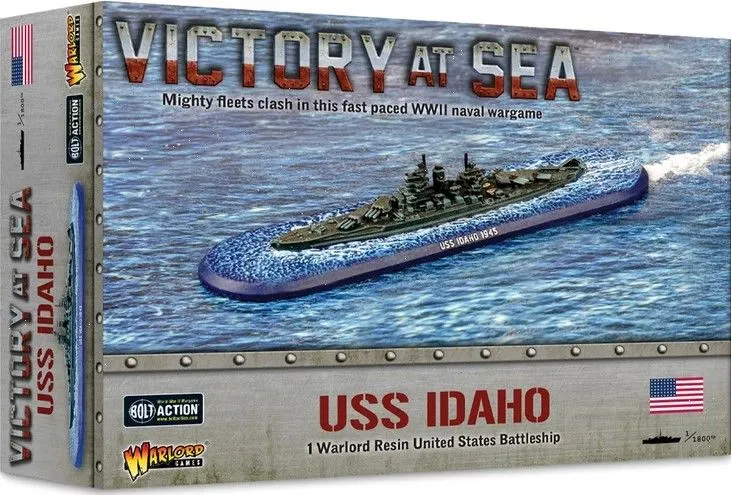
Victory at Sea: USS Idaho is an expansion for Victory at Sea: Battle for the Pacific released in 2020 for 2 players and ages 10 and up. Its main mechanics are Dice Rolling, Simulation, and Measurement Movement.


USS Idaho, the third of three ships of the New Mexico-class of Battleship, was the fourth vessel to bear the name. She was launched in June 1917 and commissioned in March 1919. She was armed with a battery of twelve 14” guns in four turrets and was protected with heavy armour plate (13.5” thick in the main belt). During the 20s and 30s, Idaho spent the majority of her time as part of the Pacific Fleet, conducting routine training exercises. She was modernised in the early 30s. During World War II, but before the United States’ entry into hostilities, she was assigned to join the Neutrality Patrols that protected American shipping during the Battle of the Pacific. Following the attack on Pearl Harbour, she was redeployed to the Pacific Theatre, along with her sister ships. For the remainder of the war she supported amphibious operations in the Pacific, shelling Japanese forces during the Gilbert and Marshall Islands and Philippines campaigns. She also supported the invasions of Peleliu, Iwo Jima and Okinawa. Idaho was present in Tokyo Bay when Japan formally surrendered on 2 September 1945. Idaho was decommissioned the next year and dismantled in 1947. Contents: 1 Model Ship ‣ USS Idaho 1 Ship Card Damage Sliders —description from the publisher
Victory at Sea: USS Idaho supports 2 players according to the catalogue. This is the publisher’s listed player count, so the game is designed for exactly that number of participants. Variants for other group sizes, if any, are described in the rulebook of your edition, so check it before setting up a different configuration.
The catalogue lists Victory at Sea: USS Idaho for ages 10 and up. This is the publisher’s recommendation and reflects reading demands, rule complexity and small components rather than theme alone. Younger players can often join with help from an adult, so check the age guidance on your edition and consider your group’s experience with board games.
Victory at Sea: USS Idaho belongs to these categories: Wargame, Miniatures, and Nautical. Its main mechanics are Dice Rolling, Simulation, and Measurement Movement. Categories describe the theme and setting of a game, while mechanics describe what players actually do on their turns. Each mechanic links to a catalogue hub with similar games, which helps when you want something comparable.
The catalogue lists Victory at Sea: USS Idaho as an expansion for Victory at Sea: Battle for the Pacific. Expansions add new content, rules or scenarios to the base game and usually cannot be played on their own, so you need Victory at Sea: Battle for the Pacific to use it. Check that your edition of Victory at Sea: Battle for the Pacific is compatible, as some expansions were revised between editions.