
- BGG rating
- 7.3
War in the Pacific Extension Kit
- 1–6 players
- 480 min
- Complexity 3.0/5
- 2008
2006
Rules assistance for War in the Pacific (Second Edition)
Plain-language explanations of turns, card effects and disputed situations, with official source references and saved question history.
What would you like to know?
Answers come from the official rulebook, with the page to check.
War in the Pacific (Second Edition) is a board game released in 2006 for 2–6 players, 480 minutes per game, and ages 12 and up. It was designed by Kevin Kiff and its main mechanics are Hexagon Grid and Simulation.






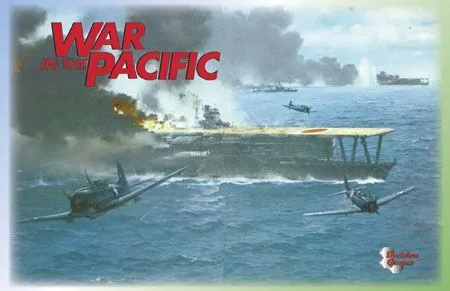
On Sunday, 7 December 1941, the US naval base at Pearl Harbor, Hawaii, was attacked by Japanese aircraft. For the next four years, Allied task forces engaged elements of the Imperial Japanese fleet throughout the ocean. Marines and army units began their program of island-hopping, wresting from the Japanese the empire that they had expanded in every direction. War in the Pacific is a multi-level simulation of the Pacific theater of operations during World War II. The game enables players to recreate the entire course of the war with the US, from the opening Japanese attack on 7 December, 1941 to the climatic Allied assaults in the closing days of 1945. Representing some 30% of the globe, the strategic maps let players move and engage in combat on all levels: air, ground and naval. War in the Pacific is not a simple game; there are a number of rules and concepts that will, at first, be unfamiliar to a majority of players. But playing through smaller map sections and scenarios enables the player to become familiar with the mechanics of the game. This is a reprint edition which substantially expanded the original's components. Components: 7 full size (22 x 34") strategic maps in full color, new tactical maps with nearly 338 individual islands for new ground units to fight over, 32 die-cut counter sheets, nearly 9,000 counters showing all types of units from the Pacific Theater, rule books, chart books and assorted displays and player aid charts. The rules have undergone significant change with greatly increased emphasis on detail in combat while removing the detailed logistics system that was the focus of the old game and replacing it with a command point system modeled after Victory Games' "Pacific War." The order of battle is significantly more detailed. Leaders on many levels (and whose combat performance may be unpredictable), often serve to limit players' ability to affect the outcome of every battle to the Nth degree. A player's assignment of the right task force commander (for the right force at the right time), may spell the difference between a tactical victory and defeat. The ground combat system has been completely revised, substituting a step-loss system adapted from VG's "Pacific War." Pitched battles on islands and atolls are now resolved, including maneuver, on expanded tactical maps in six different scales, rather than simply being abstractly represented in a single hex on the strategic maps. War in the Pacific's original air and naval systems are retained, in their essence, albeit with substantial modifications and above all added chrome in combat. Thus the game still feels like the original in those two aspects. The game comes with the grand campaign and some small introductory battle scenarios. Booklets: Rulebook I (rule 1.0 to 25.0) Rulebook II (rule 26.0 to 62.0) Scenarios & Campaign reinforcements Examples of Play, Optional Rules & Designer's Notes Chartbook I Chartbook II
War in the Pacific (Second Edition) supports 2–6 players according to the catalogue. This range comes from the publisher’s listed player count, so the game can be set up for any group size within it. Some setups, rules and scoring details may still vary by player count, so check your edition’s rulebook for the exact configuration.
The listed playing time for War in the Pacific (Second Edition) is 480 minutes. This is the publisher’s estimate for a full game. The actual duration depends on the group, the player count and familiarity with the rules: first sessions usually run longer, while experienced groups often finish faster. Setup and teaching time are not included in this estimate.
The catalogue lists War in the Pacific (Second Edition) for ages 12 and up. This is the publisher’s recommendation and reflects reading demands, rule complexity and small components rather than theme alone. Younger players can often join with help from an adult, so check the age guidance on your edition and consider your group’s experience with board games.
War in the Pacific (Second Edition) has a complexity rating of 4.4 out of 5 from BoardGameGeek players, which makes it a heavy game. The rating reflects how much rules knowledge, planning and decision-making a typical game demands. Expect a longer first teach for heavier games, and use a preparation guide before game night.
War in the Pacific (Second Edition) belongs to these categories: Wargame and World War II. Its main mechanics are Hexagon Grid and Simulation. Categories describe the theme and setting of a game, while mechanics describe what players actually do on their turns. Each mechanic links to a catalogue hub with similar games, which helps when you want something comparable.
The credited designers of War in the Pacific (Second Edition) are: Kevin Kiff. These credits come from the published game data and name the people responsible for the game’s design, not its illustrators or publishers. Designer pages on MeepleRules collect other titles by the same designers, which helps when you enjoy a game and want to find similar ones.
The catalogue lists War in the Pacific (Second Edition) as a base game. It can be played on its own with the components in the box and does not require any other title. Expansions, if any exist, add new content or rules on top of it and are listed separately in the catalogue with a link back to this base game.
