
- Puntuación BGG
- 9,3
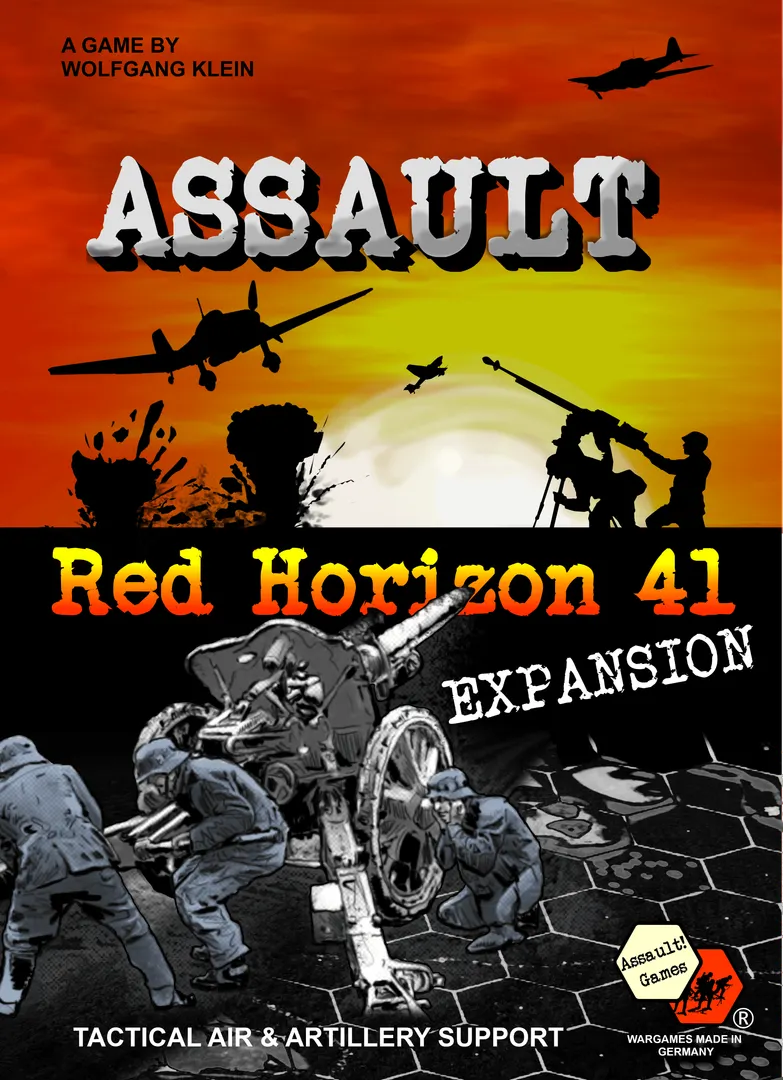
Assault Red Horizon 41: TA/OAS Expansion
- 2–4 jugadores
- 30–180 min
- 2022
2021
Ayuda con las reglas de Assault Red Horizon 41
Explicaciones claras de turnos, efectos de cartas y situaciones dudosas, con referencias a fuentes oficiales e historial de preguntas guardado.
Para 2 jugadores
¿Qué quieres saber?
Las respuestas salen del reglamento oficial, con la página para comprobarlo.
Assault Red Horizon 41 es un juego de mesa publicado en 2021 para 2–4 jugadores, con partidas de 30 a 180 minutos y a partir de 13 años. Fue diseñado por Wolfgang Klein y Erich Rankl y sus mecánicas principales son Dice Rolling, Modular Board y Hexagon Grid.







En inglés
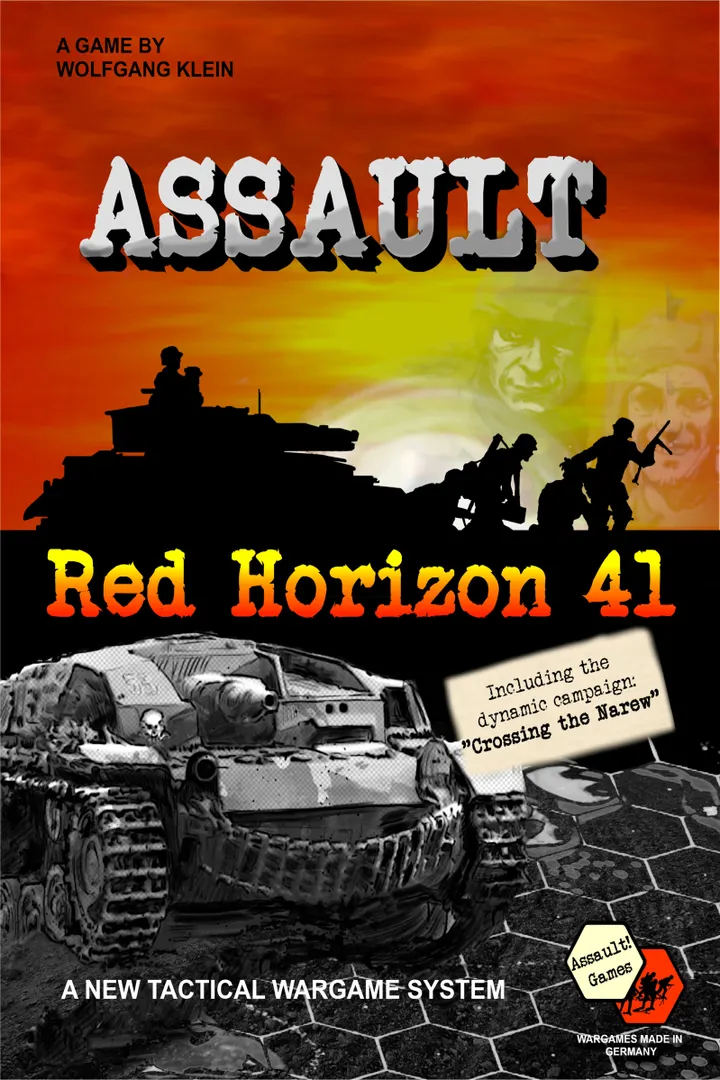
Assault – Red Horizon 41 is the first volume in a planned series of tactical level wargames in which players lead historical units into battle during Operation Barbarossa (June through October 1941). A Clash of Titans – the German Army and the Soviet Army fighting one another in a life and death struggle with infantry, artillery and armored units. Assault – Red Horizon 41 is intentionally not intended to be a simulation, but rather it abstracts certain aspects in favor of playability and manageable game length to convey the feeling of comprehensive tactical combat situations. Game Mechanics and rules: The Assault Game System is designed to be completely modular and to accommodate a wide range of preferences for those playing it. There are different scenarios that the players can choose from, and within these scenarios, the Order of Battle can vary through the use of Formation Cards. In each scenario, rather than being given a set Order of Battle, the players will randomly select Formation Cards (infantry, artillery, or armor/vehicle) based on the side they are playing. The Formation Cards give the player a certain number and type of units available for the scenario. This ensures both variation and regular surprises, since the make-up of your forces will change from game to game. Your High Command has assigned you certain units to achieve a particular goal; you will have to adjust your individual tactics based on the available units and the objectives you have been given! Units in the Assault Game System are activated by Command points. Players receive a certain number of Command points, which are listed on the Formation cards. Before Command Phase, players secretly decide (behind a small screen or divider) which units to activate in the current turn. The Command point allowance lets the player activate approximately 75% of all available units. Thus, players must set priorities for the turn. Not only does this speed up the game play, since all units are not used in each turn, but it also makes for some exciting moments in the fight. In the Assault Game System, we have tried to minimize the counter stacking issue. With many game systems in the hobby, you can find towers of counters and markers on certain hexes of the game board. The overview is then quickly lost. In the Assault Game System, there is a clear limit of one unit counter per hex, with the exception being when units in are being transported. In addition, there is usually only one command and/or status marker. Regarding Command and Unit State Markers, we have devised a simple double-marker system: each marker is double-sided and after the end of the round, in the Organization Phase, the markers are simply flipped or removed depending on their color. This helps to speed up play. In general, Assault has attempted to emphasize game flow. The fact that Command Points are assigned to activate units in the Planning Phase accelerates the game. Since the units to be activated are already established before the Action Phase, there is less for the player to think about and fewer opportunities for AP to set in. The Dynamic Campaign System: "Crossing the Narew" "It is the end of June 1941, when the German Wehrmacht begins the largest land operation of World War II, Operation Barbarossa. More than four million German soldiers are in their starting positions on the eastern borders of the German Reich. The strategic objective is the capital Moscow. To be successful, the operation must combine strength with speed. Key to this will be seizing control the bridges that lie between the German Wehrmacht and its ultimate prize. In this campaign, players take on the role of a company commander in order to achieve victory for their own faction. Each serving in the ranks of one of the two divisions that took part historically, the German 7th Infantry Division and the Soviet 13th Rifle Division. The campaign consists of four connected battles and covers the period 24-25 June 1941. This campaign is in line with historical operations for crossing the Narew River. This crossing was important and had to be achieved quickly in order to close the town of Bialystok and the connected basin." Another aspect that sets Assault Red Horizons ’41 apart from the competition is our Dynamic Campaign Systemwhich will be included in the base game. We have designed a system whereby multiple scenarios can be linked with a variable starting set up for each subsequent scenario dependent upon how many of the victory conditions each side achieves. The players conduct operations, each commanding a company of troops from regiments that actually served on the Eastern Front. The campaign includes 8 different plots for a high replay value.
Según el catálogo, Assault Red Horizon 41 admite de 2 a 4 jugadores. Este intervalo corresponde al número de jugadores indicado por la editorial, así que el juego puede prepararse para cualquier grupo dentro de ese margen. La preparación, algunas reglas y la puntuación pueden variar según el número de jugadores; consulta la configuración exacta en el reglamento de tu edición.
La duración indicada para Assault Red Horizon 41 es de 30 a 180 minutos, la estimación de la editorial para una partida completa. El tiempo real depende del grupo, del número de jugadores y del conocimiento de las reglas: las primeras partidas suelen alargarse y los grupos con experiencia terminan antes. La preparación y la explicación de las reglas no están incluidas.
El catálogo indica Assault Red Horizon 41 a partir de 13 años. Es la recomendación de la editorial y refleja la lectura necesaria, la complejidad de las reglas y las piezas pequeñas, no solo el tema. Los más pequeños a menudo pueden jugar con ayuda de un adulto: comprueba la edad recomendada en tu edición y la experiencia de tu grupo.
Assault Red Horizon 41 tiene una puntuación de complejidad de 3,0 sobre 5 según los jugadores de BoardGameGeek, lo que lo convierte en un juego de complejidad media. La puntuación refleja cuánto conocimiento de reglas, planificación y toma de decisiones exige una partida típica. Los juegos exigentes requieren una explicación inicial más larga, así que conviene usar una guía de preparación.
Assault Red Horizon 41 pertenece a estas categorías: Wargame y World War II. Sus mecánicas principales son Dice Rolling, Modular Board y Hexagon Grid. Las categorías describen el tema y la ambientación de un juego, mientras que las mecánicas describen lo que los jugadores hacen realmente en su turno. Cada mecánica lleva a una página del catálogo con juegos similares.
Los autores acreditados de Assault Red Horizon 41 son: Wolfgang Klein y Erich Rankl. Estos créditos proceden de los datos publicados del juego y nombran a las personas responsables de su diseño, no a ilustradores ni editoriales. Las páginas de autor de MeepleRules reúnen otros títulos de los mismos autores, algo útil cuando un juego te gusta y buscas otros parecidos.
El catálogo clasifica Assault Red Horizon 41 como juego base. Se juega por sí solo con los componentes de la caja y no requiere ningún otro título. Las expansiones, si existen, añaden contenido o reglas nuevas y aparecen por separado en el catálogo con un enlace a este juego base.