
- Puesto en BGG
- BGG #1723
- Puntuación BGG
- 6,6
Quoridor
- 2–4 jugadores
- 15 min
- Complejidad 1,8/5
- 1997
1680
Ayuda con las reglas de Fanorona
Explicaciones claras de turnos, efectos de cartas y situaciones dudosas, con referencias a fuentes oficiales e historial de preguntas guardado.
Para 2 jugadores
¿Qué quieres saber?
Las respuestas salen del reglamento oficial, con la página para comprobarlo.
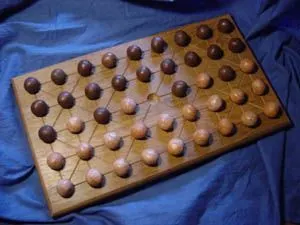
Fanorona es un juego de mesa publicado en 1680 para 2 jugadores, con partidas de 20 minutos y a partir de 7 años. Sus mecánicas principales son Square Grid y Grid Movement.

En inglés
Fanorona is a classical two-person strategic abstract game that comes from the island of Madagascar and is still popular there today. It is played on a rectangular board made up of two Alquerque boards with 22 plain black and white pieces. Capturing is compulsory and a series of captures may be made by the same piece on a turn, as in checkers. Unique aspects of the game include its method of capture (either approaching or withdrawing your piece from a line of enemy pieces), and the "vela partie" (debt game) after winning a decisive game (the winner must let the loser "eat" one man each turn for 17 consecutive moves). Because of the density of the board (only one open spot at the games beginning) and the unique method of capture, strategy is complex and enigmatic, with fewer pieces often beating more pieces. (While very different, the game feels somewhat like Zertz due to the above.) Historical note from one game box: Some Fanorona matches were devoted to the Gods and last but not least the fate and colonialization of Madagascar (1895) supposed to be solved unbloody with Fanorona on the game table.
Según el catálogo, Fanorona admite 2 jugadores. Es el número de jugadores indicado por la editorial, así que el juego está diseñado exactamente para esa cantidad de participantes. Las variantes para otros tamaños de grupo, si existen, se describen en el reglamento de tu edición; consúltalo antes de preparar otra configuración.
La duración indicada para Fanorona es de 20 minutos, la estimación de la editorial para una partida completa. El tiempo real depende del grupo, del número de jugadores y del conocimiento de las reglas: las primeras partidas suelen alargarse y los grupos con experiencia terminan antes. La preparación y la explicación de las reglas no están incluidas.
El catálogo indica Fanorona a partir de 7 años. Es la recomendación de la editorial y refleja la lectura necesaria, la complejidad de las reglas y las piezas pequeñas, no solo el tema. Los más pequeños a menudo pueden jugar con ayuda de un adulto: comprueba la edad recomendada en tu edición y la experiencia de tu grupo.
Fanorona tiene una puntuación de complejidad de 2,4 sobre 5 según los jugadores de BoardGameGeek, lo que lo convierte en un juego algo ligero. La puntuación refleja cuánto conocimiento de reglas, planificación y toma de decisiones exige una partida típica. Los juegos exigentes requieren una explicación inicial más larga, así que conviene usar una guía de preparación.
Fanorona pertenece a estas categorías: Children's Game y Abstract Strategy. Sus mecánicas principales son Square Grid y Grid Movement. Las categorías describen el tema y la ambientación de un juego, mientras que las mecánicas describen lo que los jugadores hacen realmente en su turno. Cada mecánica lleva a una página del catálogo con juegos similares.
El catálogo clasifica Fanorona como juego base. Se juega por sí solo con los componentes de la caja y no requiere ningún otro título. Las expansiones, si existen, añaden contenido o reglas nuevas y aparecen por separado en el catálogo con un enlace a este juego base.