

- Puesto en BGG
- BGG #1403
- Puntuación BGG
- 7,8
Falling Sky: The Gallic Revolt Against Caesar
- 1–4 jugadores
- 180–360 min
- Complejidad 4,0/5
- 2016
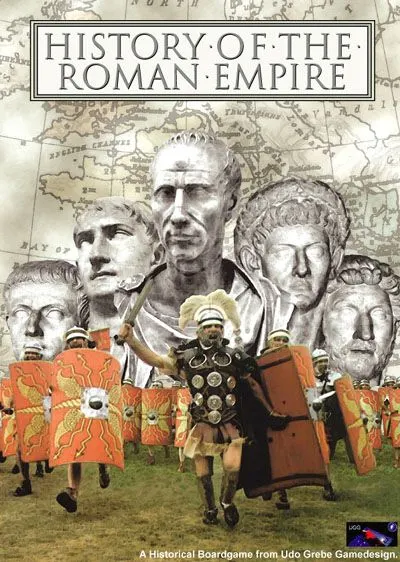
2008
Ayuda con las reglas de History of the Roman Empire
Explicaciones claras de turnos, efectos de cartas y situaciones dudosas, con referencias a fuentes oficiales e historial de preguntas guardado.
Para 2 jugadores
¿Qué quieres saber?
Las respuestas salen del reglamento oficial, con la página para comprobarlo.
History of the Roman Empire es un juego de mesa publicado en 2008 para 2–4 jugadores, con partidas de 180 minutos y a partir de 12 años. Fue diseñado por Marco Broglia y sus mecánicas principales son Area Movement, Dice Rolling y Area Majority / Influence.




En inglés
(From the Publishers Website: P500 production) "The History of the Roman Empire" covers the time-period from the Rise to the Fall of the Roman Empire in seven game turns starting in 60 BC (the first Triumvirate composed of Caesar, Crassus and Pompeus) until the last [Western] Emperor (Romulus Augustus) in 476 AD. The map contains the entire Mediterranean area as well as a part of Asia Minor. Each of the up to four Players takes the role of one Roman Faction and one group of "Barbarian" Peoples (non-Romans), and by playing certain event cards you can gain control over minor Kingdoms. The game is best suited for 4 Players but can be played by 3 or 2 Players as well. Since every Player controls a Roman Faction and a "Barbarian" People it is not possible to completely remove a Player from the Game (The Roman Faction that Player controls can be eliminated but the Barbarians can not). The Game "History of the Roman Empire" is not strictly historic but offers "a great lot of Flavor" with its 42 Roman Emperors (and Pretenders) and the 34 different "Barbarian" Peoples and minor Kingdoms. Since every Player controls Romans as well as Barbarians you will get all kinds of situations like Romans vs. Barbarians, Romans fighting among themselves, or Barbarians fighting other Barbarians. The Emperor for each Roman Faction changes every Game Turn as well as the Barbarian Peoples that the Players control. With its easy to learn rules - players who are familiar with "Hispania", "Britannia" or "History of the World" will find some similarities and some new features - and the constantly changing Barbarians, "The History of the Roman Empire" can be great fun. The Players will have to decide how to use their Roman Legions as well as how to use the armies of their Barbarians and of course where to plan new Cities and Forts (for the Roman Factions). Since it is worth many more Victory Points to control all areas of one color, soon everyone will try to establish his own small empire (and of course to disturb the others), until the more powerful Barbarians like the Goths or the Huns arrive and threaten to take control of the map. Each turn the Roman Factions spend some of their Victory Points on new Legions and/or Forts or Fortresses. The Barbarians do not use their Victory Points for recruiting Units but rather "mobilize" up to a certain number of Armies (how many units depends on the Barbarian People). Every game will present you with new situations since the Players will work on and change their strategies and the 45 random cards will influence every game in a unique way. At the end of the seventh turn, the players total their victory points and determine the winner. Will the Roman Empire rise to Glory or will it be crushed by the overwhelming Barbarians? It's up to YOU…
Según el catálogo, History of the Roman Empire admite de 2 a 4 jugadores. Este intervalo corresponde al número de jugadores indicado por la editorial, así que el juego puede prepararse para cualquier grupo dentro de ese margen. La preparación, algunas reglas y la puntuación pueden variar según el número de jugadores; consulta la configuración exacta en el reglamento de tu edición.
La duración indicada para History of the Roman Empire es de 180 minutos, la estimación de la editorial para una partida completa. El tiempo real depende del grupo, del número de jugadores y del conocimiento de las reglas: las primeras partidas suelen alargarse y los grupos con experiencia terminan antes. La preparación y la explicación de las reglas no están incluidas.
El catálogo indica History of the Roman Empire a partir de 12 años. Es la recomendación de la editorial y refleja la lectura necesaria, la complejidad de las reglas y las piezas pequeñas, no solo el tema. Los más pequeños a menudo pueden jugar con ayuda de un adulto: comprueba la edad recomendada en tu edición y la experiencia de tu grupo.
History of the Roman Empire tiene una puntuación de complejidad de 2,6 sobre 5 según los jugadores de BoardGameGeek, lo que lo convierte en un juego algo ligero. La puntuación refleja cuánto conocimiento de reglas, planificación y toma de decisiones exige una partida típica. Los juegos exigentes requieren una explicación inicial más larga, así que conviene usar una guía de preparación.
History of the Roman Empire pertenece a estas categorías: Wargame, Ancient y Civil War. Sus mecánicas principales son Area Movement, Dice Rolling y Area Majority / Influence. Las categorías describen el tema y la ambientación de un juego, mientras que las mecánicas describen lo que los jugadores hacen realmente en su turno. Cada mecánica lleva a una página del catálogo con juegos similares.
Los autores acreditados de History of the Roman Empire son: Marco Broglia. Estos créditos proceden de los datos publicados del juego y nombran a las personas responsables de su diseño, no a ilustradores ni editoriales. Las páginas de autor de MeepleRules reúnen otros títulos de los mismos autores, algo útil cuando un juego te gusta y buscas otros parecidos.
El catálogo clasifica History of the Roman Empire como juego base. Se juega por sí solo con los componentes de la caja y no requiere ningún otro título. Las expansiones, si existen, añaden contenido o reglas nuevas y aparecen por separado en el catálogo con un enlace a este juego base.