
- Puesto en BGG
- BGG #14.917
- Puntuación BGG
- 7,1
Taĉmento
- 1–2 jugadores
- 5–10 min
- Complejidad 1,5/5
- 2023
2025
Ayuda con las reglas de Iwo Jima: Hell On Earth
Explicaciones claras de turnos, efectos de cartas y situaciones dudosas, con referencias a fuentes oficiales e historial de preguntas guardado.
Para 1 jugador
¿Qué quieres saber?
Las respuestas salen del reglamento oficial, con la página para comprobarlo.
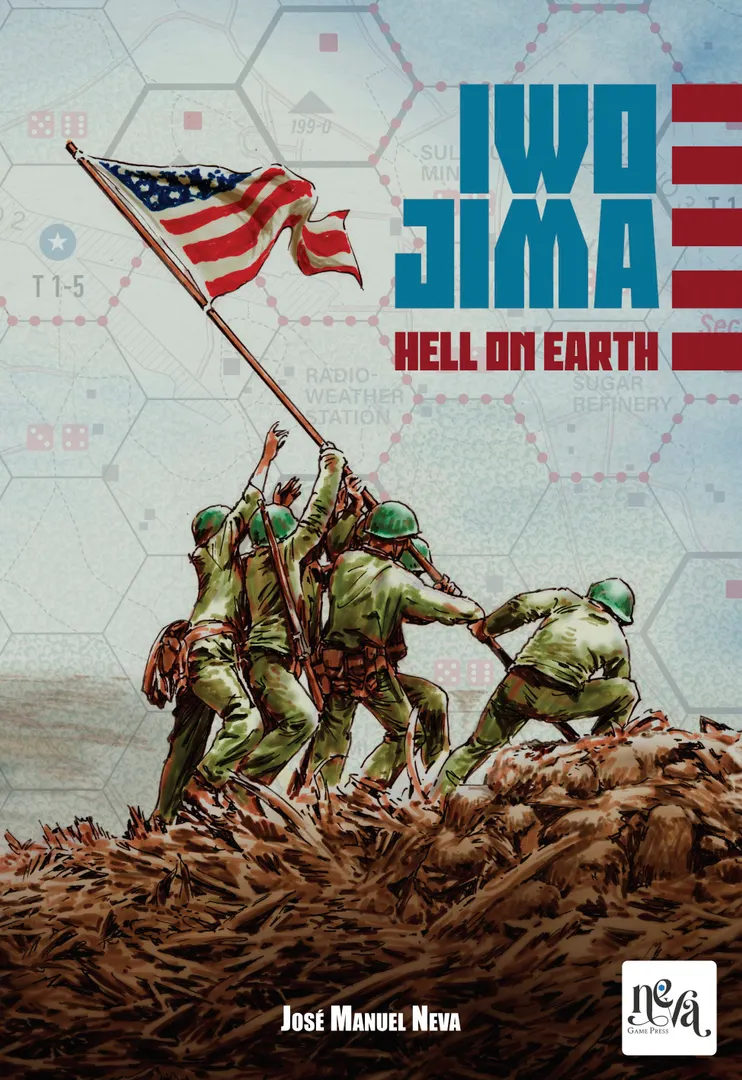
Iwo Jima: Hell On Earth es un juego de mesa publicado en 2025 para 1 jugador, con partidas de 90 a 120 minutos y a partir de 14 años. Fue diseñado por José Manuel Neva y sus mecánicas principales son Dice Rolling, Variable Set-up y Hexagon Grid.


En inglés
THE HISTORICAL CONTEXT The Battle of Iwo Jima, a pivotal momentin the Pacific Theater of World War II, stands as a testament to the indomitable spirit of the human will and the immense cost of victory. This brutal conflict, fought between the United States Marine Corps and the Imperial Japanese Army, unfolded on the small volcanic island of Iwo Jima, a mere 660 miles south of Tokyo. From February 19 to March 26, 1945, American forces waged a relentless assault against a well-fortified enemy, determined to seize control of the island’s strategic airfields. Iwo Jima was crucial to the Allied war effort, serving as a vital base for fighter planes escorting long-range bombers on missions to the Japanese mainland. The battle was marked by fierce resistance from the Japanese defenders, who had meticulously constructed a network of underground tunnels and fortifications.The Marines faced relentless attacks, as they fought their way across the island’s rugged terrain. The iconic image of Marines raising the American flag atop Mount Suribachi became a symbol of American determination and sacrifice. The Battle of Iwo Jima was one of the bloodiest battles in Marine Corps history, with thousands of American and Japanese soldiers losing their lives. The island’s volcanic ash and the intense fighting conditions made it a grueling ordeal for both sides. Despite the heavy casualties, the Marines ultimately achieved their objective, securing Iwo Jima and bringing the United States one step closer to victory in the Pacific War. GAMEPLAY AT A GLANCE In “Iwo Jima: Hell on Earth,” your mission as the commander of US forces is to conquer the island of Iwo Jima to secure its three airfields and the iconic Mount Suribachi. The game simulates the 36-day battle in nine turns, with each turn representing approximately four days. Objective and how to win: Victory is determined at the end of Turn 9 by calculating your Victory Points (VPs). You earn VPs by: Eliminating Japanese units, Capturing key objectives on time, Japanese surrender. You can lose VPs if: You play too many Special Orders and/or You suffer too many US casualties. Your final VP score will give you an assessment of your performance, ranging from a “pen-pushing job” (1 or less to 5 VP) to an “incredible victory” (19-20 VP) Sequence of play: The game is played over nine turns, and each turn follows the sequence below: 1. Weather Phase: A die is rolled to determine the weather conditions for the turn, which can affect bombardment points and unit movement. Turn 1 always has “Good Weather”. 2. Bombardment Phase: Both US and Japanese forces bombard enemy units. First, each side’s bombardment points (BP) are determined, which can be modified by weather or airfield control. Then bombardments are resolved, US first, then Japanese, by selecting targets and rolling dice to determine hits. 3. First Movement Phase: US units can attempt to recover from retreat markers (rally) and then move across the map, choosing between normal or strategic movement. 4. First Attack Phase: US units that have not performed a previous action can conduct a Reconnaissance-in-Force (Recon) or an Assault against adjacent Japanese units. They can also provide Combat Support to an assault. During assaults, hidden Japanese units will reveal their response, which may include a Banzai Attack or a Redeployment. The combat ratio is calculated, and results are applied. 5. Raid Phase (Japanese): Japanese forces react with limited attacks, carrying out raids against nearby US units. 6. Second Movement Phase: This phase is a repeat of the First Movement Phase for US units. 7. Second Attack Phase: Similar to the First Attack Phase, US units can perform Reconnaissance or Assaults. At the end of this phase, all situation markers are removed. 8. Command Phase (Skipped on Turn 9): US units attempt to rally again with a +1 modifier. Command Points (CPs) are gained by rolling a die, which can be spent on reinforcements, unit deployment, or to obtain special command markers. The Japanese side also resolves a limited command step, where their single-step units can attempt to gain a step or perform a Banzai attack. 9. Organization Phase: The turn marker is advanced. US units on the turn track can move to the Reserve Area or recover steps. Reaction markers are put into the red bag, and Command markers can be drawn if the turn space is highlighted. At the end of Turn 9, the player’s performance is assessed based on criteria such as Japanese units eliminated, capture of key objectives, special order markers played, and US casualties. Key decision/challenges: US units have a dual role, acting as both direct assault regiments and providing various combat support types (Flamethrowers, Tank, Artillery). This requires careful planning to combine their direct combat strength with support for optimal attacks. Assaults against hidden Japanese units are resolved using a chit-pull system: Intelligence markers are drawn to determine Japanese defense, support, and unpredictable “Banzai” attacks or “Redeployments” via tunnels. This random element ensures high replayability, making each game fresh. The game is designed to be very difficult to achieve a significant victory, reflecting the brutal historical battle. WHAT’S IN THE BOX? 1 Mounted Map 120 Counters 2 6-sided dice 4 Player Aid Sheets 2 Cloth bags 1 Rulebook —description from the publisher
Según el catálogo, Iwo Jima: Hell On Earth admite 1 jugador. Es el número de jugadores indicado por la editorial, así que el juego está diseñado exactamente para esa cantidad de participantes. Las variantes para otros tamaños de grupo, si existen, se describen en el reglamento de tu edición; consúltalo antes de preparar otra configuración.
La duración indicada para Iwo Jima: Hell On Earth es de 90 a 120 minutos, la estimación de la editorial para una partida completa. El tiempo real depende del grupo, del número de jugadores y del conocimiento de las reglas: las primeras partidas suelen alargarse y los grupos con experiencia terminan antes. La preparación y la explicación de las reglas no están incluidas.
El catálogo indica Iwo Jima: Hell On Earth a partir de 14 años. Es la recomendación de la editorial y refleja la lectura necesaria, la complejidad de las reglas y las piezas pequeñas, no solo el tema. Los más pequeños a menudo pueden jugar con ayuda de un adulto: comprueba la edad recomendada en tu edición y la experiencia de tu grupo.
Iwo Jima: Hell On Earth tiene una puntuación de complejidad de 2,3 sobre 5 según los jugadores de BoardGameGeek, lo que lo convierte en un juego algo ligero. La puntuación refleja cuánto conocimiento de reglas, planificación y toma de decisiones exige una partida típica. Los juegos exigentes requieren una explicación inicial más larga, así que conviene usar una guía de preparación.
Iwo Jima: Hell On Earth pertenece a estas categorías: Wargame y World War II. Sus mecánicas principales son Dice Rolling, Variable Set-up y Hexagon Grid. Las categorías describen el tema y la ambientación de un juego, mientras que las mecánicas describen lo que los jugadores hacen realmente en su turno. Cada mecánica lleva a una página del catálogo con juegos similares.
Los autores acreditados de Iwo Jima: Hell On Earth son: José Manuel Neva. Estos créditos proceden de los datos publicados del juego y nombran a las personas responsables de su diseño, no a ilustradores ni editoriales. Las páginas de autor de MeepleRules reúnen otros títulos de los mismos autores, algo útil cuando un juego te gusta y buscas otros parecidos.
El catálogo clasifica Iwo Jima: Hell On Earth como juego base. Se juega por sí solo con los componentes de la caja y no requiere ningún otro título. Las expansiones, si existen, añaden contenido o reglas nuevas y aparecen por separado en el catálogo con un enlace a este juego base.