
- Puntuación BGG
- 7,1
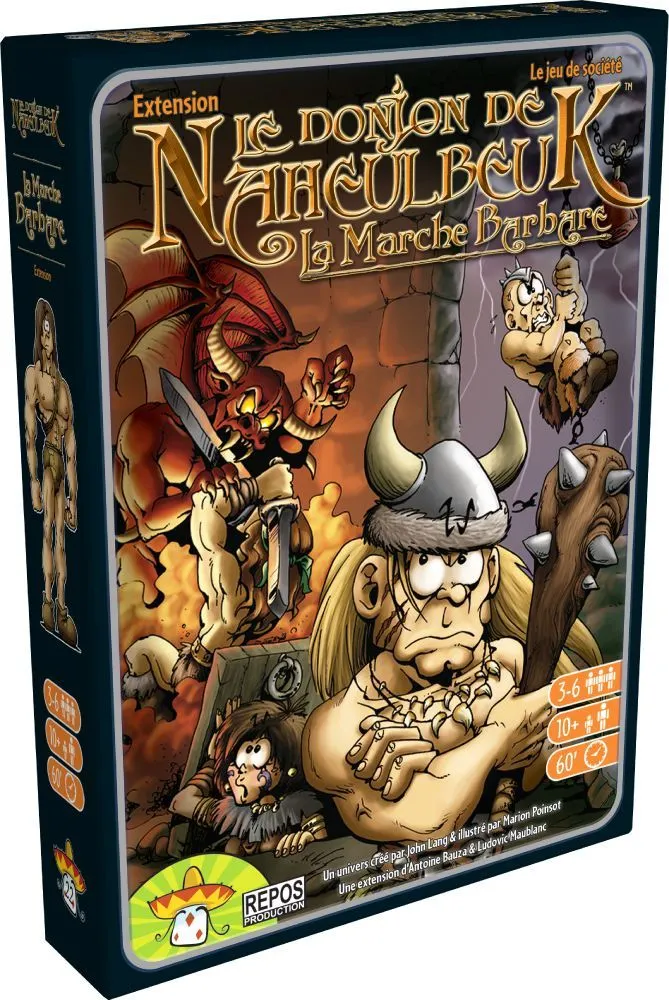
Le Donjon de Naheulbeuk: La marche Barbare
- 3–6 jugadores
- 60 min
- Complejidad 1,0/5
- 2012
2010
Ayuda con las reglas de Le Donjon de Naheulbeuk
Explicaciones claras de turnos, efectos de cartas y situaciones dudosas, con referencias a fuentes oficiales e historial de preguntas guardado.
Para 3 jugadores
¿Qué quieres saber?
Las respuestas salen del reglamento oficial, con la página para comprobarlo.
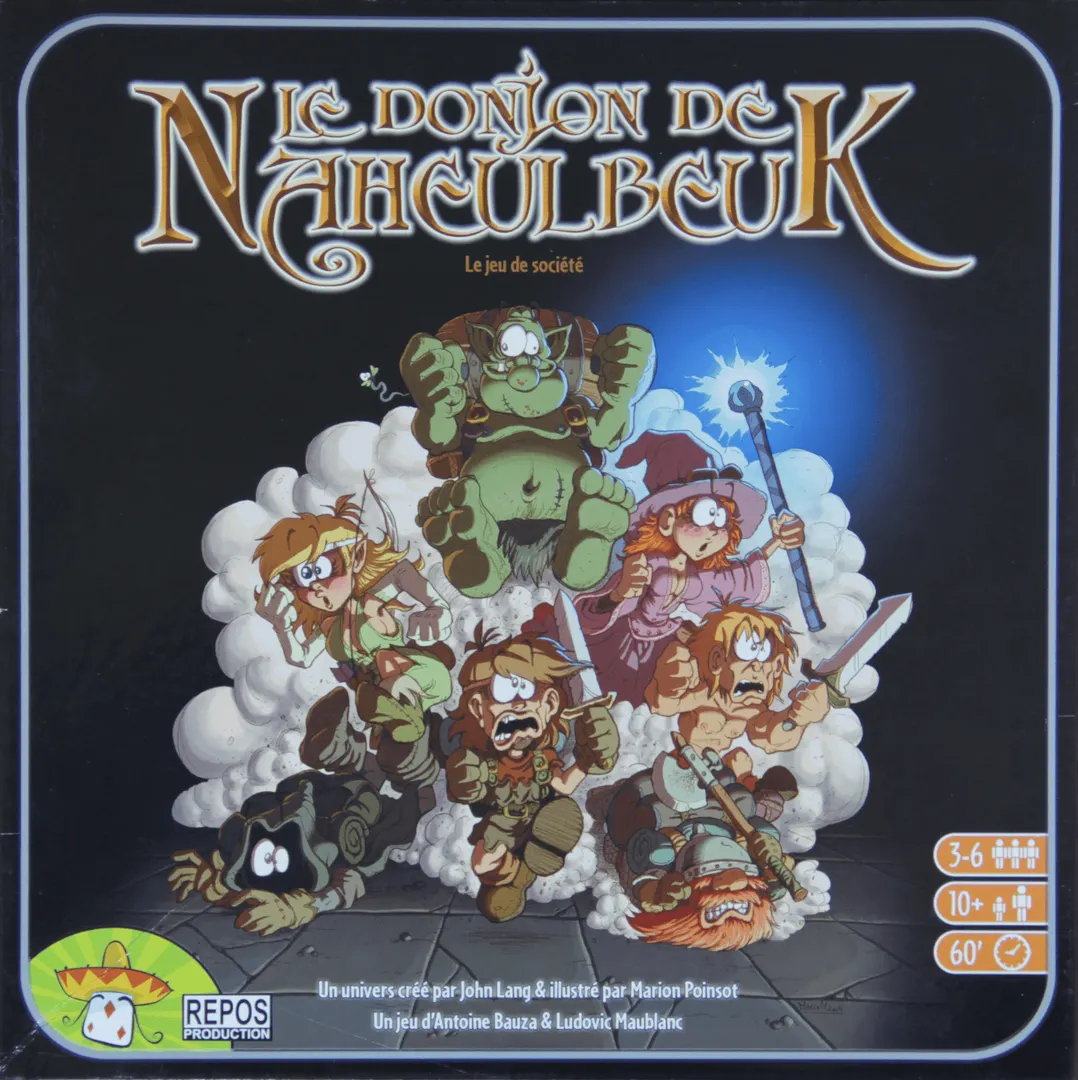
Le Donjon de Naheulbeuk es un juego de mesa publicado en 2010 para 3–6 jugadores, con partidas de 60 minutos y a partir de 10 años. Fue diseñado por Antoine Bauza y Ludovic Maublanc y sus mecánicas principales son Variable Player Powers y Cooperative Game.

En inglés
"Le Donjon de Naheulbeuk" is a cooperative game in which the players try to recover the last of Gladeulfeurha's statuettes. Players embody adventurers in this dungeon-crawling quest, each with a different class, skill and personality: there're the stupid barbarian, the belching ogre, the haughty sorceress, the dumb elf, the coward thief, the ever-singing bard, the cranky dwarf and the ranger who wishes he were a leader… (all the characters and elements of the game are inspired by the audio and comics saga by the same name, parodies of Fantasy RPG — à la Munchkin). In each game, the group must go through 14 of the 56 available dungeon rooms in order to defeat the powerful sorcerer Zangdar. In every room, players will face choices, skill checks or battles, and maybe rewards (as xp, gold or loot cards) There're 8 kind of skill checks, and each checks can slightly differ from the others of the same kind (number of players involved, special rule, etc.). Most of the skill checks use Destiny Tiles (which are 16 thick cards, which also represents monsters) and a special timer (with 3 difficulty levels) Balance Check: the player must put a Destiny Tile on the top of his head, walk/run around and sit down again without letting the tile fall. Climbing Check: the player must put a Destiny Tile on the top of his head, stand up on his chair, then sit down again without letting the tile fall. Dexterity Check: the player must build a house of cards using Destiny Tiles. Speed Check: the player must put a Destiny Tile on the edge of the table, then slap it up the air and catch it before it falls back down. Precision Check: a player stands 3 steps from the table, holding the game box, and the others must throw Destiny Tiles into the box from the other side of the table. Intelligence Check: players play a memory game with the 16 Destiny Tiles Coordination Check: players stands a step from the table, and must circle all the Destiny Tiles around the table, throwing them from one player to the next. Stamina Check: the player must stand on one leg, with a Destiny Tile on his other knee and another one on both of his forefingers, without dropping down either one. The battles are also timed and are played with Letter Cards, that can be exchanged one by one between 2 players. They are used to spell special words (several different words for each character) as blows to the enemy. Every time a player plays cards to spell a word, he draw 3 new cards and keep on playing. At the end of the battle, if there're enough blows, the enemy is defeated. For instance, the sorceress can cast a spell by spelling "wazaaa" with any number of a's at the end, wounding the enemy for every extra a's. The barbarian can misspell a letter in each of his word. The bard and the ranger can make other players draw cards. And so on… For every 3 cards played with a punch symbol on it, a player takes one wound him/herself. Using gold and/or xp, characters can level up (up to level 3) and gain access to more powerful attacks or skills. The party can rest up to 3 times a game to recover from one wound each. If a player dies, he shuffles his character sheet with the other available sheets and pick one : if it's the same, he recovers all his health and keep all his loot, gold and xp; if it's another one, he dies, loses everything, and continues the game as a totally new character. If the players defeat Zangdar the Sorcerer in the 14th room (4 tiles with different rules so every game doesn't end the same way), they win the game.
Según el catálogo, Le Donjon de Naheulbeuk admite de 3 a 6 jugadores. Este intervalo corresponde al número de jugadores indicado por la editorial, así que el juego puede prepararse para cualquier grupo dentro de ese margen. La preparación, algunas reglas y la puntuación pueden variar según el número de jugadores; consulta la configuración exacta en el reglamento de tu edición.
La duración indicada para Le Donjon de Naheulbeuk es de 60 minutos, la estimación de la editorial para una partida completa. El tiempo real depende del grupo, del número de jugadores y del conocimiento de las reglas: las primeras partidas suelen alargarse y los grupos con experiencia terminan antes. La preparación y la explicación de las reglas no están incluidas.
El catálogo indica Le Donjon de Naheulbeuk a partir de 10 años. Es la recomendación de la editorial y refleja la lectura necesaria, la complejidad de las reglas y las piezas pequeñas, no solo el tema. Los más pequeños a menudo pueden jugar con ayuda de un adulto: comprueba la edad recomendada en tu edición y la experiencia de tu grupo.
Le Donjon de Naheulbeuk tiene una puntuación de complejidad de 1,8 sobre 5 según los jugadores de BoardGameGeek, lo que lo convierte en un juego ligero. La puntuación refleja cuánto conocimiento de reglas, planificación y toma de decisiones exige una partida típica. Los juegos exigentes requieren una explicación inicial más larga, así que conviene usar una guía de preparación.
Le Donjon de Naheulbeuk pertenece a estas categorías: Fantasy, Humor y Comic Book / Strip. Sus mecánicas principales son Variable Player Powers y Cooperative Game. Las categorías describen el tema y la ambientación de un juego, mientras que las mecánicas describen lo que los jugadores hacen realmente en su turno. Cada mecánica lleva a una página del catálogo con juegos similares.
Los autores acreditados de Le Donjon de Naheulbeuk son: Antoine Bauza y Ludovic Maublanc. Estos créditos proceden de los datos publicados del juego y nombran a las personas responsables de su diseño, no a ilustradores ni editoriales. Las páginas de autor de MeepleRules reúnen otros títulos de los mismos autores, algo útil cuando un juego te gusta y buscas otros parecidos.
El catálogo clasifica Le Donjon de Naheulbeuk como juego base. Se juega por sí solo con los componentes de la caja y no requiere ningún otro título. Las expansiones, si existen, añaden contenido o reglas nuevas y aparecen por separado en el catálogo con un enlace a este juego base.