
- Puntuación BGG
- 7,4
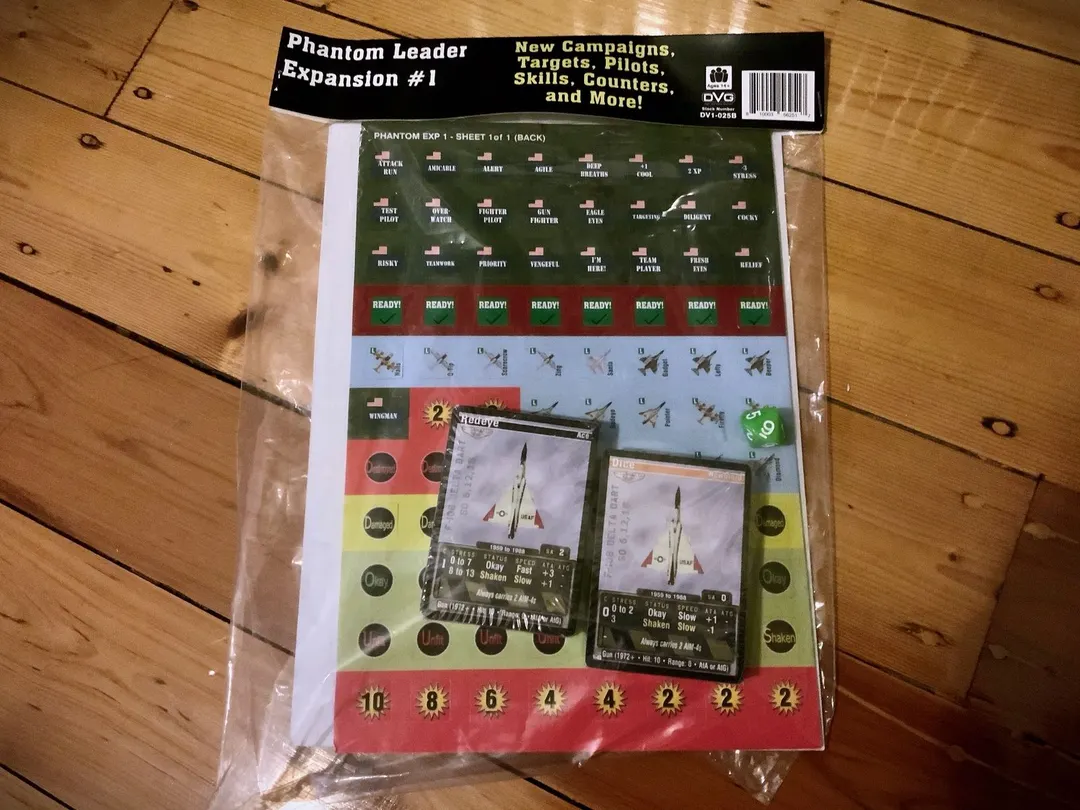
Phantom Leader: Expansion #1
- 1–6 jugadores
- 60 min
- Complejidad 2,5/5
- 2021
2013
Ayuda con las reglas de Phantom Leader: Deluxe Edition
Explicaciones claras de turnos, efectos de cartas y situaciones dudosas, con referencias a fuentes oficiales e historial de preguntas guardado.
Para 1 jugador
¿Qué quieres saber?
Las respuestas salen del reglamento oficial, con la página para comprobarlo.
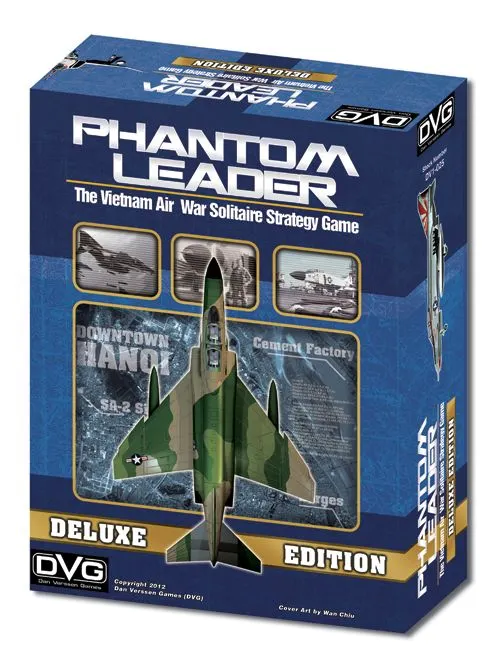
Phantom Leader: Deluxe Edition es un juego de mesa publicado en 2013 para 1 jugador, con partidas de 30 minutos y a partir de 12 años. Fue diseñado por Dan Verssen y sus mecánicas principales son Solo / Solitaire Game.


En inglés
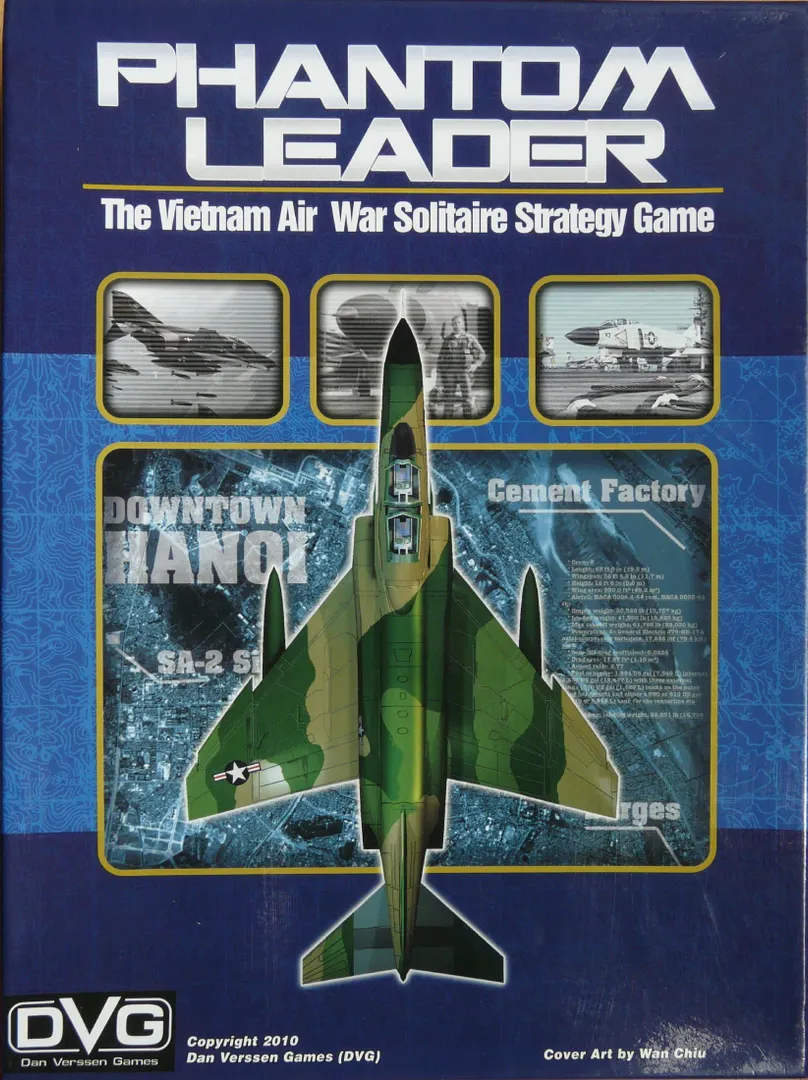
Phantom Leader – Solitaire What’s New in the Deluxe Edition? We have expanded and updated the original Phantom Leader game to the high standard set by our Hornet Leader game. Increase the cards from 165 to 330 - All pilots get all 6 experience levels - Add new aircraft: Air Force F-5, Air Force A-7 - Add more pilots for all aircraft types - Add more Target cards - Add more Special Event cards - Revise the 6 original Campaigns to include the new Targets and Aircraft Add Air Force and Navy Campaigns for the 1962 Cuban Missile Crisis Upgrade to a mounted 11"x17" Tactical Display Description: Phantom Leader places you in command of a US Air Force or US Navy Tactical Fighter squadron in Vietnam between 1964 and 1972. You must not only destroy the targets but you must also balance the delicate political repercussions of your attacks. If you strike too hard, your air offensive might be put on hold, strike to light, and you’ll be blamed for losing the war. Welcome to the Vietnam Air War! Each of the campaigns can be played with either an Air Force or Navy squadron. The targets assigned to each service are different and change the complexion of the campaigns. Each campaign can be played with three different durations of: Skirmish, Conflict, or War. Each mission takes roughly 30 minutes to set-up, plan, and resolve. Each of your pilots has their own skills. Selecting the right pilots and weapons for a mission is vital to its success. As you fly missions, your pilots will gain experience and fatigue. With experience, their skills improve, but as their fatigue increases, their skills decrease and they might not be able to fly for several missions. For those of you familiar with our modern era Hornet Leader series of games, you might be wondering what’s different about Phantom Leader… The freedom of being able to select the best mission based on military objectives is something that is commonplace for today’s military. Back in Vietnam, the military was responsible for carrying out their orders, while at the same time being extremely limited in the weapons and tactics they were allowed to use to complete those orders. In many cases, the specific weapons, approach paths, and bombing altitudes were generated target-by-target at the White House. The mission specifics were then sent down the chain of command to the individual pilots flying the mission. As you can imagine, this was not the best way to run an air campaign. Every target has a Political value. If you destroy it, you move the Political counter to the right a number of spaces equal to its value. As the counter gets moved to the right, your future target choices are reduced to those that are less politically sensitive. Which target you choose not to attack is also important. You get to move the Political counter to the left a number of spaces equal its Political value. This means that while you might like to flatten a big enemy target and rack up the victory points, it might be better for you to choose a pointless target and move the Political counter in your favor instead. Another difference is in combat power. For the last couple decades, the US Air Force and Navy have enjoyed air superiority due to training and technology. Such was not the case in the skies over Vietnam. The enemy had different, but just as capable, equipment. They also had the training and will to use it to its utmost. They soon became aware of the limitations placed on the US forces by the politicians, and used those limitations to their advantage. For example, at times, US pilots were not permitted to fire on enemy aircraft until they were visually identified. This negated any range advantage conveyed by the radar-homing AIM-7 Sparrow missiles. It was also a common limitation that enemy aircraft could only be attacked in the air. US pilots were not allowed to attack enemy airbases. US aircraft were also limited to flying predictable flight paths, at set times. This made setting up ambushes much easier for the enemy. So, while you might be a Hornet Leader ace, Vietnam is a whole different ballgame! Campaigns included in the core game: 1962 Cuban Missile Crisis (USAF) 1964 War in the South (USAF) 1967 Rolling Thunder (USAF) 1972 Linebacker (USAF) 1962 Cuban Missile Crisis (USN) 1964 War in the South (USN) 1967 Rolling Thunder (USN) 1972 Linebacker (USN)
Según el catálogo, Phantom Leader: Deluxe Edition admite 1 jugador. Es el número de jugadores indicado por la editorial, así que el juego está diseñado exactamente para esa cantidad de participantes. Las variantes para otros tamaños de grupo, si existen, se describen en el reglamento de tu edición; consúltalo antes de preparar otra configuración.
La duración indicada para Phantom Leader: Deluxe Edition es de 30 minutos, la estimación de la editorial para una partida completa. El tiempo real depende del grupo, del número de jugadores y del conocimiento de las reglas: las primeras partidas suelen alargarse y los grupos con experiencia terminan antes. La preparación y la explicación de las reglas no están incluidas.
El catálogo indica Phantom Leader: Deluxe Edition a partir de 12 años. Es la recomendación de la editorial y refleja la lectura necesaria, la complejidad de las reglas y las piezas pequeñas, no solo el tema. Los más pequeños a menudo pueden jugar con ayuda de un adulto: comprueba la edad recomendada en tu edición y la experiencia de tu grupo.
Phantom Leader: Deluxe Edition tiene una puntuación de complejidad de 2,6 sobre 5 según los jugadores de BoardGameGeek, lo que lo convierte en un juego algo ligero. La puntuación refleja cuánto conocimiento de reglas, planificación y toma de decisiones exige una partida típica. Los juegos exigentes requieren una explicación inicial más larga, así que conviene usar una guía de preparación.
Phantom Leader: Deluxe Edition pertenece a estas categorías: Wargame, Aviation / Flight y Vietnam War. Sus mecánicas principales son Solo / Solitaire Game. Las categorías describen el tema y la ambientación de un juego, mientras que las mecánicas describen lo que los jugadores hacen realmente en su turno. Cada mecánica lleva a una página del catálogo con juegos similares.
Los autores acreditados de Phantom Leader: Deluxe Edition son: Dan Verssen. Estos créditos proceden de los datos publicados del juego y nombran a las personas responsables de su diseño, no a ilustradores ni editoriales. Las páginas de autor de MeepleRules reúnen otros títulos de los mismos autores, algo útil cuando un juego te gusta y buscas otros parecidos.
El catálogo clasifica Phantom Leader: Deluxe Edition como juego base. Se juega por sí solo con los componentes de la caja y no requiere ningún otro título. Las expansiones, si existen, añaden contenido o reglas nuevas y aparecen por separado en el catálogo con un enlace a este juego base.