

- Puesto en BGG
- BGG #10.321
- Puntuación BGG
- 7,7
1940: The Fall of France – A Panzer Grenadier Game
- 2 jugadores
- 120 min
- Complejidad 2,7/5
- 2009
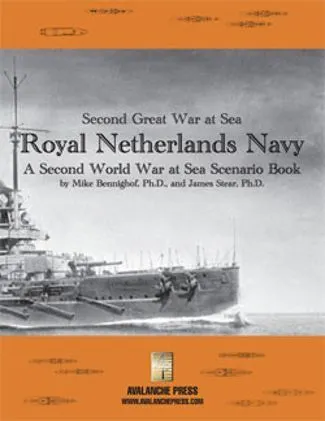
Expansión de Second World War at Sea: Eastern Fleet
2015
Ayuda con las reglas de Second World War at Sea: Royal Netherlands Navy
Explicaciones claras de turnos, efectos de cartas y situaciones dudosas, con referencias a fuentes oficiales e historial de preguntas guardado.
¿Qué quieres saber?
Las respuestas salen del reglamento oficial, con la página para comprobarlo.
Second World War at Sea: Royal Netherlands Navy es una expansión de Second World War at Sea: Eastern Fleet publicada en 2015 para 1–2 jugadores, con partidas de 30 minutos y a partir de 12 años. Fue diseñado por Michael Bennighof y James Stear y sus mecánicas principales son Dice Rolling, Secret Unit Deployment y Hexagon Grid.







En inglés
From the Avalanche Press website: Return to the world of the Second Great War, where Wilson’s Peace ended the First Great War on Christmas 1916. Twenty-four years later war returned to Europe, with Russia, France and Italy seeking to overturn the settlement with a war of aggression against the Central Powers of Imperial Germany, Austria-Hungary and the Ottoman Empire. Royal Netherlands Navy is the third book in our alternative history series, The Second Great War. In the first book, The Kaiser’s Navy, we looked at the High Seas Fleet of 1940 and its campaigns in the North Sea and Atlantic. In the second, The Habsburg Fleet, the Imperial and Royal Austro-Hungarian Navy, alongside its Turkish allies, wages war in the Mediterranean Sea. In this volume, the fleet the Dutch admirals hoped to build in our world, but could not get approved, finds itself pressured by the Japanese in the Far East and the British and French in Europe. Defending their rights with armed force, the Dutch find themselves drawn into desperate battles in the North Sea, North Atlantic, South China Sea and the interior waters of the East Indies. In the 1930s, Dutch shipyards stood at the leading edge of naval technology: Dutch submarines first deployed the schnorkel breathing device, for example, and Dutch warships boasted the sophisticated Hazemeyer fire control system that would be enthusiastically copied by the Royal Navy and others. The Netherlands had the industrial and financial means to create a large and modern fleet, and the oil wealth of Borneo and Sumatra provided the motive. Seeing deficits as a more lethal enemy than the Axis, the Dutch government of our reality doomed both the home country and the colonies to defeat and occupation. In the world of Wilson's Peace, things are a little different. There are 210 die-cut and mounted playing pieces from the old, out-of-print Spice Islands booklet, and 90 brand-new laser-cut pieces (scorchless and sootless!) for 300 total: 120 double-sized "long" ship pieces and 180 standard-sized ones representing task forces, aircraft and smaller warships. The Dutch fleet that never was is present, along with French, British, Japanese and German ships, aircraft and airships. Yes, airships! There are also thirty new scenarios based on the battles that might have been waged by the Royal Netherlands Navy in this alternate world, plus more of the story of the Second Great War begun in The Kaiser's Navy and continued in The Habsburg Fleet. This module is not playable by itself, but requires ownership of Strike South and Eastern Fleet to enjoy all of the scenarios.
Según el catálogo, Second World War at Sea: Royal Netherlands Navy admite de 1 a 2 jugadores. Este intervalo corresponde al número de jugadores indicado por la editorial, así que el juego puede prepararse para cualquier grupo dentro de ese margen. La preparación, algunas reglas y la puntuación pueden variar según el número de jugadores; consulta la configuración exacta en el reglamento de tu edición.
La duración indicada para Second World War at Sea: Royal Netherlands Navy es de 30 minutos, la estimación de la editorial para una partida completa. El tiempo real depende del grupo, del número de jugadores y del conocimiento de las reglas: las primeras partidas suelen alargarse y los grupos con experiencia terminan antes. La preparación y la explicación de las reglas no están incluidas.
El catálogo indica Second World War at Sea: Royal Netherlands Navy a partir de 12 años. Es la recomendación de la editorial y refleja la lectura necesaria, la complejidad de las reglas y las piezas pequeñas, no solo el tema. Los más pequeños a menudo pueden jugar con ayuda de un adulto: comprueba la edad recomendada en tu edición y la experiencia de tu grupo.
Second World War at Sea: Royal Netherlands Navy pertenece a estas categorías: Wargame, Nautical y World War II. Sus mecánicas principales son Dice Rolling, Secret Unit Deployment y Hexagon Grid. Las categorías describen el tema y la ambientación de un juego, mientras que las mecánicas describen lo que los jugadores hacen realmente en su turno. Cada mecánica lleva a una página del catálogo con juegos similares.
Los autores acreditados de Second World War at Sea: Royal Netherlands Navy son: Michael Bennighof y James Stear. Estos créditos proceden de los datos publicados del juego y nombran a las personas responsables de su diseño, no a ilustradores ni editoriales. Las páginas de autor de MeepleRules reúnen otros títulos de los mismos autores, algo útil cuando un juego te gusta y buscas otros parecidos.
El catálogo clasifica Second World War at Sea: Royal Netherlands Navy como expansión de Second World War at Sea: Eastern Fleet. Las expansiones añaden contenido, reglas o escenarios al juego base y normalmente no se pueden jugar solas, así que necesitas Second World War at Sea: Eastern Fleet para usarla. Comprueba que tu edición de Second World War at Sea: Eastern Fleet sea compatible, porque algunas expansiones se revisaron entre ediciones.