

- Puesto en BGG
- BGG #34
- Puntuación BGG
- 8,1
Root
- 2–4 jugadores
- 60–90 min
- Complejidad 3,8/5
- 2018
2016
Ayuda con las reglas de Spheres of Influence: Struggle for Global Supremacy
Explicaciones claras de turnos, efectos de cartas y situaciones dudosas, con referencias a fuentes oficiales e historial de preguntas guardado.
Para 2 jugadores
¿Qué quieres saber?
Las respuestas salen del reglamento oficial, con la página para comprobarlo.
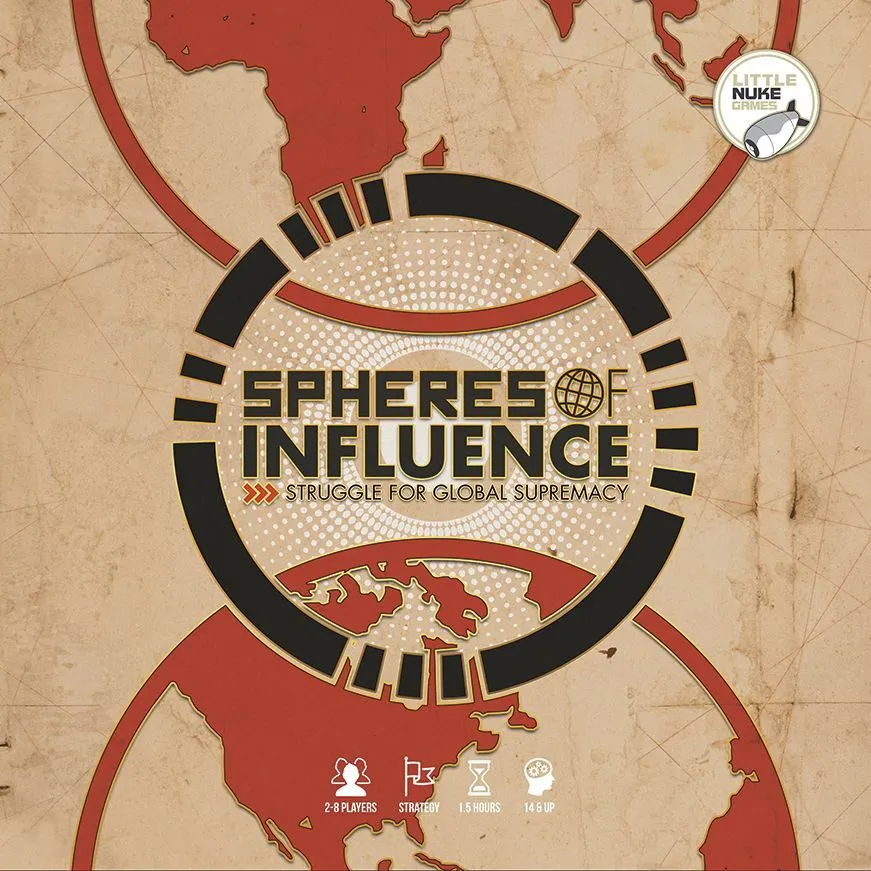
Spheres of Influence: Struggle for Global Supremacy es un juego de mesa publicado en 2016 para 2–8 jugadores, con partidas de 90 minutos y a partir de 14 años. Fue diseñado por Josh Lamont y sus mecánicas principales son Dice Rolling, Point to Point Movement y Area Majority / Influence.





En inglés
Spheres of Influence: Struggle for Global Supremacy is a 2-8 player free-for-all light wargame, set on a modern world map. Players will take control of one of the games 8 mighty factions as they compete over the world's spheres of influence, capitals and oil reserves. Will a mighty caliphate rise to power? Will the communist curtain once again fall? Or will western democracy sweep the world? In games with fewer than 5 players, each player will control 1-4 factions simultaneously, coordinating their efforts against the other players' coalitions. Each faction will begin the game with only a single, semi-randomly determined territory under its control. From this one space, factions will aggressively expand. The gameplay of Spheres of Influence is divided into a set number of rounds, with each round being split into 2 phases: the mobilization phase and the turn phase. During the mobilization phase, factions take turns placing units based on how powerful they are. During this phase, the global turn deck is also formed. This deck will be used to determine the turn order and frequency of action for each faction during the upcoming turn phase. To form it, each faction contributes a number of their turn cards (based on the number of oil fields they control) to a single, shared deck of turn cards. This deck is then shuffled and place down on the table. During the turn phase, one at a time the top card of the turn deck is revealed. Whichever faction's card was just flipped, that faction takes a turn, performing a single action with its units on a single space (moving, attacking, annexing or passing). Once that action is complete, that turn ends and the next turn card is revealed, with the process repeating itself. This makes turns both fast (with many turns lasting only a couple of seconds) and suspenseful, since none of the factions know precisely when their turns will be. It also ensures more incremental game developments - factions cannot sweep across all of Asia in a single turn and players can respond to attacks or betrayals much sooner. Once the last turn card in the global turn deck has been revealed, a round ends and another round begins. Combat is resolved by a simple dice mechanic fused with a "situational" modifier that loosely simulates the increased difficulty of attacking a defended coastline, breaking a naval blockade, or striking a fortified position. Along the way, powerful special cards can be played, allowing players to strike with submarines, deploy heavy armor, paradrop troops around enemy defenses, and launch devastating nuclear attacks. Games have either 5 or 6 rounds depending on the number of factions. Once the final round is complete, the faction who controls the most spheres of influence wins the game for its owner. Games typically last about an hour and a half, and experienced players can sometimes finish in just a single hour.
Según el catálogo, Spheres of Influence: Struggle for Global Supremacy admite de 2 a 8 jugadores. Este intervalo corresponde al número de jugadores indicado por la editorial, así que el juego puede prepararse para cualquier grupo dentro de ese margen. La preparación, algunas reglas y la puntuación pueden variar según el número de jugadores; consulta la configuración exacta en el reglamento de tu edición.
La duración indicada para Spheres of Influence: Struggle for Global Supremacy es de 90 minutos, la estimación de la editorial para una partida completa. El tiempo real depende del grupo, del número de jugadores y del conocimiento de las reglas: las primeras partidas suelen alargarse y los grupos con experiencia terminan antes. La preparación y la explicación de las reglas no están incluidas.
El catálogo indica Spheres of Influence: Struggle for Global Supremacy a partir de 14 años. Es la recomendación de la editorial y refleja la lectura necesaria, la complejidad de las reglas y las piezas pequeñas, no solo el tema. Los más pequeños a menudo pueden jugar con ayuda de un adulto: comprueba la edad recomendada en tu edición y la experiencia de tu grupo.
Spheres of Influence: Struggle for Global Supremacy tiene una puntuación de complejidad de 2,4 sobre 5 según los jugadores de BoardGameGeek, lo que lo convierte en un juego algo ligero. La puntuación refleja cuánto conocimiento de reglas, planificación y toma de decisiones exige una partida típica. Los juegos exigentes requieren una explicación inicial más larga, así que conviene usar una guía de preparación.
Spheres of Influence: Struggle for Global Supremacy pertenece a estas categorías: Wargame, Territory Building y Negotiation. Sus mecánicas principales son Dice Rolling, Point to Point Movement y Area Majority / Influence. Las categorías describen el tema y la ambientación de un juego, mientras que las mecánicas describen lo que los jugadores hacen realmente en su turno. Cada mecánica lleva a una página del catálogo con juegos similares.
Los autores acreditados de Spheres of Influence: Struggle for Global Supremacy son: Josh Lamont. Estos créditos proceden de los datos publicados del juego y nombran a las personas responsables de su diseño, no a ilustradores ni editoriales. Las páginas de autor de MeepleRules reúnen otros títulos de los mismos autores, algo útil cuando un juego te gusta y buscas otros parecidos.
El catálogo clasifica Spheres of Influence: Struggle for Global Supremacy como juego base. Se juega por sí solo con los componentes de la caja y no requiere ningún otro título. Las expansiones, si existen, añaden contenido o reglas nuevas y aparecen por separado en el catálogo con un enlace a este juego base.