
- Puesto en BGG
- BGG #8645
- Puntuación BGG
- 8,0
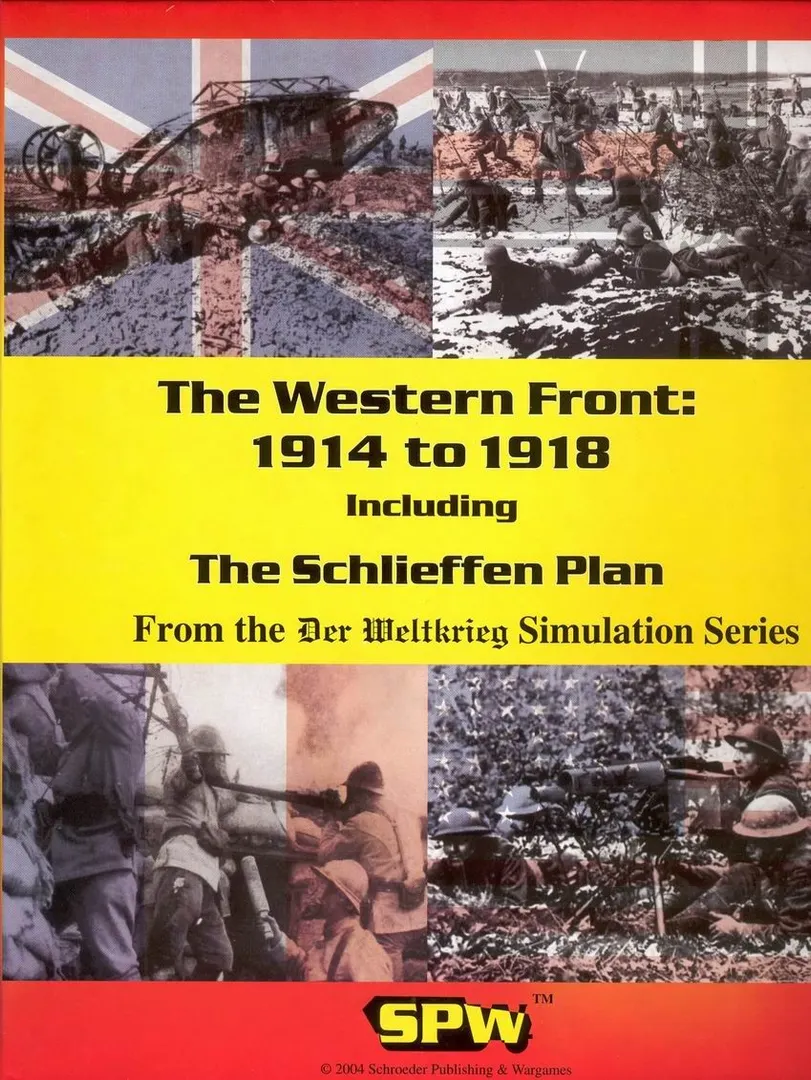
The Western Front: 1914 to 1918
- 2 jugadores
- 360 min
- Complejidad 3,4/5
- 2004
Expansión de Serbia the Defiant / Romania: Transylvanian Gambit
2001
Ayuda con las reglas de The 1916 Brusilov Offensive / Gorlice-Tarnow Breakthrough
Explicaciones claras de turnos, efectos de cartas y situaciones dudosas, con referencias a fuentes oficiales e historial de preguntas guardado.
¿Qué quieres saber?
Las respuestas salen del reglamento oficial, con la página para comprobarlo.
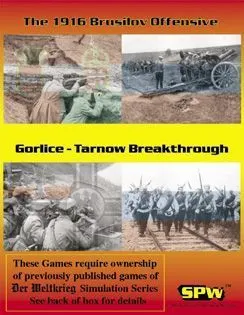
The 1916 Brusilov Offensive / Gorlice-Tarnow Breakthrough es una expansión de Serbia the Defiant / Romania: Transylvanian Gambit publicada en 2001 para 2 jugadores, con partidas de 360 minutos y a partir de 12 años. Fue diseñado por David Schroeder y sus mecánicas principales son Dice Rolling, Hexagon Grid y Simulation.


En inglés
Part of David Schroeder's "Der Weltkrieg" wargame series. Gorlice-Tarnow Breakthrough: May 1915 The head of the German armies, von Falkenhayn, wants the focus of the German operations in the war to be on the western front. Yet to make this a reality, he feels that relief must first be provided to the endangered Austro-Hungarians. Recent Russian pressure had almost cracked the final Austro-Hungarian defensive lines in the Carpathians, and new pressure was being brought to bear on Germany's weak ally by the Italians, who had just entered the war. To help the Austro-Hungarians, a new German army is formed under the capable von Mackensen, and placed in the line east of Crackow. After a furious hurricane barrage, von Mackensen attacks and completely pierces the Russian lines. A Russian retreat ensues that enables the Central Powers' forces to recapture most of Galicia. Von Falkenhayn wanted to stop operations at this point and shift to the west, but pressure from the Kaiser, at the insistance of Hindenburg and Ludendorff, resulted in a widening of the offensive. Attacks were then launched in the northern sector of the eastern front as well. Enveloped on two sides, the Russians reacted with their classic response, a retreat back into Russia, leaving Russian Poland to the Germans. The Central Powers offensive wound down as they struggled to supply troops hundreds of miles past the supply heads. The offensive has saved Austria-Hungary from immediate peril, but it does not knock Russia out of the war. And instead of enabling von Falkenhayn to focus on the west, most of the newly created German forces are fed into the increasing vastness of the eastern front. The Brusilov Offensive: June 1916 In response to French pleas for help to relieve the pressure at Verdun, the Russian STAVKA authorizes a major offensive. General Brusilov plans attacks all along the front of his Southwest Army Group aiming primarily at Austro-Hungarian positions. His belief is that attacks across the width of his front will prevent the enemy from being able to quickly reinforce areas under local attack. The Austro-Hungarians are caught off-guard as their focus is a new offensive of their own in Italy. The Russian attacks achieves numerous breakthroughs in numerous sectors and many Austro-Hungarian units are completely routed. The Russians take hundreds of thousands of prisoners and advance tens of miles, recapturing significant cities. German reinforcements are rushed from the north and from Verdun. The Germans also take over command of almost the entire eastern front, and Austria-Hungary is placed in a subserviant position. The Russian offensive peters out as Brusilov's forces start to experience supply shortages, and Central Powers' resistance stiffens. Brusilov had planned on support from Russian armies to the north to pin down German forces with attacks of their own, but they failed to support him. The losses mount and, after months of fighting, the Russians finally call a halt to further attacks. The Brusilov Offensive did relieve the pressure on the French and it came very close to knocking Austria-Hungary out of the war. Had Brusilov been supported by his peers to the north, and by the Russian Allies (including the hesitant Romanians) the war might well have been won by the Entente in 1916. This game contains 2 scenarios covering the 1915 Gorlice-Tarnow offensive and the 1916 Brusilov Offensive. NOTE: This is not a stand-alone game. It requires the ownership of Tannenberg: Eagles in the East / Galicia: The Forgotten Cauldron and Serbia the Defiant / Romania: Transylvanian Gambit to play. 20km/hex 4 days/turn 560 counters (2 countersheets) 3 small maps (4-5N, 4-5E, 5-5S) Complexity = medium
Según el catálogo, The 1916 Brusilov Offensive / Gorlice-Tarnow Breakthrough admite 2 jugadores. Es el número de jugadores indicado por la editorial, así que el juego está diseñado exactamente para esa cantidad de participantes. Las variantes para otros tamaños de grupo, si existen, se describen en el reglamento de tu edición; consúltalo antes de preparar otra configuración.
La duración indicada para The 1916 Brusilov Offensive / Gorlice-Tarnow Breakthrough es de 360 minutos, la estimación de la editorial para una partida completa. El tiempo real depende del grupo, del número de jugadores y del conocimiento de las reglas: las primeras partidas suelen alargarse y los grupos con experiencia terminan antes. La preparación y la explicación de las reglas no están incluidas.
El catálogo indica The 1916 Brusilov Offensive / Gorlice-Tarnow Breakthrough a partir de 12 años. Es la recomendación de la editorial y refleja la lectura necesaria, la complejidad de las reglas y las piezas pequeñas, no solo el tema. Los más pequeños a menudo pueden jugar con ayuda de un adulto: comprueba la edad recomendada en tu edición y la experiencia de tu grupo.
The 1916 Brusilov Offensive / Gorlice-Tarnow Breakthrough tiene una puntuación de complejidad de 3,0 sobre 5 según los jugadores de BoardGameGeek, lo que lo convierte en un juego de complejidad media. La puntuación refleja cuánto conocimiento de reglas, planificación y toma de decisiones exige una partida típica. Los juegos exigentes requieren una explicación inicial más larga, así que conviene usar una guía de preparación.
The 1916 Brusilov Offensive / Gorlice-Tarnow Breakthrough pertenece a estas categorías: Wargame, Expansion for Base-game y World War I. Sus mecánicas principales son Dice Rolling, Hexagon Grid y Simulation. Las categorías describen el tema y la ambientación de un juego, mientras que las mecánicas describen lo que los jugadores hacen realmente en su turno. Cada mecánica lleva a una página del catálogo con juegos similares.
Los autores acreditados de The 1916 Brusilov Offensive / Gorlice-Tarnow Breakthrough son: David Schroeder. Estos créditos proceden de los datos publicados del juego y nombran a las personas responsables de su diseño, no a ilustradores ni editoriales. Las páginas de autor de MeepleRules reúnen otros títulos de los mismos autores, algo útil cuando un juego te gusta y buscas otros parecidos.
El catálogo clasifica The 1916 Brusilov Offensive / Gorlice-Tarnow Breakthrough como expansión de Serbia the Defiant / Romania: Transylvanian Gambit. Las expansiones añaden contenido, reglas o escenarios al juego base y normalmente no se pueden jugar solas, así que necesitas Serbia the Defiant / Romania: Transylvanian Gambit para usarla. Comprueba que tu edición de Serbia the Defiant / Romania: Transylvanian Gambit sea compatible, porque algunas expansiones se revisaron entre ediciones.