- Puntuación BGG
- 8,8
The Eye of Judgment: Biolith Rebellion – Series 2
- 1–2 jugadores
- 30 min
- 2008

2007
Ayuda con las reglas de The Eye of Judgment
Explicaciones claras de turnos, efectos de cartas y situaciones dudosas, con referencias a fuentes oficiales e historial de preguntas guardado.
¿Qué quieres saber?
Las respuestas salen del reglamento oficial, con la página para comprobarlo.
The Eye of Judgment es un juego de mesa publicado en 2007 para 1–2 jugadores, con partidas de 30 minutos y a partir de 12 años. Fue diseñado por Yusuke Watanabe y Kazuhito Miyaki y sus mecánicas principales son Area Movement, Area Majority / Influence y Rock-Paper-Scissors.







En inglés
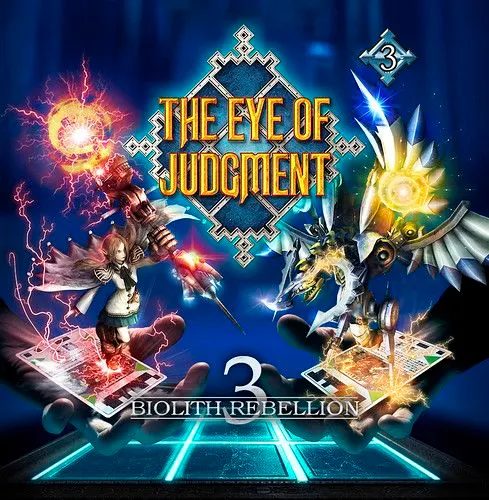
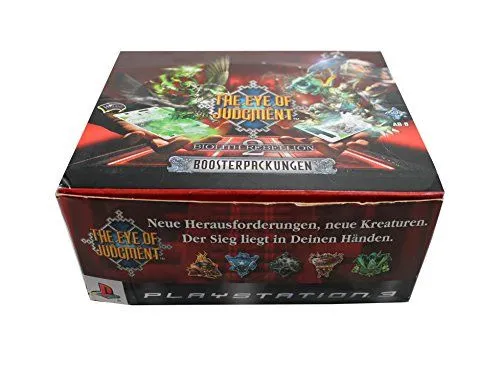
(See VGG entry: The Eye Of Judgment) The Eye of Judgment is a hybrid paper and electronic collectible card game which can be played using the PlayStation 3 game console, supported by the PlayStation Eye camera peripheral. It is one of the first games to use the peripheral, which is bundled with the game, along with a fixed Starter Deck and 1 booster pack. The trading cards are encrypted along their edges with a CyberCode matrix code. The game can also be played without the use of the Playstation 3 system, as a stand-alone card game. However this will cut out many unique graphics and require a person to keep track of numerous scores normally tracked by a computer - mana gain/loss, health bars, element advantages, field terrain changes, etc. Players take turns playing creatures or spell cards from a 30-card deck in order to control a majority (5 fields) of the 9 total fields on the playing mat which is laid out in a 3x3 grid. Other than controlling a majority of fields, players can also win if their opponent runs out of cards to play. Creatures' overall effectiveness is determined by their Hit Points and Attack Score as well as any special abilities they may possess. Five elements divide the game's units: Water, Fire, Earth, Wood, and Biolith. The playing grid fields have a top and bottom side and each side is affiliated with one of the five elements. Creatures placed on friendly elements receive HP bonuses while creatures placed on an opposite element (a Fire creature placed on a Water field) suffer a loss of Hit Points, so unit placement is important. In order to play any card (creature or spell), players must first pay a card's required summoning cost in mana (auto-generated for players every turn). Each creature has a specific attack and defense pattern and these, along with the unit's placement on the 3x3 grid, determine where combat occurs and to some extent, how it resolves. The extremely unique aspect of the Eye of Judgment game, however, is that when you play a card, the PlayStation Eye peripheral automatically generates that creature or spell into a 3D graphical version on your TV or monitor and it places it on a computerized version of the playing grid. It also generates battle animations and resolutions digitally based on the cards involved or recently played. This adds a level of visceral excitement to the collectible card game experience since you can actually see your minions battling it out in colorful digital fashion. There isn't a single-player campaign but players can play matches vs. an AI opponent, another human, or online vs. other human opponents. A rudimentary creature combat mode entitled Judgment allows players to determine which units would defeat other specific units in a head-to-head match-up. The Eye of Judgment provides 5 themed pre-constructed decks (Fire Crusader, Earth Emperor, Water Barrage, Wood Swarm, and Biolith Scourge) and the Starter deck that's provided with the base game (containing a variety of card types). Set 2 is due for release sometime in mid-April 2008 and will add another 100+ cards to the game, with more advanced powers.
Según el catálogo, The Eye of Judgment admite de 1 a 2 jugadores. Este intervalo corresponde al número de jugadores indicado por la editorial, así que el juego puede prepararse para cualquier grupo dentro de ese margen. La preparación, algunas reglas y la puntuación pueden variar según el número de jugadores; consulta la configuración exacta en el reglamento de tu edición.
La duración indicada para The Eye of Judgment es de 30 minutos, la estimación de la editorial para una partida completa. El tiempo real depende del grupo, del número de jugadores y del conocimiento de las reglas: las primeras partidas suelen alargarse y los grupos con experiencia terminan antes. La preparación y la explicación de las reglas no están incluidas.
El catálogo indica The Eye of Judgment a partir de 12 años. Es la recomendación de la editorial y refleja la lectura necesaria, la complejidad de las reglas y las piezas pequeñas, no solo el tema. Los más pequeños a menudo pueden jugar con ayuda de un adulto: comprueba la edad recomendada en tu edición y la experiencia de tu grupo.
The Eye of Judgment tiene una puntuación de complejidad de 2,5 sobre 5 según los jugadores de BoardGameGeek, lo que lo convierte en un juego algo ligero. La puntuación refleja cuánto conocimiento de reglas, planificación y toma de decisiones exige una partida típica. Los juegos exigentes requieren una explicación inicial más larga, así que conviene usar una guía de preparación.
The Eye of Judgment pertenece a estas categorías: Card Game, Fantasy y Collectible Components. Sus mecánicas principales son Area Movement, Area Majority / Influence y Rock-Paper-Scissors. Las categorías describen el tema y la ambientación de un juego, mientras que las mecánicas describen lo que los jugadores hacen realmente en su turno. Cada mecánica lleva a una página del catálogo con juegos similares.
Los autores acreditados de The Eye of Judgment son: Yusuke Watanabe y Kazuhito Miyaki. Estos créditos proceden de los datos publicados del juego y nombran a las personas responsables de su diseño, no a ilustradores ni editoriales. Las páginas de autor de MeepleRules reúnen otros títulos de los mismos autores, algo útil cuando un juego te gusta y buscas otros parecidos.
El catálogo clasifica The Eye of Judgment como juego base. Se juega por sí solo con los componentes de la caja y no requiere ningún otro título. Las expansiones, si existen, añaden contenido o reglas nuevas y aparecen por separado en el catálogo con un enlace a este juego base.