

- Puesto en BGG
- BGG #502
- Puntuación BGG
- 7,4
Gùgōng
- 1–5 jugadores
- 60–90 min
- Complejidad 3,1/5
- 2018
2014
Ayuda con las reglas de The Staufer Dynasty
Explicaciones claras de turnos, efectos de cartas y situaciones dudosas, con referencias a fuentes oficiales e historial de preguntas guardado.
Para 2 jugadores
¿Qué quieres saber?
Las respuestas salen del reglamento oficial, con la página para comprobarlo.
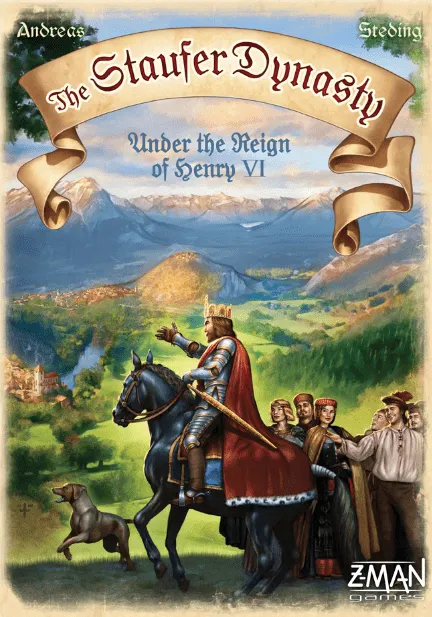
The Staufer Dynasty es un juego de mesa publicado en 2014 para 2–5 jugadores, con partidas de 90 minutos y a partir de 13 años. Fue diseñado por Andreas Steding y sus mecánicas principales son Set Collection, Area Majority / Influence y Modular Board.



En inglés
In The Staufer Dynasty, the players are nobles in the 12th century, accompanying Henry VI on his tour of the areas of Europe brought under control by the Staufer family, an area that included much of modern-day Germany, from the Baltic Sea in the north to Sicily in the south. You're eager to improve your own lot in the land by placing envoys and nobles in positions of power in the six regions represented in this game. The game lasts five rounds with each player having three actions per round. Players take actions in order of their family members on the action board from top to bottom; on a turn you either take a supply action (moving to one side of the action board) or a move/deploy action (moving to the other side). For a supply action, you pick one of the spaces on the supply table, move the indicated number of envoys and nobles from the province to your personal court, then claim any chests underneath that space. The treasure chests come in different colors, with each color having a different function in the game: the brown treasure chests score points based on how many you collect, the orange ones provide immediate points or figures, the blue ones provide a one-shot bonus, and the purple ones let you collect one of the privilege cards on display. The privilege cards often modify other actions or give you a bonus for doing a particular thing. For a move/deploy action, you decide which office seat you want to occupy in a particular region. If this seat isn't in the region where the king is located, you need to spend one envoy as you move clockwise away from the king, placing each envoy in the top part of those regions, until you reach the region that you want to occupy. You then pay the cost of the office seat, placing one figure — possibly a noble if the seat demands it — in that seat and all the other figures in clockwise order, one per region. When you occupy a seat, you claim the chest underneath it. After everyone has finished their actions, you score for the round — but you score only in the region indicated in the current row of scoring tiles (Aachen, Nijmegen, Palermo, etc.) and the region that best meets the condition laid out in a separate part of the current row of scoring tiles (fewest chests, most occupants, where the king is located, etc.) If these two regions turn out to be the same one, you score that region only once. Players score points for having the most office seats in a region (or the second- or thirdmost most office seats) based on the point tile placed in the region at the start of the game. Each region also has a printed bonus that players receive, such as bonus chests or additional envoys. To end the round, you remove all of the office occupants of the region that scored, add new chests under each office seat in those scoring regions and each space on the supply table, then sweep the king clockwise 1-3 regions. As the king moves, he returns all of the envoys that he encounters in the regions that he enters to their owners. After five rounds, players score for their treasure chests as well as for how well they completed their secret job cards, and the player with the most points wins.
Según el catálogo, The Staufer Dynasty admite de 2 a 5 jugadores. Este intervalo corresponde al número de jugadores indicado por la editorial, así que el juego puede prepararse para cualquier grupo dentro de ese margen. La preparación, algunas reglas y la puntuación pueden variar según el número de jugadores; consulta la configuración exacta en el reglamento de tu edición.
La duración indicada para The Staufer Dynasty es de 90 minutos, la estimación de la editorial para una partida completa. El tiempo real depende del grupo, del número de jugadores y del conocimiento de las reglas: las primeras partidas suelen alargarse y los grupos con experiencia terminan antes. La preparación y la explicación de las reglas no están incluidas.
El catálogo indica The Staufer Dynasty a partir de 13 años. Es la recomendación de la editorial y refleja la lectura necesaria, la complejidad de las reglas y las piezas pequeñas, no solo el tema. Los más pequeños a menudo pueden jugar con ayuda de un adulto: comprueba la edad recomendada en tu edición y la experiencia de tu grupo.
The Staufer Dynasty tiene una puntuación de complejidad de 3,0 sobre 5 según los jugadores de BoardGameGeek, lo que lo convierte en un juego algo ligero. La puntuación refleja cuánto conocimiento de reglas, planificación y toma de decisiones exige una partida típica. Los juegos exigentes requieren una explicación inicial más larga, así que conviene usar una guía de preparación.
The Staufer Dynasty pertenece a estas categorías: Medieval. Sus mecánicas principales son Set Collection, Area Majority / Influence y Modular Board. Las categorías describen el tema y la ambientación de un juego, mientras que las mecánicas describen lo que los jugadores hacen realmente en su turno. Cada mecánica lleva a una página del catálogo con juegos similares.
Los autores acreditados de The Staufer Dynasty son: Andreas Steding. Estos créditos proceden de los datos publicados del juego y nombran a las personas responsables de su diseño, no a ilustradores ni editoriales. Las páginas de autor de MeepleRules reúnen otros títulos de los mismos autores, algo útil cuando un juego te gusta y buscas otros parecidos.
El catálogo clasifica The Staufer Dynasty como juego base. Se juega por sí solo con los componentes de la caja y no requiere ningún otro título. Las expansiones, si existen, añaden contenido o reglas nuevas y aparecen por separado en el catálogo con un enlace a este juego base.