
- Puesto en BGG
- BGG #1833
- Puntuación BGG
- 6,9
Butterfly Garden
- 2–4 jugadores
- 30 min
- Complejidad 1,5/5
- 2012
1969
Ayuda con las reglas de Three Musketeers
Explicaciones claras de turnos, efectos de cartas y situaciones dudosas, con referencias a fuentes oficiales e historial de preguntas guardado.
Para 2 jugadores
¿Qué quieres saber?
Las respuestas salen del reglamento oficial, con la página para comprobarlo.
Three Musketeers es un juego de mesa publicado en 1969 para 2 jugadores y con partidas de 10 minutos. Fue diseñado por Haar Hoolim y sus mecánicas principales son Point to Point Movement.


En inglés
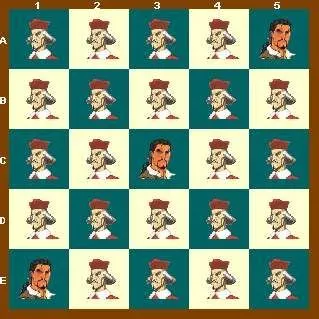
Three Musketeers was first published in Sid Sackson´s A Gamut of Games. Three Musketeers is played on a 5 x 5 square grid board. The bottom left corner, the center and the top right corner are starting spaces for the three musketeers. All other spaces are initially occupied by "enemies." Musketeers can only move to adjacent spaces with an enemy piece, which is captured by this move. Enemies can only move to empty adjacent spaces. Enemies win if all three musketeers are ever on the same line or column. Musketeers win as soon as they run out of legal moves. Musketeers will start the game. According to Wikipedia the game was strongly solved in 2009 by Johannes Laire. The enemies (that could be called Cardinal Richelieu's men) can always force a own win. References are missing but due to the restricted amount of available moves for the Musketeers and the strict, clear, and simple rule set proof is possible with acceptable effort with same result.
Según el catálogo, Three Musketeers admite 2 jugadores. Es el número de jugadores indicado por la editorial, así que el juego está diseñado exactamente para esa cantidad de participantes. Las variantes para otros tamaños de grupo, si existen, se describen en el reglamento de tu edición; consúltalo antes de preparar otra configuración.
La duración indicada para Three Musketeers es de 10 minutos, la estimación de la editorial para una partida completa. El tiempo real depende del grupo, del número de jugadores y del conocimiento de las reglas: las primeras partidas suelen alargarse y los grupos con experiencia terminan antes. La preparación y la explicación de las reglas no están incluidas.
Three Musketeers tiene una puntuación de complejidad de 1,7 sobre 5 según los jugadores de BoardGameGeek, lo que lo convierte en un juego ligero. La puntuación refleja cuánto conocimiento de reglas, planificación y toma de decisiones exige una partida típica. Los juegos exigentes requieren una explicación inicial más larga, así que conviene usar una guía de preparación.
Three Musketeers pertenece a estas categorías: Abstract Strategy. Sus mecánicas principales son Point to Point Movement. Las categorías describen el tema y la ambientación de un juego, mientras que las mecánicas describen lo que los jugadores hacen realmente en su turno. Cada mecánica lleva a una página del catálogo con juegos similares.
Los autores acreditados de Three Musketeers son: Haar Hoolim. Estos créditos proceden de los datos publicados del juego y nombran a las personas responsables de su diseño, no a ilustradores ni editoriales. Las páginas de autor de MeepleRules reúnen otros títulos de los mismos autores, algo útil cuando un juego te gusta y buscas otros parecidos.
El catálogo clasifica Three Musketeers como juego base. Se juega por sí solo con los componentes de la caja y no requiere ningún otro título. Las expansiones, si existen, añaden contenido o reglas nuevas y aparecen por separado en el catálogo con un enlace a este juego base.