

- Puesto en BGG
- BGG #15.219
- Puntuación BGG
- 6,3
Highlander: The Card Game
- 2 jugadores
- 20 min
- Complejidad 2,2/5
- 1996
1994
Ayuda con las reglas de Towers in Time
Explicaciones claras de turnos, efectos de cartas y situaciones dudosas, con referencias a fuentes oficiales e historial de preguntas guardado.
Para 2 jugadores
¿Qué quieres saber?
Las respuestas salen del reglamento oficial, con la página para comprobarlo.
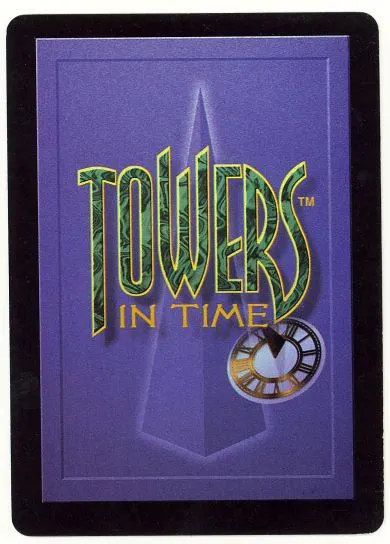
Towers in Time es un juego de mesa publicado en 1994 para 2 jugadores, con partidas de 30 minutos y a partir de 12 años. Fue diseñado por Mike Sager y sus mecánicas principales son Hand Management.

En inglés
From the box: In the beginning those that could master going between dimensions thought of it as novelty. There were worlds to discover, creatures to see and most importantly magic to master. But with all these things to keep them busy there was one thing they did not forget, Power. Soon it was easier to take from others than to find it on your own. The only place to hide was in great magical towers that they built between dimensions. All times in your world and in the others are at your disposal. Will you be the last to Reign in Towers in Time? Play overview: Each player represents a spellcaster, dueling with the other players for control of an abstractly defined extradimensional space. Each player has five shields, represented by cards from that player's deck, that serve to anchor the player the dimension within the game's story, and as the player's presence in the game mechanically. The goal is to eliminate the shields of all other players; when a player has no shields remaining, they are banished from the pocket dimension, and out of the game. Victory goes to the last player with shields in play. To combat one another, players play Source cards, representing connections to various natural locations, be they landforms, weather phenomena, or natural disasters. These resource cards allow the player to access Temper, the main resource in Towers in Time, themed to the four elements. Using Temper, players pay the costs to summon creatures to wage war, conjure magical objects and artifacts to enhance the effectiveness of recruited creatures, and cast spells to strengthen their minions and weaken the opposing armies. Additionally, once creatures are in play, most of them can provide Temper as well, although typically less than Source cards; most cards in Towers in Time are resource generators in addition to their other game effects. Source cards serve as the base for the titular Towers of Towers in Time. Each Source has a default file of three ranks atop it, each space of which can be occupied by creatures and the cards they carry. Creatures enter play within Towers, and must match the element represented by the Source atop which it stands (except for Neutral creatures, which may be played into any Tower). There are rules to determine which creatures can enter play in which locations within a Tower, but once in play, most creatures can move between Towers, taking attached cards with them when they move. Turns do not follow the turn format common to many contemporary CCGs. Instead, several phases are completed simultaneously by all players, then players alternate initiating and resolving a single action until both players have passed. Action resolution varies depending on their effect, with some actions initiating a separate resolution phase with its own actions and timing (such as combat) and others are single-step actions (such as playing a card). Additionally, a number of supplemental actions ("free" actions) facilitate utility functions, such as drawing Temper to pay for spells. The opportunity to act first during the action round is determined by the player who won initiative during game setup (for the first turn only), or the player who did not take the last pass action on the previous turn.
Según el catálogo, Towers in Time admite 2 jugadores. Es el número de jugadores indicado por la editorial, así que el juego está diseñado exactamente para esa cantidad de participantes. Las variantes para otros tamaños de grupo, si existen, se describen en el reglamento de tu edición; consúltalo antes de preparar otra configuración.
La duración indicada para Towers in Time es de 30 minutos, la estimación de la editorial para una partida completa. El tiempo real depende del grupo, del número de jugadores y del conocimiento de las reglas: las primeras partidas suelen alargarse y los grupos con experiencia terminan antes. La preparación y la explicación de las reglas no están incluidas.
El catálogo indica Towers in Time a partir de 12 años. Es la recomendación de la editorial y refleja la lectura necesaria, la complejidad de las reglas y las piezas pequeñas, no solo el tema. Los más pequeños a menudo pueden jugar con ayuda de un adulto: comprueba la edad recomendada en tu edición y la experiencia de tu grupo.
Towers in Time tiene una puntuación de complejidad de 2,3 sobre 5 según los jugadores de BoardGameGeek, lo que lo convierte en un juego algo ligero. La puntuación refleja cuánto conocimiento de reglas, planificación y toma de decisiones exige una partida típica. Los juegos exigentes requieren una explicación inicial más larga, así que conviene usar una guía de preparación.
Towers in Time pertenece a estas categorías: Card Game, Fantasy y Collectible Components. Sus mecánicas principales son Hand Management. Las categorías describen el tema y la ambientación de un juego, mientras que las mecánicas describen lo que los jugadores hacen realmente en su turno. Cada mecánica lleva a una página del catálogo con juegos similares.
Los autores acreditados de Towers in Time son: Mike Sager. Estos créditos proceden de los datos publicados del juego y nombran a las personas responsables de su diseño, no a ilustradores ni editoriales. Las páginas de autor de MeepleRules reúnen otros títulos de los mismos autores, algo útil cuando un juego te gusta y buscas otros parecidos.
El catálogo clasifica Towers in Time como juego base. Se juega por sí solo con los componentes de la caja y no requiere ningún otro título. Las expansiones, si existen, añaden contenido o reglas nuevas y aparecen por separado en el catálogo con un enlace a este juego base.