

- Puesto en BGG
- BGG #5907
- Puntuación BGG
- 8,4
Death Valley: Battles for the Shenandoah
- 1–2 jugadores
- 300–1200 min
- Complejidad 4,3/5
- 2019
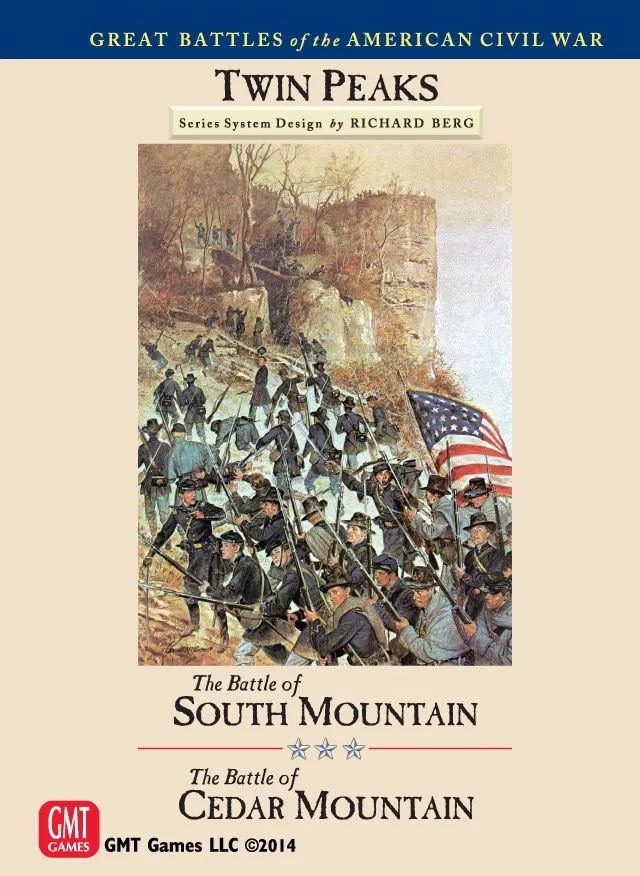
2014
Ayuda con las reglas de Twin Peaks
Explicaciones claras de turnos, efectos de cartas y situaciones dudosas, con referencias a fuentes oficiales e historial de preguntas guardado.
Para 1 jugador
¿Qué quieres saber?
Las respuestas salen del reglamento oficial, con la página para comprobarlo.
Twin Peaks es un juego de mesa publicado en 2014 para 1–4 jugadores y con partidas de 360 a 780 minutos. Fue diseñado por Richard H. Berg y Greg Laubach y sus mecánicas principales son Dice Rolling, Hexagon Grid y Simulation.



En inglés
Twin Peaks is the sixth installment in the Great Battles of the American Civil War (GBACW) series, published by GMT Games. Two full battles are included: Cedar Mountain August 9th, 1862. With the Peninsular Campaign winding down, Gen. Robert E. Lee sent Maj. Gens. Stonewall Jackson and A.P. Hill to attack Maj. Gen. John Pope’s new Federal Army of Virginia with 27,000 troops. Gen. John Pope, hoping to draw attention away from Maj. Gen. George McClellan’s withdrawal from the Peninsula, moved against the rail junction at Gordonsville, Va. Stonewall Jackson found USA Maj. Gen. Nathaniel Banks’s division isolated. Jackson crossed the Rapidan River to engage. Pope ordered Brig. Gen. James Ricketts’s division to unite with Banks’s forces on high ground near Cedar Run, seven miles south of the town of Culpeper. These two forces met in the afternoon heat. South Mountain September 14th, 1862. After the CSA success at Second Bull Run Gen. Robert E. Lee believed the demoralized USA armies could not respond to any bold action. Thusly, he planned a campaign to raid Maryland and Pennsylvania and to threaten Washington D.C. itself. Once again Lee confidently divided his army to both move north and neutralize the large Union garrison at Harper’s Ferry. However, the Union Army under Gen. George B. McClellan was quick to recover from the Bull Run defeat and was already in pursuit of Lee. The gods of war smiled on the Union troops as a copy of Lee’s orders fell into Union hands. An attack through the lightly held gaps at South Mountain would cut Lee’s army in two and perhaps end the war. At 6:00 am the Union Army moved. The Great Battles of the American Civil War Series: This series is one of the hobby’s longest lived design concepts, springing from the legendary regimental level Gettysburg game -Terrible Swift Sword (SPI)- designed by Richard Berg in 1976. Under GMT, the rules system has remained stable but has shown remarkable flexibility to allow each game to smoothly incorporate additional rules to reflect the historical battles. The series relies on interactive chit-pull mechanics to simulate the oftentimes chaotic nature of the 19th Century battlefield at the regimental level. The Game: Twin Peaks contains two battle games each with its own full size map on one double-sided mapsheet. Experienced players will be able to play either in one sitting. Both battles highlight the effects of fatigue from the late summer heat and the difficult terrain. The optional fatigue rules are mandatory in both battles. The Cedar Mountain battle also includes optional units which could have joined the battle.
Según el catálogo, Twin Peaks admite de 1 a 4 jugadores. Este intervalo corresponde al número de jugadores indicado por la editorial, así que el juego puede prepararse para cualquier grupo dentro de ese margen. La preparación, algunas reglas y la puntuación pueden variar según el número de jugadores; consulta la configuración exacta en el reglamento de tu edición.
La duración indicada para Twin Peaks es de 360 a 780 minutos, la estimación de la editorial para una partida completa. El tiempo real depende del grupo, del número de jugadores y del conocimiento de las reglas: las primeras partidas suelen alargarse y los grupos con experiencia terminan antes. La preparación y la explicación de las reglas no están incluidas.
Twin Peaks tiene una puntuación de complejidad de 4,1 sobre 5 según los jugadores de BoardGameGeek, lo que lo convierte en un juego exigente. La puntuación refleja cuánto conocimiento de reglas, planificación y toma de decisiones exige una partida típica. Los juegos exigentes requieren una explicación inicial más larga, así que conviene usar una guía de preparación.
Twin Peaks pertenece a estas categorías: Wargame y American Civil War. Sus mecánicas principales son Dice Rolling, Hexagon Grid y Simulation. Las categorías describen el tema y la ambientación de un juego, mientras que las mecánicas describen lo que los jugadores hacen realmente en su turno. Cada mecánica lleva a una página del catálogo con juegos similares.
Los autores acreditados de Twin Peaks son: Richard H. Berg y Greg Laubach. Estos créditos proceden de los datos publicados del juego y nombran a las personas responsables de su diseño, no a ilustradores ni editoriales. Las páginas de autor de MeepleRules reúnen otros títulos de los mismos autores, algo útil cuando un juego te gusta y buscas otros parecidos.
El catálogo clasifica Twin Peaks como juego base. Se juega por sí solo con los componentes de la caja y no requiere ningún otro título. Las expansiones, si existen, añaden contenido o reglas nuevas y aparecen por separado en el catálogo con un enlace a este juego base.