

- Puesto en BGG
- BGG #2333
- Puntuación BGG
- 6,9
Historia
- 1–6 jugadores
- 120 min
- Complejidad 3,1/5
- 2014
2011
Ayuda con las reglas de Upon a Salty Ocean
Explicaciones claras de turnos, efectos de cartas y situaciones dudosas, con referencias a fuentes oficiales e historial de preguntas guardado.
Para 2 jugadores
¿Qué quieres saber?
Las respuestas salen del reglamento oficial, con la página para comprobarlo.
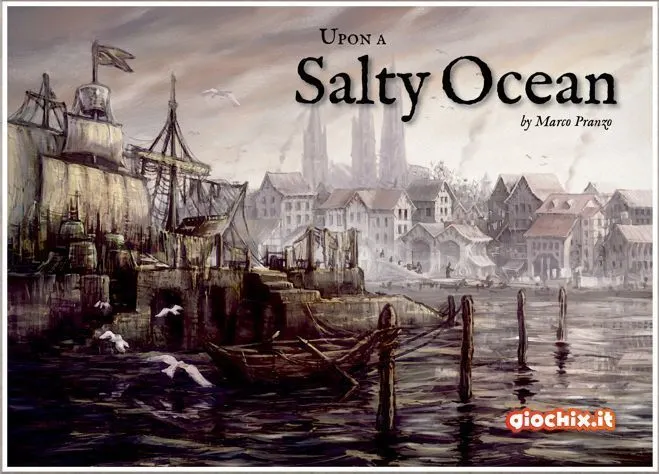
Upon a Salty Ocean es un juego de mesa publicado en 2011 para 2–4 jugadores, con partidas de 120 minutos y a partir de 13 años. Fue diseñado por Marco Pranzo y sus mecánicas principales son Action Points y Variable Phase Order.






En inglés
At the beginning of the 16th century, the city of Rouen is the main French port. The city's wealth depends on fishing and the trading of salted fish. Salt produced in the mines has to be loaded onto ships and used to preserve herring and cod fished in the Atlantic Ocean. Every week ships full of salt barrels leave Rouen for the fishing grounds of the Atlantic Ocean, and once back, the goods are sold in the city markets. The players represent city merchants, and they invest in ships and city buildings to try to get rich. Who will be the richest merchant of Rouen, when Francis I, King of France, comes to visit the City? In Upon a Salty Ocean, players start the game with one caravel loaded with three salt barrels, a salt mine and 10-16 money. From this, they must build a shipping empire! The game lasts five turns, with each turn being divided into three phases. In the event phase, players adjust prices on the market based on the current event tile, take into the account the weather and environmental conditions that will affect them the remainder of the round, and reveal the event tile for the subsequent round. The action phase lasts a variable number of rounds depending on how many actions players want to take and can afford. Eight actions are available and they're divided into four types: City: (1) buy a saline and (2) buy a building Navigation: (1) travel to the ocean and fish and (2) travel to Rouen Harbor: (1) build a ship and (2) move goods Market: (1) sell to the market and (2) buy from the market On a player's turn, he can take any one of the either actions or pass; the cost of an action is the number of times this type of action has been performed previously during this round. For example, the first use of a City action costs 0, while the next use (whether to buy a saline or a building) costs 1. A player who passes can take an action later in the same phase. The action phase ends once all players pass. A player can go into debt during a turn, paying one coin in interest when doing so; as long as the player is in the black once the action round ends (by selling to the market), no further payment is due. In the turn end phase, players produce salt, may use special buildings, pay interest (if needed), reset the cost of the actions to zero, and so on. A player can have no more than 40 coins at the end of a turn unless he owns a banque, and the limit is 80 coins without owning Salle des Coffres. This limit is important as the player with the most coins after five rounds wins. Some buildings provide endgame bonuses to which the coin limit doesn't apply.
Según el catálogo, Upon a Salty Ocean admite de 2 a 4 jugadores. Este intervalo corresponde al número de jugadores indicado por la editorial, así que el juego puede prepararse para cualquier grupo dentro de ese margen. La preparación, algunas reglas y la puntuación pueden variar según el número de jugadores; consulta la configuración exacta en el reglamento de tu edición.
La duración indicada para Upon a Salty Ocean es de 120 minutos, la estimación de la editorial para una partida completa. El tiempo real depende del grupo, del número de jugadores y del conocimiento de las reglas: las primeras partidas suelen alargarse y los grupos con experiencia terminan antes. La preparación y la explicación de las reglas no están incluidas.
El catálogo indica Upon a Salty Ocean a partir de 13 años. Es la recomendación de la editorial y refleja la lectura necesaria, la complejidad de las reglas y las piezas pequeñas, no solo el tema. Los más pequeños a menudo pueden jugar con ayuda de un adulto: comprueba la edad recomendada en tu edición y la experiencia de tu grupo.
Upon a Salty Ocean tiene una puntuación de complejidad de 2,9 sobre 5 según los jugadores de BoardGameGeek, lo que lo convierte en un juego algo ligero. La puntuación refleja cuánto conocimiento de reglas, planificación y toma de decisiones exige una partida típica. Los juegos exigentes requieren una explicación inicial más larga, así que conviene usar una guía de preparación.
Upon a Salty Ocean pertenece a estas categorías: Economic, Nautical y Renaissance. Sus mecánicas principales son Action Points y Variable Phase Order. Las categorías describen el tema y la ambientación de un juego, mientras que las mecánicas describen lo que los jugadores hacen realmente en su turno. Cada mecánica lleva a una página del catálogo con juegos similares.
Los autores acreditados de Upon a Salty Ocean son: Marco Pranzo. Estos créditos proceden de los datos publicados del juego y nombran a las personas responsables de su diseño, no a ilustradores ni editoriales. Las páginas de autor de MeepleRules reúnen otros títulos de los mismos autores, algo útil cuando un juego te gusta y buscas otros parecidos.
El catálogo clasifica Upon a Salty Ocean como juego base. Se juega por sí solo con los componentes de la caja y no requiere ningún otro título. Las expansiones, si existen, añaden contenido o reglas nuevas y aparecen por separado en el catálogo con un enlace a este juego base.