

- Puesto en BGG
- BGG #12.472
- Puntuación BGG
- 6,9
Victory at Sea: World War II Naval Combat Game
- 2 jugadores
- 360 min
- Complejidad 2,5/5
- 2006
Ayuda con las reglas de Victory at Sea: Bismarck
Explicaciones claras de turnos, efectos de cartas y situaciones dudosas, con referencias a fuentes oficiales e historial de preguntas guardado.
¿Qué quieres saber?
Las respuestas salen del reglamento oficial, con la página para comprobarlo.
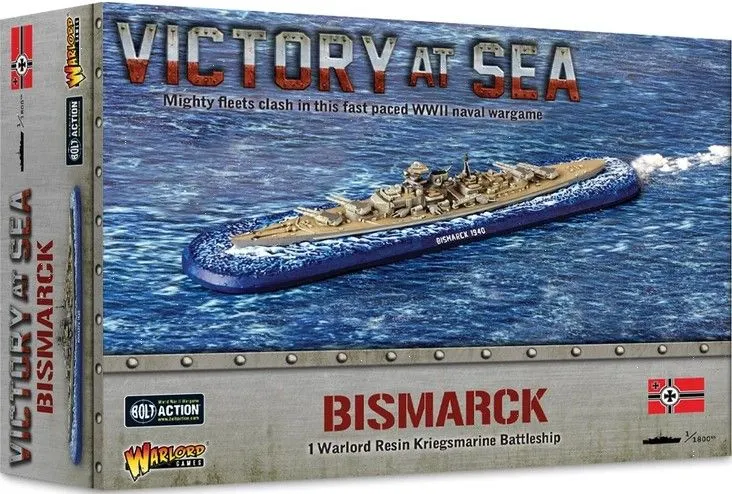
Victory at Sea: Bismarck es una expansión de Victory at Sea: Battle for the Pacific publicada en 2020 para 2 jugadores y a partir de 10 años. Sus mecánicas principales son Dice Rolling, Simulation y Measurement Movement.



En inglés
Two Bismarck-class battleships were built for the Kriegsmarine. Bismarck was the first, named for the Chancellor (Otto von Bismarck). The battleship was laid down in July 1936 and launched February 1939. She and her sister ship, Tirpitz, were two of the largest battleships built by any European power, and certainly the largest built by Germany. Whilst the physical power they held was tremendous, they also wreaked psychological havoc amongst the allies. Churchill was determined that the two battleships not be let loose upon the Atlantic. Bismarck's career, however, was woefully short, spanning just eight months under a single Captain, Ernst Lindeman. During this time, she only took part in a single offensive action that lasted just eight days in May 1941. This operation, codenamed Rheinübung, was to attempt what the Allies feared, a breakthrough to the Atlantic and raid allied shipping efforts between Britain and North America (along with the heavy cruiser Prinz Eugen). The two vessels were detected multiple times off Scandinavia, prompting Britain to initiate naval blocking maneuvers. The resultant battle, the Battle of the Denmark Strait, saw the British vessels HMS Hood and HMS Prince of Wales engage the two vessels. Hood was destroyed for her efforts and Prince of Wales suffered damage, forcing a retreat. However, Bismarck had suffered damage significant enough to put an end to her raiding mission. Limping for occupied France for repairs, Bismarck was pursued by a Royal Navy set on retribution for the sinking of HMS Hood. She was attacked by 16 Fairey Swordfish biplane torpedo bombers deployed by HMS Ark Royal. A direct hit rendered Bismarck's steering gear inoperable. The following morning, she suffered crippling damage in a battle against two British battleships and two cruisers. She was subsequently, on 27 May 1941, scuttled by her crew and sank with many lives lost. Contents: 1 Model Ship ‣ Bismarck 1 Ship Card Damage Sliders —description from the publisher
Según el catálogo, Victory at Sea: Bismarck admite 2 jugadores. Es el número de jugadores indicado por la editorial, así que el juego está diseñado exactamente para esa cantidad de participantes. Las variantes para otros tamaños de grupo, si existen, se describen en el reglamento de tu edición; consúltalo antes de preparar otra configuración.
El catálogo indica Victory at Sea: Bismarck a partir de 10 años. Es la recomendación de la editorial y refleja la lectura necesaria, la complejidad de las reglas y las piezas pequeñas, no solo el tema. Los más pequeños a menudo pueden jugar con ayuda de un adulto: comprueba la edad recomendada en tu edición y la experiencia de tu grupo.
Victory at Sea: Bismarck pertenece a estas categorías: Wargame, Miniatures y Nautical. Sus mecánicas principales son Dice Rolling, Simulation y Measurement Movement. Las categorías describen el tema y la ambientación de un juego, mientras que las mecánicas describen lo que los jugadores hacen realmente en su turno. Cada mecánica lleva a una página del catálogo con juegos similares.
El catálogo clasifica Victory at Sea: Bismarck como expansión de Victory at Sea: Battle for the Pacific. Las expansiones añaden contenido, reglas o escenarios al juego base y normalmente no se pueden jugar solas, así que necesitas Victory at Sea: Battle for the Pacific para usarla. Comprueba que tu edición de Victory at Sea: Battle for the Pacific sea compatible, porque algunas expansiones se revisaron entre ediciones.