
- Puesto en BGG
- BGG #5638
- Puntuación BGG
- 7,0
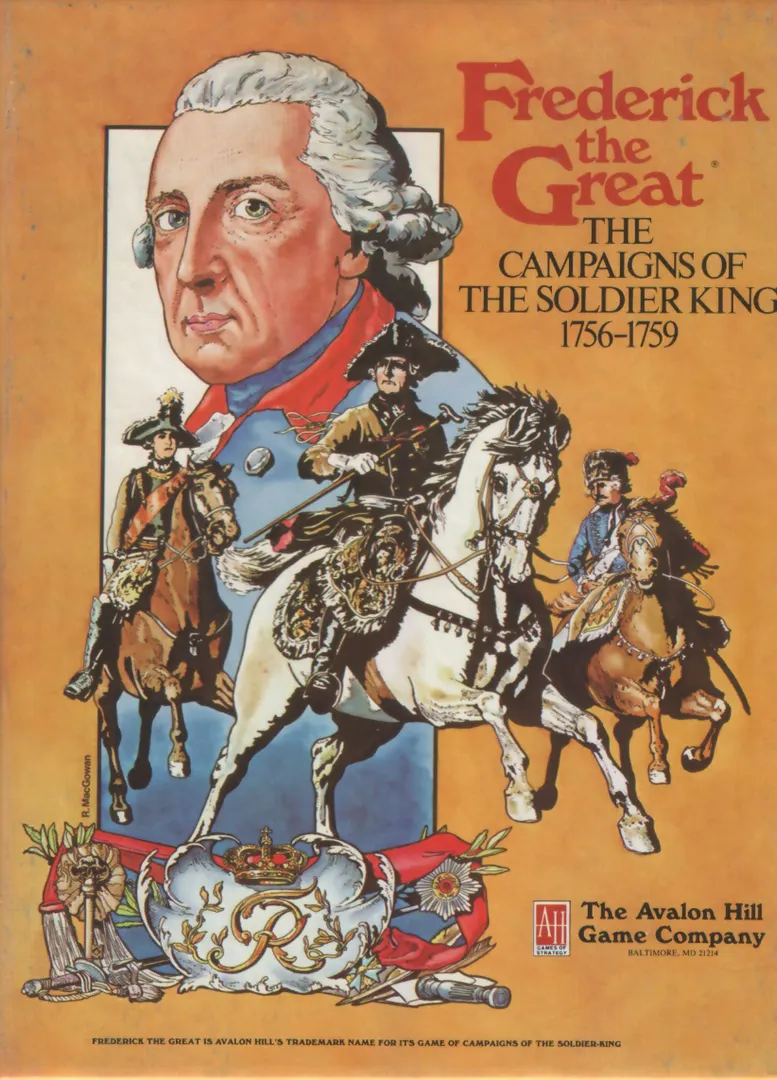
Frederick the Great: The Campaigns of The Soldier King 1756-1759
- 2–4 jugadores
- 180–240 min
- Complejidad 2,7/5
- 1975
1976
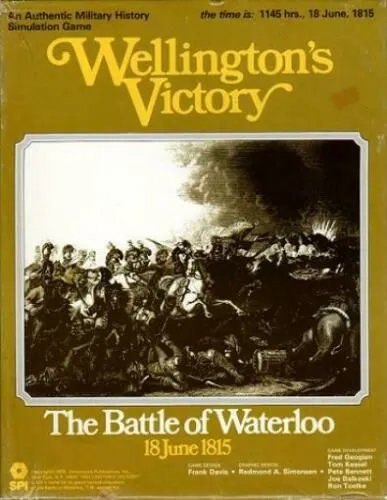
Ayuda con las reglas de Wellington's Victory: Battle of Waterloo Game – June 18th, 1815
Explicaciones claras de turnos, efectos de cartas y situaciones dudosas, con referencias a fuentes oficiales e historial de preguntas guardado.
Para 2 jugadores
¿Qué quieres saber?
Las respuestas salen del reglamento oficial, con la página para comprobarlo.
Wellington's Victory: Battle of Waterloo Game – June 18th, 1815 es un juego de mesa publicado en 1976 para 2 jugadores, con partidas de 240 minutos y a partir de 12 años. Fue diseñado por Frank Davis y sus mecánicas principales son Dice Rolling, Hexagon Grid y Ratio / Combat Results Table.






En inglés
[from the back of the flatpack edition] Wellington's Victory : The Battle of Waterloo - Four-color 68” x 44” contour map in four sections - Innovative Fire and Shock Combat mechanics - Line, Column, Square, Skirmish and Cavalry formations - Hougomont, La Haye Sainte and Plancenoit Scenarios - 40 Game-Turn Grand Battle Scenario Wellington's Victory is a grand tactical simulation of the Battle of Waterloo which occurred on June 18, 1815, at a minor crossroads south of Brussels, Belgium. The battle marked the first and only encounter of history's two most renowned generals, Sir Arthur Wellesley, Duke of Wellington, and Napoleon Bonaparte, Emperor of France. A brutal day-long French assault against the British held ridge brought Wellington's army to the brink of defeat. By later afternoon, however, the arrival of Wellington's allies tipped the odds decisively against the French; Napoleon chose to stake his empire on the outcome of a final attack by his most trusted troops – the Imperial Guard. Wellington's Victory is played on an innovative game map composed of four 34” x 22” map sections on which significant differences in ground contours are differentiated by color. There are five distinct contour levels depicted on the map as well as an extremely accurate survey of all battle field terrain features including Hougomont, La Haye Sainte, and almost every other farm and dwelling, woods and orchards, streams and ponds, and raised and sunken roads. Each of more than 500 French, Prussian and Anglo-Dutch combat and command units are fully identified by battalion, regiment, brigade, division and corps designations as well as numerical game values which differentiate each unit's strength, effectiveness, and mobility. The game utilizes a fifteen minute Game-Turn. Each mapsheet hex represents a distance of 100 yards. Each Strength Point represents 100 infantry or cavalry troops or one gun or howitzer within an artillery battery. Each Game-Turn employs a unique, asymmetrical, sequence of play in which Players alternately participate in a series of Phases covering activities which include the execution of chain of command mechanics (such as activating and committing reserve formations and initiating cavalry charges), rallying disordered and routed units, executing facing and formation changes (including a repertoire of infantry formations such as column, line, square and open order or skirmish formation), regular and grand tactical movement, and finally executing artillery and small arms fire as well as infantry and cavalry shock command. The Fire and Shock Combat mechanics which decide the battle were also designed to yield realistic results without sacrificing playability. Fire resolution requires no arithmetic calculation since each unit fires separately. The Relative Firepower Table used to resolve Fire Combat is a new type of CRT which directly interrelates the strength, formation and quality of the firing unit with the formation and terrain cover employed by the defending unit. The Shock Combat Table is also unique in that it employs an “odds” comparison to account for Troop strength differences between the attacker and defender and a “differential” comparison to account for any qualitative difference between the opposing forces. Losses, which are recorded directly on the map by placing a Strength marker under the unit suffering casualties, may result from either Fire or Shock combat. In general, however, Shock Combat is depicted as a “morale showdown” more useful for gaining ground than inflicting casualties. Morale, which Napoleon deemed to be three times as important as numerical strength on the battlefield, is accurately accounted for in the Effectiveness Rating assigned to every infantry battalion, cavalry regiment and artillery battery crew. Buyer's Guide for WELLINGTON'S VICTORY The following ratings are based on at least 100 player-replies to surveys conducted through Strategy & Tactics Magazine. Ratings are on a 1 (worst) to 9 (best) scale. Average ratings (for over 60 historical games in print) are: Acceptability-6.00, Complexity-5.00. Acceptability Rating: New Game Complexity Rating: (est.) 7.8 Avg. Playing Time [hrs.] (est.) 6.0 “Acceptability” depends a lot on which historical period interests you the most. “Complexity” ratings for other games are, for example, Monopoly – 2.34; Afrika Korps – 3.48; Diplomacy – 4.51; France, 1940 – 5.78; PanzerBlitz – 7.01. Most games average 2-3 hours playing time.
Según el catálogo, Wellington's Victory: Battle of Waterloo Game – June 18th, 1815 admite 2 jugadores. Es el número de jugadores indicado por la editorial, así que el juego está diseñado exactamente para esa cantidad de participantes. Las variantes para otros tamaños de grupo, si existen, se describen en el reglamento de tu edición; consúltalo antes de preparar otra configuración.
La duración indicada para Wellington's Victory: Battle of Waterloo Game – June 18th, 1815 es de 240 minutos, la estimación de la editorial para una partida completa. El tiempo real depende del grupo, del número de jugadores y del conocimiento de las reglas: las primeras partidas suelen alargarse y los grupos con experiencia terminan antes. La preparación y la explicación de las reglas no están incluidas.
El catálogo indica Wellington's Victory: Battle of Waterloo Game – June 18th, 1815 a partir de 12 años. Es la recomendación de la editorial y refleja la lectura necesaria, la complejidad de las reglas y las piezas pequeñas, no solo el tema. Los más pequeños a menudo pueden jugar con ayuda de un adulto: comprueba la edad recomendada en tu edición y la experiencia de tu grupo.
Wellington's Victory: Battle of Waterloo Game – June 18th, 1815 tiene una puntuación de complejidad de 4,2 sobre 5 según los jugadores de BoardGameGeek, lo que lo convierte en un juego exigente. La puntuación refleja cuánto conocimiento de reglas, planificación y toma de decisiones exige una partida típica. Los juegos exigentes requieren una explicación inicial más larga, así que conviene usar una guía de preparación.
Wellington's Victory: Battle of Waterloo Game – June 18th, 1815 pertenece a estas categorías: Wargame y Napoleonic. Sus mecánicas principales son Dice Rolling, Hexagon Grid y Ratio / Combat Results Table. Las categorías describen el tema y la ambientación de un juego, mientras que las mecánicas describen lo que los jugadores hacen realmente en su turno. Cada mecánica lleva a una página del catálogo con juegos similares.
Los autores acreditados de Wellington's Victory: Battle of Waterloo Game – June 18th, 1815 son: Frank Davis. Estos créditos proceden de los datos publicados del juego y nombran a las personas responsables de su diseño, no a ilustradores ni editoriales. Las páginas de autor de MeepleRules reúnen otros títulos de los mismos autores, algo útil cuando un juego te gusta y buscas otros parecidos.
El catálogo clasifica Wellington's Victory: Battle of Waterloo Game – June 18th, 1815 como juego base. Se juega por sí solo con los componentes de la caja y no requiere ningún otro título. Las expansiones, si existen, añaden contenido o reglas nuevas y aparecen por separado en el catálogo con un enlace a este juego base.