
- Rang BGG
- BGG #8 942
- Note BGG
- 7,6
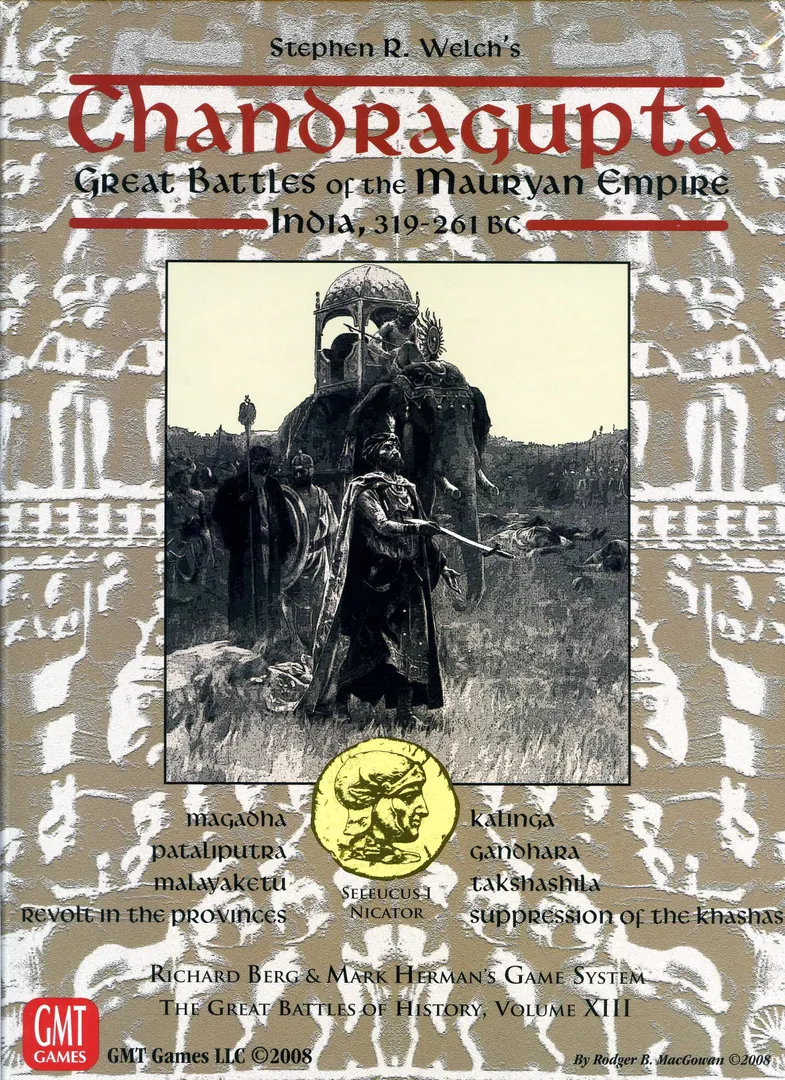
Chandragupta: Great Battles of the Mauryan Empire – India, 319-261 BC
- 2 joueurs
- 240 min
- Complexité 3,8/5
- 2008
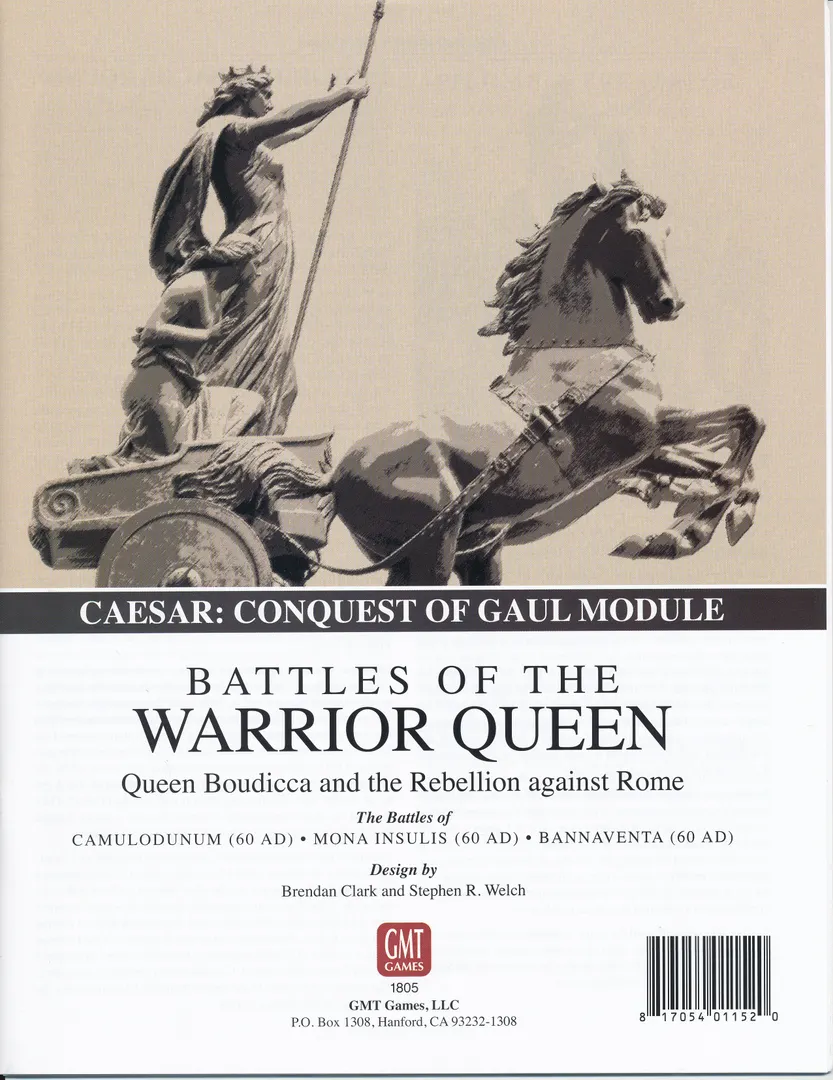
Aide aux règles de Battles of the Warrior Queen
Des explications claires des tours, effets de cartes et situations litigieuses, avec des références aux sources officielles et un historique des questions sauvegardé.
Que voulez-vous savoir ?
Les réponses viennent du livret officiel, avec la page à vérifier.
Battles of the Warrior Queen est une extension de Caesar: Conquest of Gaul sortie en 2017 pour 2 joueurs. Il a été conçu par Brendan Clark et Stephen R. Welch et ses principales mécaniques sont Dice Rolling, Hexagon Grid et Simulation.










En anglais
It is AD60, and Governor of Britannia C. Suetonius Paulinus stands ready to deal his final blow against a vicious insurgency in Rome’s new province. Inspired by Rome’s implacable opponents, the Druids, the remaining fanatical warriors of a two-year insurgency hold out on the island of Anglesey. Having made an amphibious landing on the island’s shores, Paulinus and his legionaries must cut their way through fierce opposition on the beach. While his cohorts ravage the island, a messenger reaches Paulinus with news of a tribe that is rampaging the eastern fringes of his province. The Iceni, led by Queen Boudicca, are reported to have murdered local Roman officials and their guards. Other reports soon arrive that the Iceni’s revolt is gathering both force and momentum as local tribes are responding to Boudicca’s call for open revolt. A large warrior force is said to be devastating Roman villas and farmsteads as it heads south towards the first Roman colony in Britannia, Camulodunum. Paulinus realizes that with all four of his legions posted in the north and west, this new menace has the potential to ravage Roman colonies and cut his lines of communication. He faces the very real prospect of being Governor of Britannia in name only. Battles of the Warrior Queen covers the major engagements during the rebellion of the Iceni tribe and Boudicca’s allies against the legions of Emperor Nero. Led by Queen Boudicca, the rebellion would be the greatest British threat to nearly four centuries of Roman domination of Britain. Battle of Mona Insulis Separated from mainland Britain by the treacherous waters of the Menai Straits, Paulinus faced the challenge of making an opposed beach landing on the Welsh island of Mona Insulis (today’s Anglesey). The Britons, arrayed along the shore in a dense and heavily armed line of battle, awaited the assault. Helping whip them into a battle frenzy were the Druid priests, for whom the island was their last sanctuary. Battle of Camulodunum On learning that the Iceni tribe had risen in revolt and were heading towards the Roman colony of Camulodunum (modern-day Colchester), the IXth Legion (named as “Hispana”) set off from its base in Lindum (modern-day Lincoln), under the command of legate Petillius Cerialis. Cerialis was a mercurial individual who had escaped the brink of military disaster before. His luck would be tried once again in his encounter with the Britons. Battle of Bannaventa After arriving on the mainland, Paulinus rode east and south in great haste. Outside Londinium news of the defeat of Cerialis and his IXth Legion reached him. Ordering evacuation of the city, Paulinus withdrew hurriedly northwards to the midlands and urgently concentrated the XIVth Gemina and the XXth Legions. As Boudicca’s horde approached, Paulinus drew up his troops in close order in a defile, protected on his flanks and in his rear by dense forest. He new that the Queen of the Iceni would struggle to keep her disparate coalition in check for long, and would soon be compelled to attack. Whichever way it went, this would likely be the final, climatic battle of Boudicca’s rebellion against Rome. To play this module you will need the maps, counters and rules that come with this module and the rules and some counters from Caesar: Conquest of Gaul. Battles of the Warrior Queen can also be played with the Simple Great Battles of History (SGBoH) rules. Components: One 32” and 24” back printed map sheet (one full and two half size game maps) 140 counters (from the GMT Website)
Selon le catalogue, Battles of the Warrior Queen se joue à 2 personnes. C’est le nombre de joueurs indiqué par l’éditeur : le jeu est donc conçu pour exactement ce nombre de participants. Les variantes pour d’autres tailles de groupe, s’il en existe, sont décrites dans la règle de votre édition ; consultez-la avant d’installer une autre configuration.
Battles of the Warrior Queen obtient une note de complexité de 3,0 sur 5 auprès des joueurs de BoardGameGeek, ce qui en fait un jeu de complexité moyenne. Cette note reflète la quantité de règles, de planification et de décisions qu’exige une partie typique. Prévoyez une explication plus longue pour les jeux exigeants et utilisez un guide de préparation avant la soirée.
Battles of the Warrior Queen appartient à ces catégories : Wargame et Ancient. Ses principales mécaniques sont Dice Rolling, Hexagon Grid et Simulation. Les catégories décrivent le thème et l’univers d’un jeu, tandis que les mécaniques décrivent ce que les joueurs font réellement pendant leur tour. Chaque mécanique mène à une page du catalogue avec des jeux similaires.
Les auteurs crédités pour Battles of the Warrior Queen sont : Brendan Clark et Stephen R. Welch. Ces crédits proviennent des données publiées du jeu et désignent les personnes responsables de sa conception, et non les illustrateurs ou les éditeurs. Les pages d’auteurs sur MeepleRules regroupent les autres titres des mêmes auteurs, ce qui est utile lorsqu’un jeu vous plaît et que vous en cherchez de similaires.
Le catalogue présente Battles of the Warrior Queen comme une extension de Caesar: Conquest of Gaul. Les extensions ajoutent du contenu, des règles ou des scénarios au jeu de base et ne se jouent généralement pas seules : il vous faut donc Caesar: Conquest of Gaul pour l’utiliser. Vérifiez que votre édition de Caesar: Conquest of Gaul est compatible, car certaines extensions ont été révisées d’une édition à l’autre.