
- Rang BGG
- BGG #16 202
- Note BGG
- 6,8
Ten Suns
- 1–6 joueurs
- 30–45 min
- Complexité 2,3/5
- 2020
2018
Aide aux règles de Black Souls
Des explications claires des tours, effets de cartes et situations litigieuses, avec des références aux sources officielles et un historique des questions sauvegardé.
Pour 1 joueur
Que voulez-vous savoir ?
Les réponses viennent du livret officiel, avec la page à vérifier.
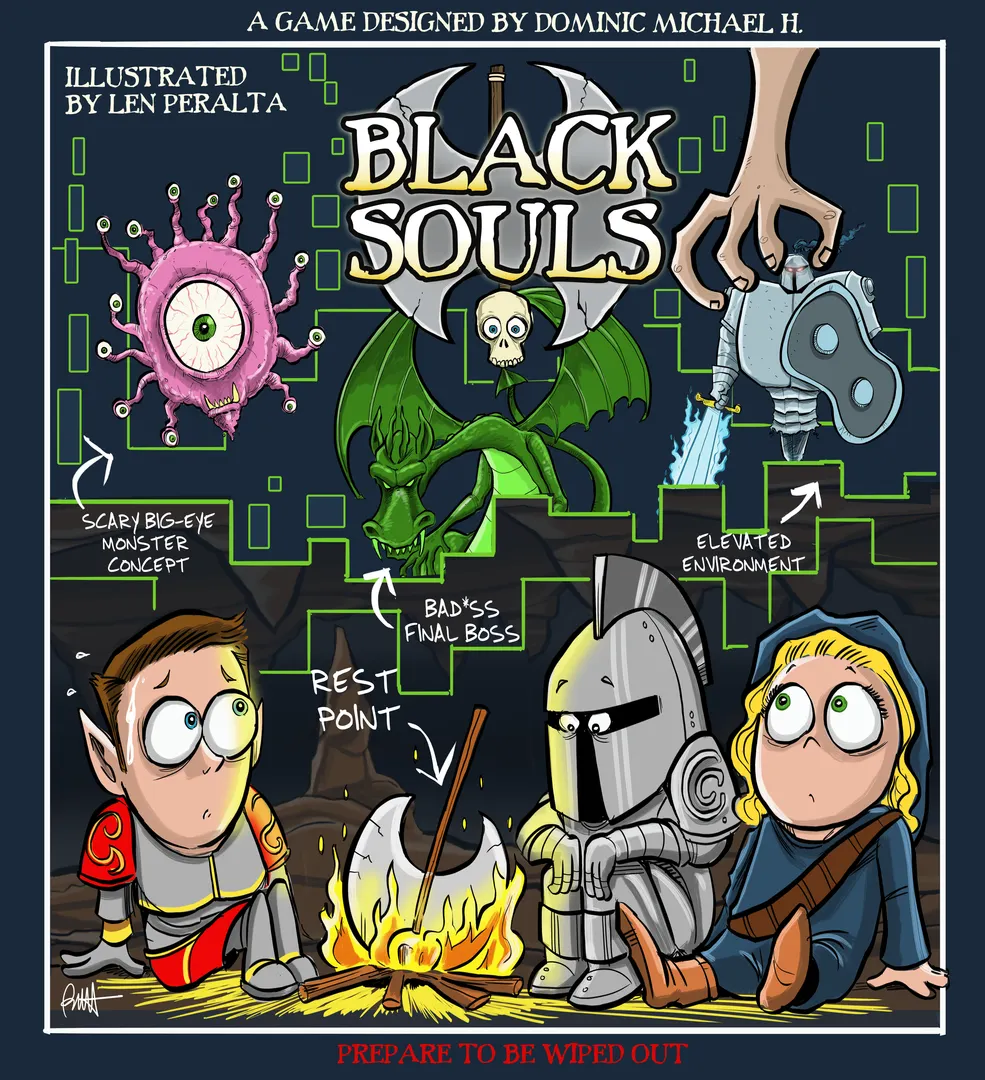
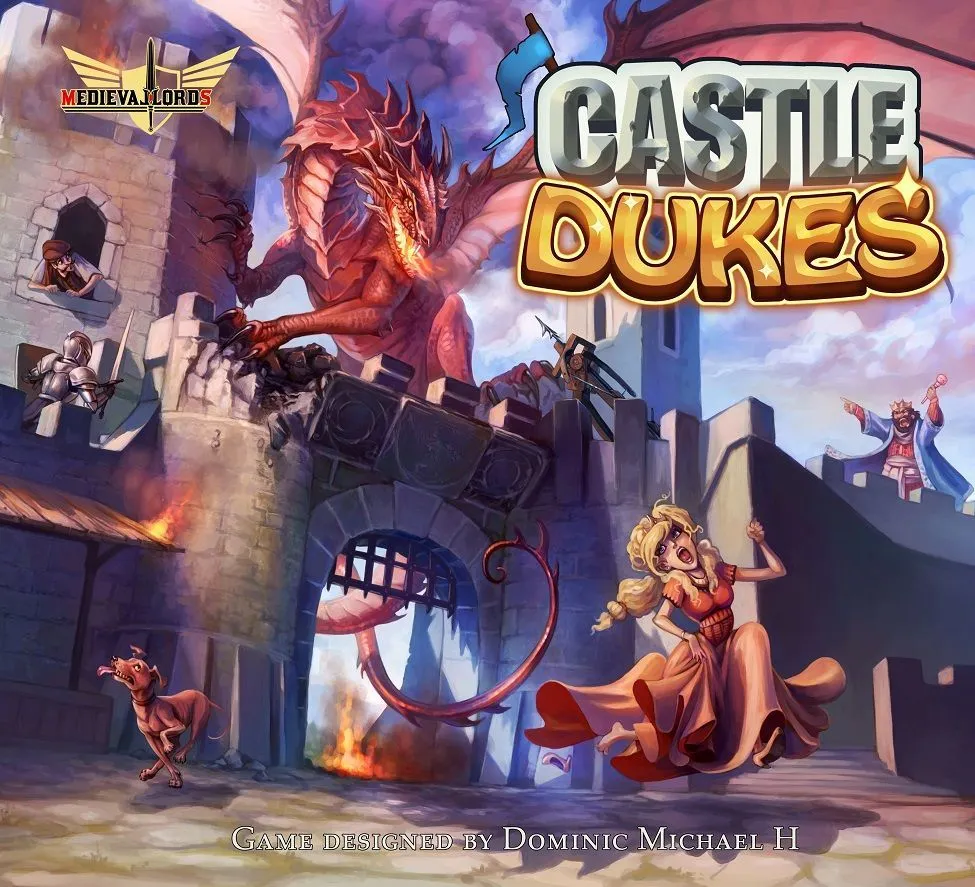
Black Souls est un jeu de société sorti en 2018 pour 1 à 6 joueurs, avec des parties de 45 à 60 minutes et à partir de 10 ans. Il a été conçu par Dominic Michael Huang et ses principales mécaniques sont Set Collection, Auction / Bidding et Tile Placement.

En anglais
Designer Inc's latest video game title Black Souls has achieved international success! Hailed as one of the toughest digital games ever, it has attracted millions of hardcore gamers. The secret behind this huge success lies not in just making an extremely difficult game. Anyone can do that. The true challenge lies in balancing it to be as difficult as possible, but still fair enough that the very best players can survive to the end. Alas, the game studio is heavily short staffed and the management is looking to hire one more Game Designer for developing more content in Black Souls. You have been given a once-in-a-lifetime opportunity to be hired by Designer Inc as a level designer, an integral part of Black Souls' development team! As one of the finalist candidates, you must prove your designing skills under the judging eyes of your future employers in an 'Early Beta Access' trial to create a level that best reflects the spirit of Black Souls - a very difficult, yet fair game. A group of seasoned playtesters will be sent to try out your carefully designed level, and provide feedback on whether they like or dislike it at the end of the run. If the level is too easy, they would not feel challenged at all. If it is too hard, they would all be killed and find it unfair. Who will be the final candidate to be inducted into the ranks of Designer Inc? This is a uniquely themed game - A game about designing a game! How To Play: All players begin the game with the same mix of party, randomly generated from a deck of Party Cards. The game is split into two phases - The Design phase, followed by the Gameplay phase. Place all tiles (also known as Assets) into the drawbag, then randomly take out an amount of Assets equal to the number of players and place them in the middle of the play area. This will be known as the Asset Pool. (Minimum Assets drawn from bag is 3, even if it is only 2 players) Players then secretly select one of their 6 Bid Cards (valued 1 - 6) and reveal them at the same time. In descending order with highest bid value first, players take turns to pick an Asset from the Pool. Players must immediately place their newly acquired Assets onto their own individual player boards. They can choose to place the Asset on any of the 3 available levels. When placing on levels 1 and 3, the Asset must be placed in the leftmost empty space of that level. If the player decides to put it on level 2, the Asset must be placed in the rightmost empty space of that level. On each Bid Card, there is also a secondary effect that will occur. Much of the game's strategies revolve around cleverly using these effects at the right time. The value 1 card allows a player to place a Tavern on the newly acquired Asset, while the value 2 card allows a player to immediately add 1 party member with the type based on a card draw from the Party deck. Value 3 allows one to take back all his previously played Bid Cards, including that card itself. When value 3 is played, all other players must place their newly acquired Asset face-down! Value 4 allows one to add one more Asset from the drawbag to the Pool when it is his turn to pick, and value 5 allows one to swap the positions of two previously placed Assets. Value 6 allows a player to place a Shrine on the newly acquired Asset. On a tie (more than 1 player playing the same value Bid Card), both players go last! (Even if they both played a 6) On top of that, their Bid Cards' secondary effects do not trigger too! Value 3's secondary ability will always trigger, even if tied. All players do have a Hack skill they can each use twice per game, which allows them to avoid losing the effect of secondary abilities during ties as well as keeping their bid numbers instead of going last. Between the tied players, the play order follows the previous turn. If player A and B tied, and player B had her turn before A in the previous turn, she will continue to have her turn before A in this new turn. If players tie in the first turn of the game, the play order ascends from the youngest first. It is important to note that Assets belong to three types - Cave, Dungeon, and Outdoor. Players will gain bonus points if they can chain and connect more Assets of the same type together. After 12 turns of Design phase, all players' boards should be filled completely with 12 Assets each. The Gameplay phase will then begin. This is when all players' parties start from their leftmost Asset on the first level, and work their way forward until the last Asset on the rightmost space of level 3. All Assets in the game have 4 values - The first value shows how many fighters will die in that Asset, the second shows how many mages will die, the third shows how many healers will die and the fourth shows a rating of how difficult the Asset is. Players choose to resolve only ONE of the first three values. Clever decision making is important to minimize death across the various classes in each party. To win the game, you must ensure that your party survives throughout the entire level to the very end (yes, the same level you designed earlier) Then you will gain bonus points for your dungeon's difficulty, as well as for every 3 dead members. Hence, the best players are the ones who can design very difficult levels but still get their party to the end. It is VERY common for entire parties to be completely wiped out though - afterall, this is Black Souls!
Selon le catalogue, Black Souls se joue de 1 à 6 personnes. Cette fourchette correspond au nombre de joueurs indiqué par l’éditeur : le jeu s’installe donc pour toute taille de groupe dans cette limite. La mise en place, certaines règles et le décompte peuvent varier selon l’effectif ; vérifiez la configuration exacte dans la règle de votre édition.
La durée indiquée pour Black Souls est de 45 à 60 minutes, selon l’estimation de l’éditeur pour une partie complète. La durée réelle dépend du groupe, de l’effectif et de la connaissance des règles : les premières parties sont plus longues, les groupes expérimentés terminent plus vite. Mise en place et explication des règles ne sont pas comprises.
Le catalogue indique Black Souls à partir de 10 ans. C’est la recommandation de l’éditeur ; elle tient compte de la lecture nécessaire, de la complexité des règles et des petits composants, pas seulement du thème. Les plus jeunes peuvent souvent participer avec l’aide d’un adulte : vérifiez l’âge indiqué sur votre édition et tenez compte de l’expérience de votre groupe.
Black Souls obtient une note de complexité de 2,0 sur 5 auprès des joueurs de BoardGameGeek, ce qui en fait un jeu plutôt léger. Cette note reflète la quantité de règles, de planification et de décisions qu’exige une partie typique. Prévoyez une explication plus longue pour les jeux exigeants et utilisez un guide de préparation avant la soirée.
Black Souls appartient à ces catégories : Video Game Theme, Exploration et Adventure. Ses principales mécaniques sont Set Collection, Auction / Bidding et Tile Placement. Les catégories décrivent le thème et l’univers d’un jeu, tandis que les mécaniques décrivent ce que les joueurs font réellement pendant leur tour. Chaque mécanique mène à une page du catalogue avec des jeux similaires.
Les auteurs crédités pour Black Souls sont : Dominic Michael Huang. Ces crédits proviennent des données publiées du jeu et désignent les personnes responsables de sa conception, et non les illustrateurs ou les éditeurs. Les pages d’auteurs sur MeepleRules regroupent les autres titres des mêmes auteurs, ce qui est utile lorsqu’un jeu vous plaît et que vous en cherchez de similaires.
Le catalogue présente Black Souls comme un jeu de base. Il se joue seul avec le matériel contenu dans la boîte et ne nécessite aucun autre titre. Les extensions, s’il en existe, y ajoutent du contenu ou des règles et sont répertoriées séparément dans le catalogue, avec un lien vers ce jeu de base.