
- Rang BGG
- BGG #8 942
- Note BGG
- 7,6
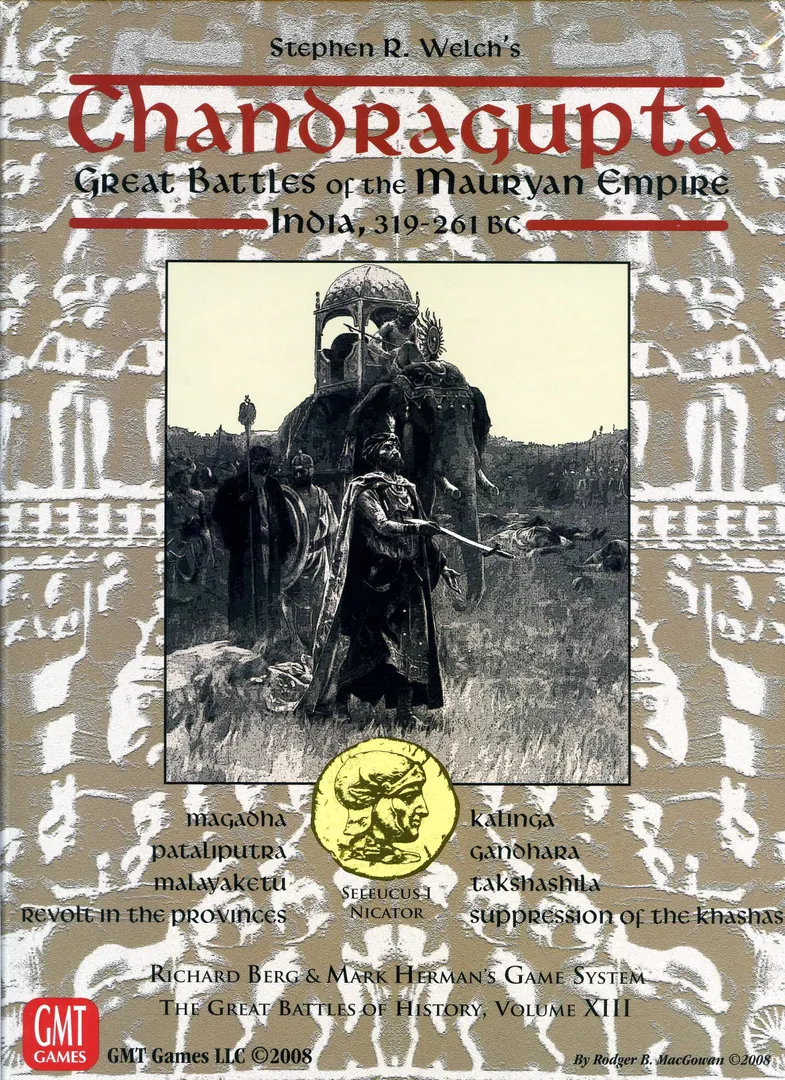
Chandragupta: Great Battles of the Mauryan Empire – India, 319-261 BC
- 2 joueurs
- 240 min
- Complexité 3,8/5
- 2008

Extension de Chariots of Fire: Warfare in the Bronze Age, 2300-1200 B.C.
Aide aux règles de Chariots of Fire: Chariots of the Gods
Des explications claires des tours, effets de cartes et situations litigieuses, avec des références aux sources officielles et un historique des questions sauvegardé.
Que voulez-vous savoir ?
Les réponses viennent du livret officiel, avec la page à vérifier.
Chariots of Fire: Chariots of the Gods est une extension de Chariots of Fire: Warfare in the Bronze Age, 2300-1200 B.C. pour 1 à 4 joueurs. Il a été conçu par Stephen R. Welch et ses principales mécaniques sont Dice Rolling, Hexagon Grid et Simulation.





En anglais
Chariots of the Gods (CG) simulates tactical-level combat in the period of India’s ancient Vedic era. Covering a period extending from roughly 1700 to 800 BCE, the age of Vedic India was one of sweeping battles between great kingdoms for supremacy over northern India. This was the age of the chariot-knight, whose prowess with the compound bow from his speeding war-car inspired legends. Often the bravery of the charioteer, whose skill in commanding the vehicle safely through the chaos and danger of the ancient battlefield was no less legendary. Given the heroic nature of the age, the Chariots of Fire Heroes rules have been expanded to portray the fighting styles in the Vedic poems. All scenarios feature Heros and Heroic Challenges. Rather than Heroes engaging in personal combat only on foot, the Vedic heroes duel each other from a moving chariot wielding their bows. The Hero counter represents not only the Hero, but his Charioteer, and his Chattra (banner) all of which may be hit by his opponent. CG introduces three new unit types: Javelin Infantry: Javelin/light spear armed troops with no armor and no missile capability, fighting in loose formations. These units provide the shock power for most of the tribes. Dismounted Chariots: Noted on the reverse side of the CH-2 counter, these are the knights on foot rather than in their chariots. This mode is mostly useful for traversing rivers and other non-chariot favorable terrain. Lance Armed Cavalry: Early light cavalry armed with lances with limited Shock capability. There are special rules for river crossings, strongholds, and given the coalition type armies in the larger battles, rules for Tribal Flight. Battles included in the Module Hariyupiya River (ca. 1660), the Anu vs. the Vrcivans Invasion of the Purus (ca. 1540), the Puru-Bharata vs. the Turvasha-Yadu Battle of the Dasyus (ca. 1500), the Puru-Bharata vs. the Dasyus Khandava Expedition (ca. 1415) the Bharata vs. the Kikatas Parushni River (ca. 1400), Tritsu and Bharata vs. the Kings of the Puru Confederation Yamuna River (ca. 1400), Tritsu and Bharata vs. the Kings of the Puru Confederation The typical tribal army consists of mixture of Chariots, bow armed infantry, and javelin armed infantry with minimal shock capability. The Vrcivans, Dasyu, and Kikatas are infantry armies composed of Shock or Barbarian infantry along with bow armed infantry. The battles against the Daysu and Kikatas play out on rough terrain which tends to neutralize the Chariots mobility. The Vrcivans, on the other hand, need to force their way across a river and then contest the chariots in open terrain. The other three battles are set piece affairs occurring on mostly chariot friendly terrain showcasing the full capabilities of that weapons system and the dueling Heroes of legend. The Hariyupiya River battle is on the small side, while the Parushni is the largest, comparable to The CoF Battle of Senzar. The remainder are of medium size like Astarpa River in CoF . —description from the publisher
Selon le catalogue, Chariots of Fire: Chariots of the Gods se joue de 1 à 4 personnes. Cette fourchette correspond au nombre de joueurs indiqué par l’éditeur : le jeu s’installe donc pour toute taille de groupe dans cette limite. La mise en place, certaines règles et le décompte peuvent varier selon l’effectif ; vérifiez la configuration exacte dans la règle de votre édition.
Chariots of Fire: Chariots of the Gods appartient à ces catégories : Wargame, Ancient et Expansion for Base-game. Ses principales mécaniques sont Dice Rolling, Hexagon Grid et Simulation. Les catégories décrivent le thème et l’univers d’un jeu, tandis que les mécaniques décrivent ce que les joueurs font réellement pendant leur tour. Chaque mécanique mène à une page du catalogue avec des jeux similaires.
Les auteurs crédités pour Chariots of Fire: Chariots of the Gods sont : Stephen R. Welch. Ces crédits proviennent des données publiées du jeu et désignent les personnes responsables de sa conception, et non les illustrateurs ou les éditeurs. Les pages d’auteurs sur MeepleRules regroupent les autres titres des mêmes auteurs, ce qui est utile lorsqu’un jeu vous plaît et que vous en cherchez de similaires.
Le catalogue présente Chariots of Fire: Chariots of the Gods comme une extension de Chariots of Fire: Warfare in the Bronze Age, 2300-1200 B.C.. Les extensions ajoutent du contenu, des règles ou des scénarios au jeu de base et ne se jouent généralement pas seules : il vous faut donc Chariots of Fire: Warfare in the Bronze Age, 2300-1200 B.C. pour l’utiliser. Vérifiez que votre édition de Chariots of Fire: Warfare in the Bronze Age, 2300-1200 B.C. est compatible, car certaines extensions ont été révisées d’une édition à l’autre.