
- Rang BGG
- BGG #18 635
- Note BGG
- 6,5
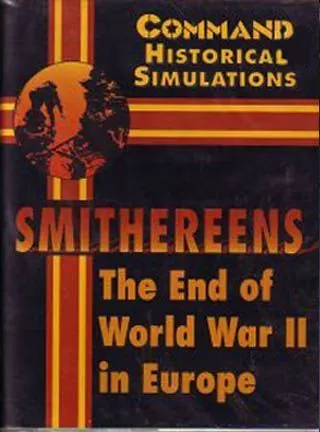
Smithereens: The End of World War II in Europe
- 1–3 joueurs
- 360 min
- Complexité 2,3/5
- 1993
2005
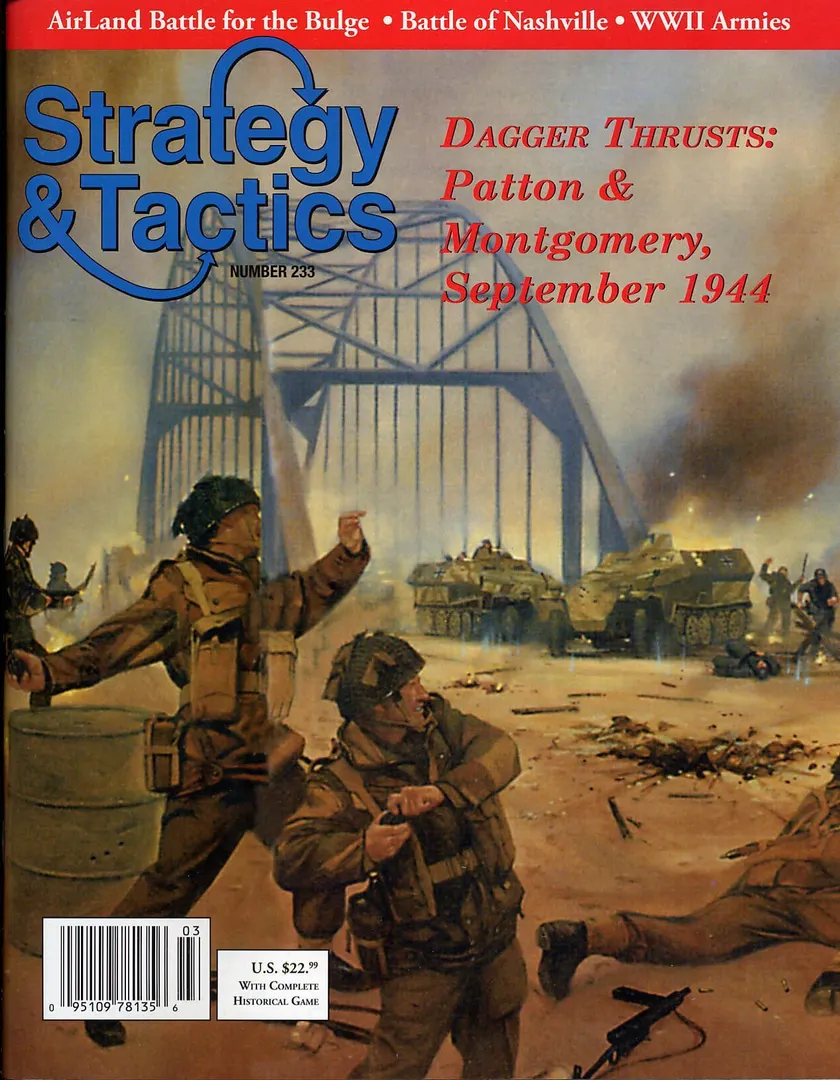
Aide aux règles de Dagger Thrusts: Patton & Montgomery, September 1944
Des explications claires des tours, effets de cartes et situations litigieuses, avec des références aux sources officielles et un historique des questions sauvegardé.
Pour 1 joueur
Que voulez-vous savoir ?
Les réponses viennent du livret officiel, avec la page à vérifier.
Dagger Thrusts: Patton & Montgomery, September 1944 est un jeu de société sorti en 2005 pour 1 à 2 joueurs, avec des parties de 180 minutes et à partir de 12 ans. Il a été conçu par Ty Bomba et ses principales mécaniques sont Secret Unit Deployment, Hexagon Grid et Simulation.
En anglais
This is low-to intermediate-complexity, two-player, examination of the historic alternative to Montgomery's ill-fated Operation Market Garden. Instead of his left-jab through lowland Holland to the Rhine, we have Patton's proposed right-hook, starting at Metz and swinging north and east toward the Ruhr for a war-winning knockout blow. Or, as an alternative within an alternative, the Allied player may try for a more conservative push straight east to the Rhine, there to create a bridgehead over that German river, thereby likely advancing the advent of V-E Day by at least three or four months. As soon as you begin to game Patton's alternative to Montgomery's all or nothing plan, it becomes clear what a huge opportunity Eisenhower missed by backing the wrong subordinate. That is, for the British field marshal's plan to have succeeded, it really did have to go all the way, or at least get across the Rhine in some significant way. Failing short of both the Rhine and the Ruhr, as happened historically, meant a month had been wasted and a lot of lives lost only to create a salient to nowhere. Had Patton's idea been tried, only to fail as badly, a salient of that same size – but jutting north into the Rhineland from a base at Metz – would've done much more for the Allied cause. We've broadened the appeal of this design beyond those who enjoy alternative history by including a second, historical, scenario. At first we were only going to cover the actual Market-Garden portion of Montgomery's operations in September 1944. It quickly became apparent, however, portrayed at these time, space and unit scales, such a game would be a dud, with a map only nine hexes long and three wide. So we broadened the thing's shoulders by expanding the coverage to take in all Montgomery's possibilities that fateful month. So now you can choose a straight-up historic approach, or you can have alternative history within your actual history. Each hex on the map equals seven miles from side to opposite side. Each game turn represents three days. Playing pieces represent divisions, brigades, combat commands, Kampfgruppen and regiments of various kinds of infantry and armor formations, each containing from about 3,000 to 14,000 men and 50 to 400 or so armored fighting vehicles.
Selon le catalogue, Dagger Thrusts: Patton & Montgomery, September 1944 se joue de 1 à 2 personnes. Cette fourchette correspond au nombre de joueurs indiqué par l’éditeur : le jeu s’installe donc pour toute taille de groupe dans cette limite. La mise en place, certaines règles et le décompte peuvent varier selon l’effectif ; vérifiez la configuration exacte dans la règle de votre édition.
La durée indiquée pour Dagger Thrusts: Patton & Montgomery, September 1944 est de 180 minutes, selon l’estimation de l’éditeur pour une partie complète. La durée réelle dépend du groupe, de l’effectif et de la connaissance des règles : les premières parties sont plus longues, les groupes expérimentés terminent plus vite. Mise en place et explication des règles ne sont pas comprises.
Le catalogue indique Dagger Thrusts: Patton & Montgomery, September 1944 à partir de 12 ans. C’est la recommandation de l’éditeur ; elle tient compte de la lecture nécessaire, de la complexité des règles et des petits composants, pas seulement du thème. Les plus jeunes peuvent souvent participer avec l’aide d’un adulte : vérifiez l’âge indiqué sur votre édition et tenez compte de l’expérience de votre groupe.
Dagger Thrusts: Patton & Montgomery, September 1944 obtient une note de complexité de 2,6 sur 5 auprès des joueurs de BoardGameGeek, ce qui en fait un jeu plutôt léger. Cette note reflète la quantité de règles, de planification et de décisions qu’exige une partie typique. Prévoyez une explication plus longue pour les jeux exigeants et utilisez un guide de préparation avant la soirée.
Dagger Thrusts: Patton & Montgomery, September 1944 appartient à ces catégories : Wargame et World War II. Ses principales mécaniques sont Secret Unit Deployment, Hexagon Grid et Simulation. Les catégories décrivent le thème et l’univers d’un jeu, tandis que les mécaniques décrivent ce que les joueurs font réellement pendant leur tour. Chaque mécanique mène à une page du catalogue avec des jeux similaires.
Les auteurs crédités pour Dagger Thrusts: Patton & Montgomery, September 1944 sont : Ty Bomba. Ces crédits proviennent des données publiées du jeu et désignent les personnes responsables de sa conception, et non les illustrateurs ou les éditeurs. Les pages d’auteurs sur MeepleRules regroupent les autres titres des mêmes auteurs, ce qui est utile lorsqu’un jeu vous plaît et que vous en cherchez de similaires.
Le catalogue présente Dagger Thrusts: Patton & Montgomery, September 1944 comme un jeu de base. Il se joue seul avec le matériel contenu dans la boîte et ne nécessite aucun autre titre. Les extensions, s’il en existe, y ajoutent du contenu ou des règles et sont répertoriées séparément dans le catalogue, avec un lien vers ce jeu de base.