

- Rang BGG
- BGG #660
- Note BGG
- 7,6
Labyrinth: The War on Terror, 2001 – ?
- 1–2 joueurs
- 180 min
- Complexité 3,7/5
- 2010
2011
Aide aux règles de Democracy under Siege
Des explications claires des tours, effets de cartes et situations litigieuses, avec des références aux sources officielles et un historique des questions sauvegardé.
Pour 2 joueurs
Que voulez-vous savoir ?
Les réponses viennent du livret officiel, avec la page à vérifier.
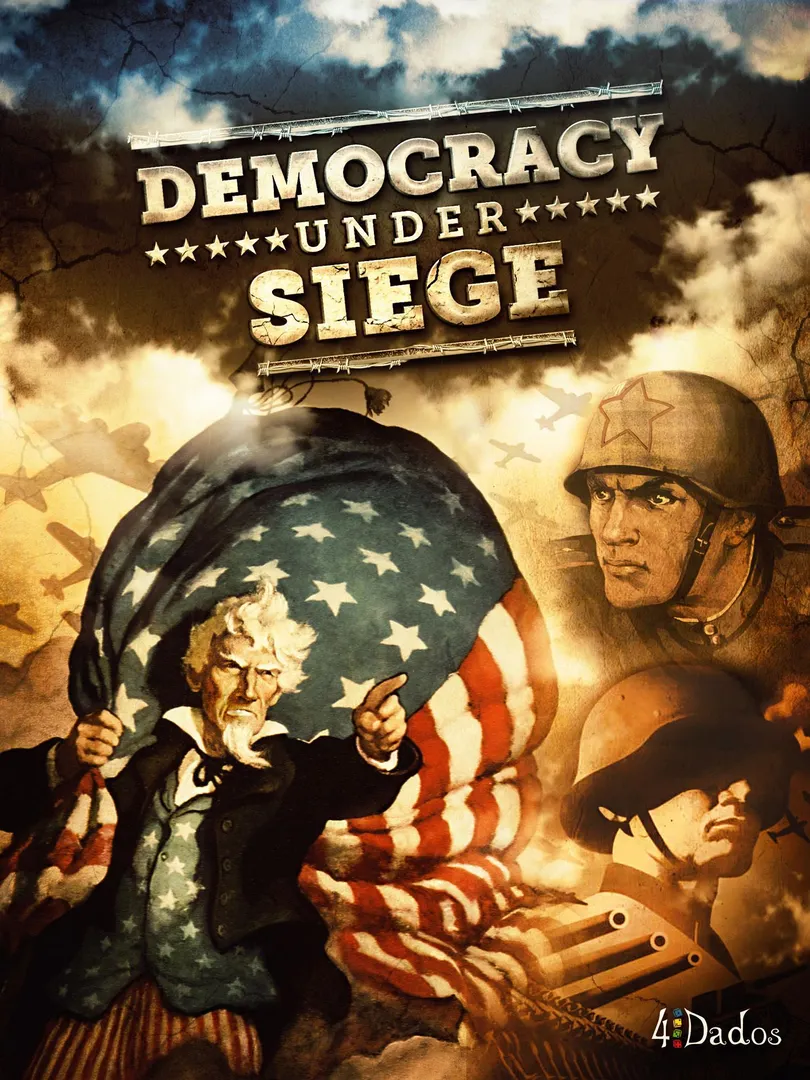
Democracy under Siege est un jeu de société sorti en 2011 pour 2 à 3 joueurs, avec des parties de 150 à 240 minutes et à partir de 12 ans. Il a été conçu par Luca Cammisa et ses principales mécaniques sont Area Majority / Influence, Simulation et Action Points.




En anglais
Dateline: Germany, 1933 Jan. 30: Hindenburg names Hitler Chancellor. Feb. 27: The burning of the Reichstag. Hitler blames his political opponents and enacts repressive laws. Mar. 5: The Nazi Party wins the Federal elections amid a climate of fear and intimidation. From this point on, with a precise and constant rhythm, Hitler dismantles all of the democratic institutions of the fragile Weimar Republic and inaugurates a reign of terror, gradually establishing a ruthless and violent dictatorial regime. The above is history, but what would have happened if instead of bringing Europe into a maelstrom of war, the infamous Austrian corporal had abandoned his plan of global domination and taken the path of peace? Would World War II still have broken out? Or would the Nazi hierarchy and German industry still have pushed the Führer to war with Poland? What would the dream of a Greater Germany have been without Austria, Czechoslovakia, and the other German territorial claims? Would the Western plutocrats or the Soviet colossus have fought the fascist dictatorship anyway and nevertheless inexorably triggered global conflict? Democracy under Siege is an interactive simulation enabling you to explore all such questions. A card-driven strategy game, it reproduces the geopolitical conflicts and political struggles that led to the Second World War. The game covers the period 1933-1940 and is designed for two or three players. Each takes the role of one of the three ideologies — Democracy, Nazism and Communism — that struggled for power during the timeline of the game. (When played by two players, the two Ideologies exclusively under player control are Democracy and Nazism, while control of Communism alternates between the two players from turn to turn according to specific rules.) Each game turn represents one year and is divided into three or four rounds. Players choose one political action and one event per round and attempt to perform the political action by rolling a die and applying some modifiers. They can affect the outcomes of their attempts by expending the ideology's political prestige. Events are activated immediately before the political actions are attempted; no die roll is required. If the political action succeeds, the card effects are applied accordingly. In any case, even when the attempt is unsuccessful, the political action cards played provide a varying number of political points (PP) that can later be expended by the players to perform activities. After political actions, players perform their action round with the PP provided by political action cards. Players can influence the political allegiance of minor countries, exploit the economic resources belonging either to minor nations or to their controlled powers, recruit and activate coup cells to attempt coups d'etat to overthrow a minor country regime, send military forces to local conflicts or intervene in a civil war in a minor nation. All of these activities, as well as the effects of successful political actions, can bring victory points (VP) when the political allegiances of minor countries come under the influence or the control of Ideologies, or when territories or nations are conquered. At the end of each round, players check the outcomes of coup attempts, then proceed to a new round. During the clean-up phase at the end of each turn, players perform end-turn checks and calculate the production of military resources (MR) by the exploitation of economic resources claimed on the map. MR are put in the ideologies' force pool and expended to maintain the minor nations allegiances. The remaining MR provide additional VP and can be employed during the subsequent turns to intervene in local conflicts and civil wars. Democracy under Siege offers an accurate and detailed historical context, supported by 108 strategy cards. Players exploit historical events and political actions to achieve political supremacy. Wars are simulated by an abstract combat system that allows players to intervene and influence their outcomes. The main concepts reproduced in the game are the ideological struggles among the major powers, the race for armaments ahead of World War II and the buildup of a network of diplomatic links with minor nations. All of these elements combine to determine victory.
Selon le catalogue, Democracy under Siege se joue de 2 à 3 personnes. Cette fourchette correspond au nombre de joueurs indiqué par l’éditeur : le jeu s’installe donc pour toute taille de groupe dans cette limite. La mise en place, certaines règles et le décompte peuvent varier selon l’effectif ; vérifiez la configuration exacte dans la règle de votre édition.
La durée indiquée pour Democracy under Siege est de 150 à 240 minutes, selon l’estimation de l’éditeur pour une partie complète. La durée réelle dépend du groupe, de l’effectif et de la connaissance des règles : les premières parties sont plus longues, les groupes expérimentés terminent plus vite. Mise en place et explication des règles ne sont pas comprises.
Le catalogue indique Democracy under Siege à partir de 12 ans. C’est la recommandation de l’éditeur ; elle tient compte de la lecture nécessaire, de la complexité des règles et des petits composants, pas seulement du thème. Les plus jeunes peuvent souvent participer avec l’aide d’un adulte : vérifiez l’âge indiqué sur votre édition et tenez compte de l’expérience de votre groupe.
Democracy under Siege obtient une note de complexité de 3,7 sur 5 auprès des joueurs de BoardGameGeek, ce qui en fait un jeu de complexité moyenne. Cette note reflète la quantité de règles, de planification et de décisions qu’exige une partie typique. Prévoyez une explication plus longue pour les jeux exigeants et utilisez un guide de préparation avant la soirée.
Democracy under Siege appartient à ces catégories : Wargame, Print & Play et Political. Ses principales mécaniques sont Area Majority / Influence, Simulation et Action Points. Les catégories décrivent le thème et l’univers d’un jeu, tandis que les mécaniques décrivent ce que les joueurs font réellement pendant leur tour. Chaque mécanique mène à une page du catalogue avec des jeux similaires.
Les auteurs crédités pour Democracy under Siege sont : Luca Cammisa. Ces crédits proviennent des données publiées du jeu et désignent les personnes responsables de sa conception, et non les illustrateurs ou les éditeurs. Les pages d’auteurs sur MeepleRules regroupent les autres titres des mêmes auteurs, ce qui est utile lorsqu’un jeu vous plaît et que vous en cherchez de similaires.
Le catalogue présente Democracy under Siege comme un jeu de base. Il se joue seul avec le matériel contenu dans la boîte et ne nécessite aucun autre titre. Les extensions, s’il en existe, y ajoutent du contenu ou des règles et sont répertoriées séparément dans le catalogue, avec un lien vers ce jeu de base.