
- Rang BGG
- BGG #10 978
- Note BGG
- 6,3
Talat
- 2–3 joueurs
- 33 min
- Complexité 2,0/5
- 2008
1968
Aide aux règles de Djambi
Des explications claires des tours, effets de cartes et situations litigieuses, avec des références aux sources officielles et un historique des questions sauvegardé.
Pour 3 joueurs
Que voulez-vous savoir ?
Les réponses viennent du livret officiel, avec la page à vérifier.
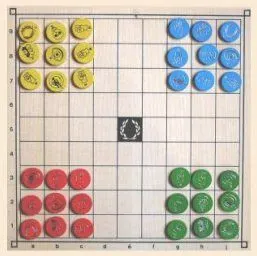
Djambi est un jeu de société sorti en 1968 pour 3 à 4 joueurs et avec des parties de 60 minutes. Il a été conçu par Jean Anesto et ses principales mécaniques sont Square Grid, Grid Movement et Pattern Movement.




En anglais
Djambi, or Chess of Machiavelli is a game for 4 players that can be played with only 3. There also exists a 5-player version called Pentachiavel. It is a game of treason. Each player is the leader of a political party composed of 9 pieces: 1 Leader 1 Journalist 1 Assassin 1 Provoker 1 Necromobile 4 Activists who roam a 9x9square board where all squares are the same except the central one, called The Labyrinth. All counters move as the Queen in Chess, except the Activist who moves the same but only for two squares. A piece cannot move through another piece, whether alive or dead. Object of the game: gaining absolute power, that is killing all other leaders. "To do this, all players have the weapons of the actual politics: manipulation, provocation, activism, recuperation, scandal and political crime. The course to power is not a gala dinner, so all pieces can be physically eliminated. In politics, a dead is as encumbrant as a living person, so all dead pieces are kept on the board, face down." Dead pieces have no color. The Labyrinth is the basement of the Legal Power, the road to Absolute Power. Only a Leader may stay on this square. It makes its parti play after each opponent. But there, it can be killed by nearly all other pieces. The Leader: can kill any piece on the board by taking its place. The taken piece is placed on any other adjacent free square of the board, dead. The Journalist kills a piece that is adjacent to any one of the 4 squares that share a common border with its square. It does this just after having moved. The body lies dead where it was killed. He must move at least one square before killing. The Assassin, can kill any piece by taking its place. The piece is placed, dead on the place the Assassin was before moving. The Provoker, mover of the living: can move any living piece if it takes its position. The taken piece is placed on any other free square of the board, alive. The Necromobile, mover of the dead: can move any dead piece if it takes its position. The taken piece is placed on any other free square of the board, dead. The Activists can kill a piece by taking its place. The taken piece is placed on any other free square of the board, dead. They CAN'T kill a leader in The Labyrinth. These are most of the rules. You can find the rest (in French, sorry) at the link below.
Selon le catalogue, Djambi se joue de 3 à 4 personnes. Cette fourchette correspond au nombre de joueurs indiqué par l’éditeur : le jeu s’installe donc pour toute taille de groupe dans cette limite. La mise en place, certaines règles et le décompte peuvent varier selon l’effectif ; vérifiez la configuration exacte dans la règle de votre édition.
La durée indiquée pour Djambi est de 60 minutes, selon l’estimation de l’éditeur pour une partie complète. La durée réelle dépend du groupe, de l’effectif et de la connaissance des règles : les premières parties sont plus longues, les groupes expérimentés terminent plus vite. Mise en place et explication des règles ne sont pas comprises.
Djambi obtient une note de complexité de 2,6 sur 5 auprès des joueurs de BoardGameGeek, ce qui en fait un jeu plutôt léger. Cette note reflète la quantité de règles, de planification et de décisions qu’exige une partie typique. Prévoyez une explication plus longue pour les jeux exigeants et utilisez un guide de préparation avant la soirée.
Djambi appartient à ces catégories : Abstract Strategy, Political et Negotiation. Ses principales mécaniques sont Square Grid, Grid Movement et Pattern Movement. Les catégories décrivent le thème et l’univers d’un jeu, tandis que les mécaniques décrivent ce que les joueurs font réellement pendant leur tour. Chaque mécanique mène à une page du catalogue avec des jeux similaires.
Les auteurs crédités pour Djambi sont : Jean Anesto. Ces crédits proviennent des données publiées du jeu et désignent les personnes responsables de sa conception, et non les illustrateurs ou les éditeurs. Les pages d’auteurs sur MeepleRules regroupent les autres titres des mêmes auteurs, ce qui est utile lorsqu’un jeu vous plaît et que vous en cherchez de similaires.
Le catalogue présente Djambi comme un jeu de base. Il se joue seul avec le matériel contenu dans la boîte et ne nécessite aucun autre titre. Les extensions, s’il en existe, y ajoutent du contenu ou des règles et sont répertoriées séparément dans le catalogue, avec un lien vers ce jeu de base.