- Note BGG
- 6,9
Florenza: Captains of Fortune
- 2–5 joueurs
- 200 min
- Complexité 1,5/5
- 2014
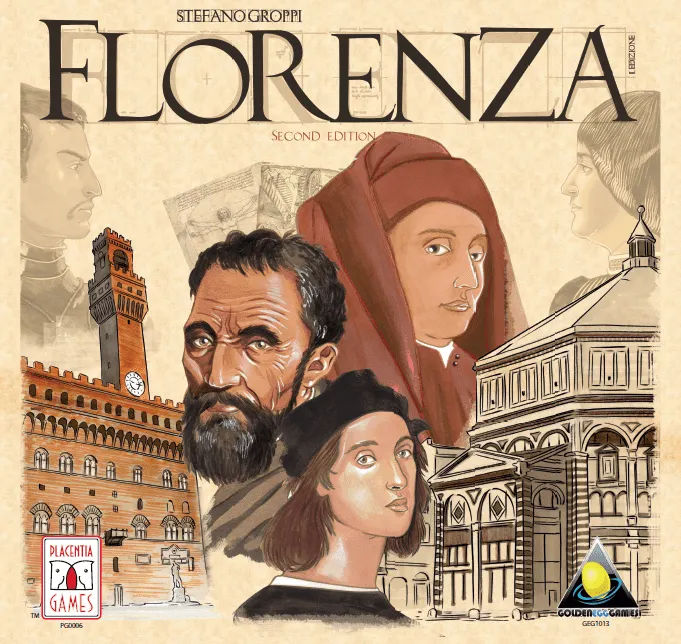
2010
Aide aux règles de Florenza
Des explications claires des tours, effets de cartes et situations litigieuses, avec des références aux sources officielles et un historique des questions sauvegardé.
Pour 2 joueurs
Que voulez-vous savoir ?
Les réponses viennent du livret officiel, avec la page à vérifier.
Florenza est un jeu de société sorti en 2010 pour 2 à 5 joueurs, avec des parties de 90 à 120 minutes et à partir de 14 ans. Il a été conçu par Stefano Groppi et ses principales mécaniques sont Worker Placement.


En anglais
In Florenza, the players are the heads of the most powerful families in Florenza during the Renaissance period. The goal of the game is to become the most famous patron of the arts by hiring the most famous artists of the period and financing their works. Each player can commission artworks in his own district, the Cathedral, or in the civic buildings of the city. Each artwork requires money and resources to complete. To earn the money and resources the artists need, the players send their workers to labor in various workshops, possibly even in their opponents’ districts. Additional workers can be earned by offering charity to the church. During the game, players will earn prestige points, primarily by completing artworks. Prestige points can be spent during the game, but at the end of the game they will be the player’s primary source of victory points. All of the characters in the game are real historical figures that lived and worked in Italy during the Renaissance. Most of them worked in Florence. All of the buildings in the game were real Renaissance workshops. The artworks the players can complete include the masterpieces of some of the most famous artists in the world. Note from the designers directly from the rulebook: "We apologize if we included some characters in the game who never worked in Florence during the Renaissance, but we wanted to include all of the most important artists (in our opinion) from that golden age of Italian art and culture. Michelangelo, for example, left an important mark on the history of the city—and the Renaissance period—even if he was only in Florence for a short time. We also added some portraits of military leaders (created by Ivan Zoni) to the rulebook. They are not involved in the game, but they were influential members of public life during this era. The names of the buildings, parts of the Cathedral, and the workshops are in the literal form they had in Italy during the 1400-1600 period. Some of them are unchanged in the modern Italian language, some have changed a little, and others have completely disappeared or remain only in some dialects. We chose to maintain those words, without translating them into a language that the real artists didn’t know. We hope you agree with our choice, and we hope you have a good time playing Florenza!"
Selon le catalogue, Florenza se joue de 2 à 5 personnes. Cette fourchette correspond au nombre de joueurs indiqué par l’éditeur : le jeu s’installe donc pour toute taille de groupe dans cette limite. La mise en place, certaines règles et le décompte peuvent varier selon l’effectif ; vérifiez la configuration exacte dans la règle de votre édition.
La durée indiquée pour Florenza est de 90 à 120 minutes, selon l’estimation de l’éditeur pour une partie complète. La durée réelle dépend du groupe, de l’effectif et de la connaissance des règles : les premières parties sont plus longues, les groupes expérimentés terminent plus vite. Mise en place et explication des règles ne sont pas comprises.
Le catalogue indique Florenza à partir de 14 ans. C’est la recommandation de l’éditeur ; elle tient compte de la lecture nécessaire, de la complexité des règles et des petits composants, pas seulement du thème. Les plus jeunes peuvent souvent participer avec l’aide d’un adulte : vérifiez l’âge indiqué sur votre édition et tenez compte de l’expérience de votre groupe.
Florenza obtient une note de complexité de 3,7 sur 5 auprès des joueurs de BoardGameGeek, ce qui en fait un jeu de complexité moyenne. Cette note reflète la quantité de règles, de planification et de décisions qu’exige une partie typique. Prévoyez une explication plus longue pour les jeux exigeants et utilisez un guide de préparation avant la soirée.
Florenza appartient à ces catégories : Economic, City Building et Renaissance. Ses principales mécaniques sont Worker Placement. Les catégories décrivent le thème et l’univers d’un jeu, tandis que les mécaniques décrivent ce que les joueurs font réellement pendant leur tour. Chaque mécanique mène à une page du catalogue avec des jeux similaires.
Les auteurs crédités pour Florenza sont : Stefano Groppi. Ces crédits proviennent des données publiées du jeu et désignent les personnes responsables de sa conception, et non les illustrateurs ou les éditeurs. Les pages d’auteurs sur MeepleRules regroupent les autres titres des mêmes auteurs, ce qui est utile lorsqu’un jeu vous plaît et que vous en cherchez de similaires.
Le catalogue présente Florenza comme un jeu de base. Il se joue seul avec le matériel contenu dans la boîte et ne nécessite aucun autre titre. Les extensions, s’il en existe, y ajoutent du contenu ou des règles et sont répertoriées séparément dans le catalogue, avec un lien vers ce jeu de base.