- Note BGG
- 6,8
Gulf, Mobile & Ohio: Expansion #1
- 3–5 joueurs
- 75 min
- Complexité 3,0/5
- 2009
2008
Aide aux règles de Gulf, Mobile & Ohio
Des explications claires des tours, effets de cartes et situations litigieuses, avec des références aux sources officielles et un historique des questions sauvegardé.
Pour 3 joueurs
Que voulez-vous savoir ?
Les réponses viennent du livret officiel, avec la page à vérifier.
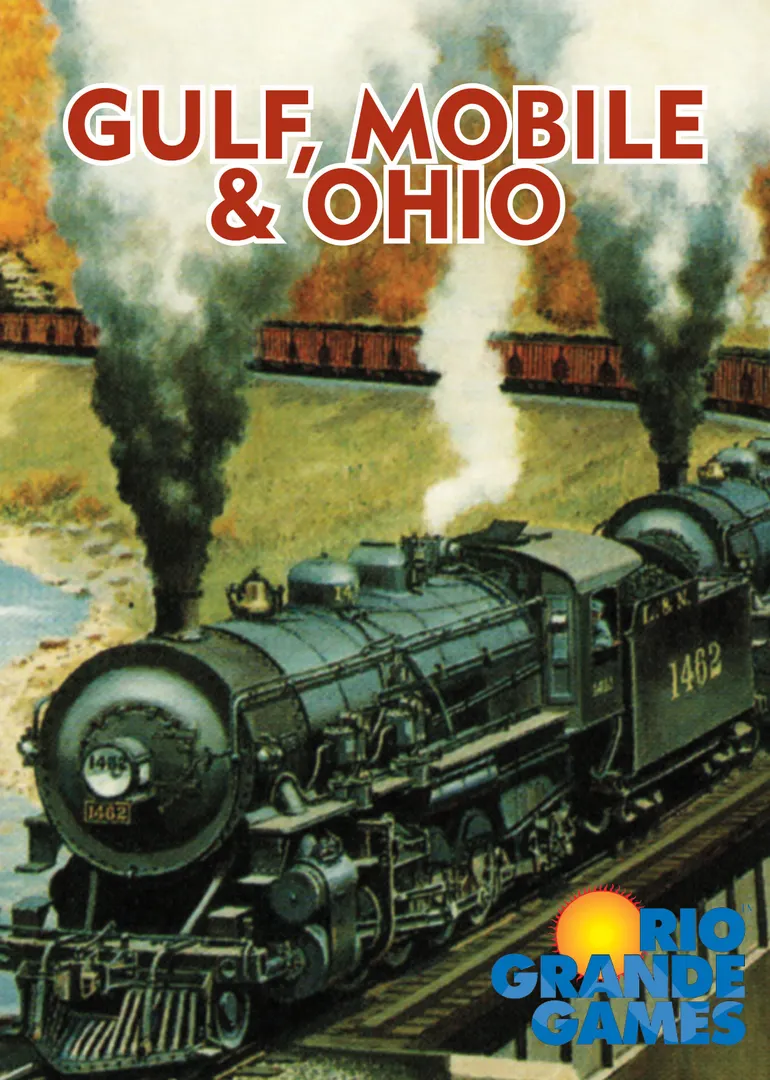
Gulf, Mobile & Ohio est un jeu de société sorti en 2008 pour 3 à 5 joueurs et avec des parties de 45 à 60 minutes. Il a été conçu par John Bohrer et ses principales mécaniques sont Auction / Bidding, Income et Hexagon Grid.



En anglais
In Gulf, Mobile & Ohio, the third entry in Winsome Games's Historic Railroads System, players build railroads in the South that existed between 1830-1860, with the game board featuring cities from Richmond to New Orleans, and from Memphis to Savannah. Twenty-three different railroad lines exist in the game, each represented by two shares of stock: a charter share for the player who founds this railroad, and a common share that might be auctioned later in the game. Eight railroads are designated as starting lines, and initially only the shares for these eight lines are available to players. Railroad lines will be represented on the game board with wooden cubes that come in six colors, with the number of cubes ranging from 6 to 32. On a turn, a player takes one of four actions: • Charter a railroad: The active player starts an auction for the charter share of a railroad that hasn't yet been founded. Players place bids for this share, with the winner claiming this charter share, placing a cube of the color that's most common on it, then using the money spent in the auction to place additional cubes on the game board at a cost of $3/cube. One cube of the same color is placed in the railroad's starting city (and sometimes you have a choice of starting city), and additional cubes are placed on track intersections and in connecting cities. You must bid enough that you can place this line in at least two cities. If the color of the cube that's most available in the stock is already in this city (thanks to railroad lines previously built), then the active player can't put this line up for auction. Whenever you build or expand railroad lines, you can't place cubes so that two lines of the same color touch. If a white cube has been placed in Grenada, for example, you can't found the MC or M&T lines in that city if white is the most common color of cubes. • Auction a common share: Once the charter share of a line has been acquired, the active player can start an auction for the common share of that line, with the winning bid once again being used to expand that line with additional cubes of that railroad's color, although in this case you have no building requirement and a winning bid of $0 is allowed. After each auction, a "common share" tracking marker is moved, and after the second such movement, players receive dividends from the bank for the shares they hold: $5 for a charter share when that railroad has issued only that one share, and $3 for each share otherwise held. • Expand a line: If you own the charter share of a line, you can spend your funds to expand this line. • Pass: If all players pass in turn, the game ends. When a railroad line expands into a city that's the starting city for a railroad line not yet available in the auction pool, you take the two shares of that new line and place them in the auction pool. Each time you build railroad lines, you score victory points: 1 VP for founding a new line (with three lines being worth 2 VP), 1 VP for placing a cube in a city (2 VP for going into Atlanta), and 1 VP for the first time that a line connects to a line of each other color (which can occur only in cities). If all players pass in turn or the sixth color of cubes is on the board following the chartering of a railroad, the game ends. Whoever has the most points wins!
Selon le catalogue, Gulf, Mobile & Ohio se joue de 3 à 5 personnes. Cette fourchette correspond au nombre de joueurs indiqué par l’éditeur : le jeu s’installe donc pour toute taille de groupe dans cette limite. La mise en place, certaines règles et le décompte peuvent varier selon l’effectif ; vérifiez la configuration exacte dans la règle de votre édition.
La durée indiquée pour Gulf, Mobile & Ohio est de 45 à 60 minutes, selon l’estimation de l’éditeur pour une partie complète. La durée réelle dépend du groupe, de l’effectif et de la connaissance des règles : les premières parties sont plus longues, les groupes expérimentés terminent plus vite. Mise en place et explication des règles ne sont pas comprises.
Gulf, Mobile & Ohio obtient une note de complexité de 2,8 sur 5 auprès des joueurs de BoardGameGeek, ce qui en fait un jeu plutôt léger. Cette note reflète la quantité de règles, de planification et de décisions qu’exige une partie typique. Prévoyez une explication plus longue pour les jeux exigeants et utilisez un guide de préparation avant la soirée.
Gulf, Mobile & Ohio appartient à ces catégories : Economic et Trains. Ses principales mécaniques sont Auction / Bidding, Income et Hexagon Grid. Les catégories décrivent le thème et l’univers d’un jeu, tandis que les mécaniques décrivent ce que les joueurs font réellement pendant leur tour. Chaque mécanique mène à une page du catalogue avec des jeux similaires.
Les auteurs crédités pour Gulf, Mobile & Ohio sont : John Bohrer. Ces crédits proviennent des données publiées du jeu et désignent les personnes responsables de sa conception, et non les illustrateurs ou les éditeurs. Les pages d’auteurs sur MeepleRules regroupent les autres titres des mêmes auteurs, ce qui est utile lorsqu’un jeu vous plaît et que vous en cherchez de similaires.
Le catalogue présente Gulf, Mobile & Ohio comme un jeu de base. Il se joue seul avec le matériel contenu dans la boîte et ne nécessite aucun autre titre. Les extensions, s’il en existe, y ajoutent du contenu ou des règles et sont répertoriées séparément dans le catalogue, avec un lien vers ce jeu de base.