
- Rang BGG
- BGG #14 917
- Note BGG
- 7,1
Taĉmento
- 1–2 joueurs
- 5–10 min
- Complexité 1,5/5
- 2023
2025
Aide aux règles de Iwo Jima: Hell On Earth
Des explications claires des tours, effets de cartes et situations litigieuses, avec des références aux sources officielles et un historique des questions sauvegardé.
Pour 1 joueur
Que voulez-vous savoir ?
Les réponses viennent du livret officiel, avec la page à vérifier.
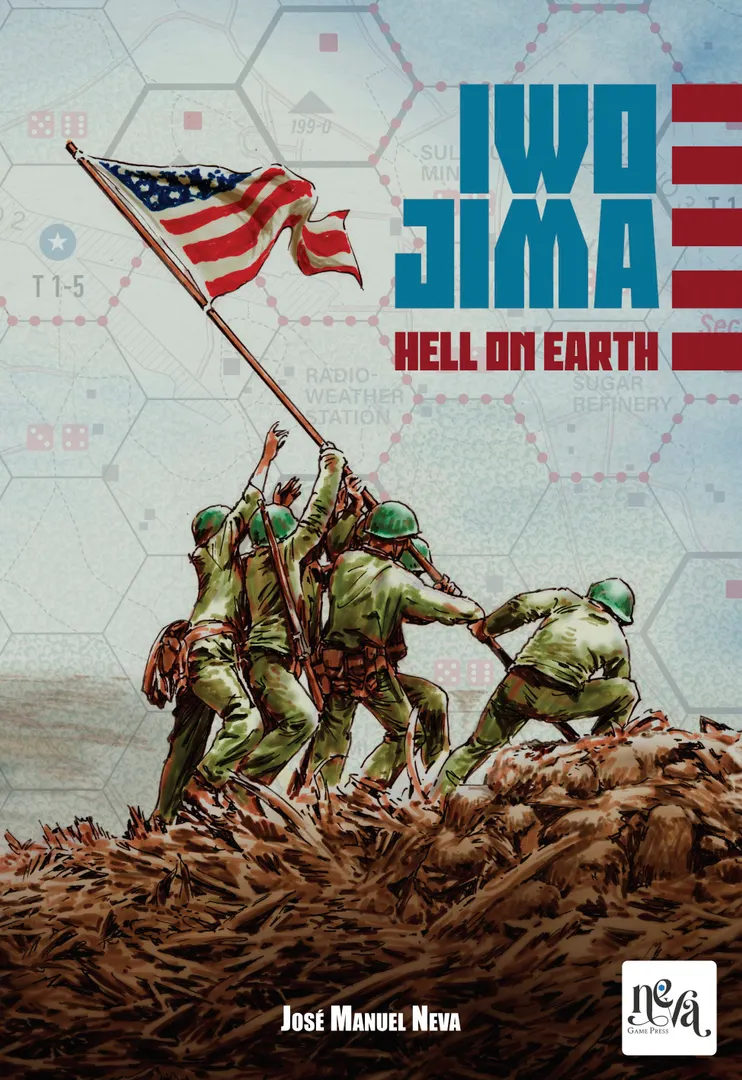
Iwo Jima: Hell On Earth est un jeu de société sorti en 2025 pour 1 joueur, avec des parties de 90 à 120 minutes et à partir de 14 ans. Il a été conçu par José Manuel Neva et ses principales mécaniques sont Dice Rolling, Variable Set-up et Hexagon Grid.


En anglais
THE HISTORICAL CONTEXT The Battle of Iwo Jima, a pivotal momentin the Pacific Theater of World War II, stands as a testament to the indomitable spirit of the human will and the immense cost of victory. This brutal conflict, fought between the United States Marine Corps and the Imperial Japanese Army, unfolded on the small volcanic island of Iwo Jima, a mere 660 miles south of Tokyo. From February 19 to March 26, 1945, American forces waged a relentless assault against a well-fortified enemy, determined to seize control of the island’s strategic airfields. Iwo Jima was crucial to the Allied war effort, serving as a vital base for fighter planes escorting long-range bombers on missions to the Japanese mainland. The battle was marked by fierce resistance from the Japanese defenders, who had meticulously constructed a network of underground tunnels and fortifications.The Marines faced relentless attacks, as they fought their way across the island’s rugged terrain. The iconic image of Marines raising the American flag atop Mount Suribachi became a symbol of American determination and sacrifice. The Battle of Iwo Jima was one of the bloodiest battles in Marine Corps history, with thousands of American and Japanese soldiers losing their lives. The island’s volcanic ash and the intense fighting conditions made it a grueling ordeal for both sides. Despite the heavy casualties, the Marines ultimately achieved their objective, securing Iwo Jima and bringing the United States one step closer to victory in the Pacific War. GAMEPLAY AT A GLANCE In “Iwo Jima: Hell on Earth,” your mission as the commander of US forces is to conquer the island of Iwo Jima to secure its three airfields and the iconic Mount Suribachi. The game simulates the 36-day battle in nine turns, with each turn representing approximately four days. Objective and how to win: Victory is determined at the end of Turn 9 by calculating your Victory Points (VPs). You earn VPs by: Eliminating Japanese units, Capturing key objectives on time, Japanese surrender. You can lose VPs if: You play too many Special Orders and/or You suffer too many US casualties. Your final VP score will give you an assessment of your performance, ranging from a “pen-pushing job” (1 or less to 5 VP) to an “incredible victory” (19-20 VP) Sequence of play: The game is played over nine turns, and each turn follows the sequence below: 1. Weather Phase: A die is rolled to determine the weather conditions for the turn, which can affect bombardment points and unit movement. Turn 1 always has “Good Weather”. 2. Bombardment Phase: Both US and Japanese forces bombard enemy units. First, each side’s bombardment points (BP) are determined, which can be modified by weather or airfield control. Then bombardments are resolved, US first, then Japanese, by selecting targets and rolling dice to determine hits. 3. First Movement Phase: US units can attempt to recover from retreat markers (rally) and then move across the map, choosing between normal or strategic movement. 4. First Attack Phase: US units that have not performed a previous action can conduct a Reconnaissance-in-Force (Recon) or an Assault against adjacent Japanese units. They can also provide Combat Support to an assault. During assaults, hidden Japanese units will reveal their response, which may include a Banzai Attack or a Redeployment. The combat ratio is calculated, and results are applied. 5. Raid Phase (Japanese): Japanese forces react with limited attacks, carrying out raids against nearby US units. 6. Second Movement Phase: This phase is a repeat of the First Movement Phase for US units. 7. Second Attack Phase: Similar to the First Attack Phase, US units can perform Reconnaissance or Assaults. At the end of this phase, all situation markers are removed. 8. Command Phase (Skipped on Turn 9): US units attempt to rally again with a +1 modifier. Command Points (CPs) are gained by rolling a die, which can be spent on reinforcements, unit deployment, or to obtain special command markers. The Japanese side also resolves a limited command step, where their single-step units can attempt to gain a step or perform a Banzai attack. 9. Organization Phase: The turn marker is advanced. US units on the turn track can move to the Reserve Area or recover steps. Reaction markers are put into the red bag, and Command markers can be drawn if the turn space is highlighted. At the end of Turn 9, the player’s performance is assessed based on criteria such as Japanese units eliminated, capture of key objectives, special order markers played, and US casualties. Key decision/challenges: US units have a dual role, acting as both direct assault regiments and providing various combat support types (Flamethrowers, Tank, Artillery). This requires careful planning to combine their direct combat strength with support for optimal attacks. Assaults against hidden Japanese units are resolved using a chit-pull system: Intelligence markers are drawn to determine Japanese defense, support, and unpredictable “Banzai” attacks or “Redeployments” via tunnels. This random element ensures high replayability, making each game fresh. The game is designed to be very difficult to achieve a significant victory, reflecting the brutal historical battle. WHAT’S IN THE BOX? 1 Mounted Map 120 Counters 2 6-sided dice 4 Player Aid Sheets 2 Cloth bags 1 Rulebook —description from the publisher
Selon le catalogue, Iwo Jima: Hell On Earth se joue à 1 personne. C’est le nombre de joueurs indiqué par l’éditeur : le jeu est donc conçu pour exactement ce nombre de participants. Les variantes pour d’autres tailles de groupe, s’il en existe, sont décrites dans la règle de votre édition ; consultez-la avant d’installer une autre configuration.
La durée indiquée pour Iwo Jima: Hell On Earth est de 90 à 120 minutes, selon l’estimation de l’éditeur pour une partie complète. La durée réelle dépend du groupe, de l’effectif et de la connaissance des règles : les premières parties sont plus longues, les groupes expérimentés terminent plus vite. Mise en place et explication des règles ne sont pas comprises.
Le catalogue indique Iwo Jima: Hell On Earth à partir de 14 ans. C’est la recommandation de l’éditeur ; elle tient compte de la lecture nécessaire, de la complexité des règles et des petits composants, pas seulement du thème. Les plus jeunes peuvent souvent participer avec l’aide d’un adulte : vérifiez l’âge indiqué sur votre édition et tenez compte de l’expérience de votre groupe.
Iwo Jima: Hell On Earth obtient une note de complexité de 2,3 sur 5 auprès des joueurs de BoardGameGeek, ce qui en fait un jeu plutôt léger. Cette note reflète la quantité de règles, de planification et de décisions qu’exige une partie typique. Prévoyez une explication plus longue pour les jeux exigeants et utilisez un guide de préparation avant la soirée.
Iwo Jima: Hell On Earth appartient à ces catégories : Wargame et World War II. Ses principales mécaniques sont Dice Rolling, Variable Set-up et Hexagon Grid. Les catégories décrivent le thème et l’univers d’un jeu, tandis que les mécaniques décrivent ce que les joueurs font réellement pendant leur tour. Chaque mécanique mène à une page du catalogue avec des jeux similaires.
Les auteurs crédités pour Iwo Jima: Hell On Earth sont : José Manuel Neva. Ces crédits proviennent des données publiées du jeu et désignent les personnes responsables de sa conception, et non les illustrateurs ou les éditeurs. Les pages d’auteurs sur MeepleRules regroupent les autres titres des mêmes auteurs, ce qui est utile lorsqu’un jeu vous plaît et que vous en cherchez de similaires.
Le catalogue présente Iwo Jima: Hell On Earth comme un jeu de base. Il se joue seul avec le matériel contenu dans la boîte et ne nécessite aucun autre titre. Les extensions, s’il en existe, y ajoutent du contenu ou des règles et sont répertoriées séparément dans le catalogue, avec un lien vers ce jeu de base.