
- Rang BGG
- BGG #5 090
- Note BGG
- 6,3
Tomb
- 1–6 joueurs
- 60 min
- Complexité 2,6/5
- 2008
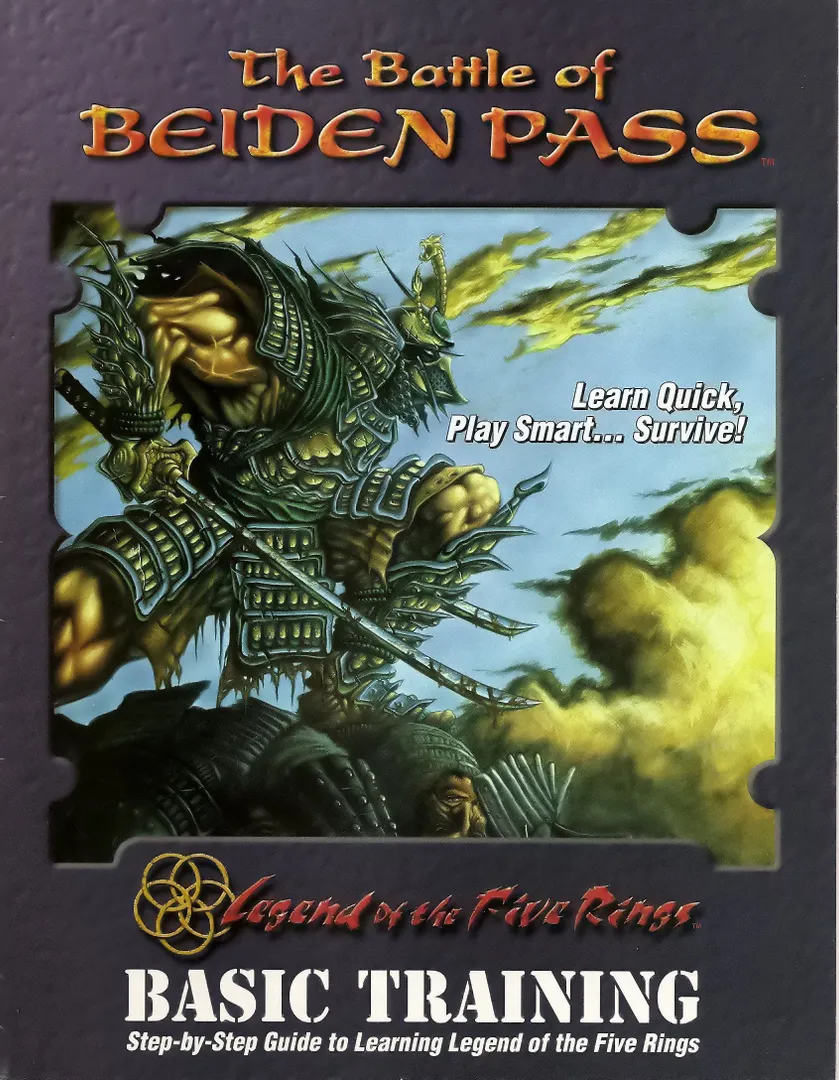
Extension de Legend of the Five Rings
1996
Aide aux règles de Legend of the Five Rings: The Battle of Beiden Pass – Basic Training for the Armies of Rokugan
Des explications claires des tours, effets de cartes et situations litigieuses, avec des références aux sources officielles et un historique des questions sauvegardé.
Que voulez-vous savoir ?
Les réponses viennent du livret officiel, avec la page à vérifier.
Legend of the Five Rings: The Battle of Beiden Pass – Basic Training for the Armies of Rokugan est une extension de Legend of the Five Rings sortie en 1996 pour 2 joueurs et à partir de 12 ans. Il a été conçu par John Zinser, Matt Wilson (I), John Wick, Matt Staroscik, D. J. Trindle, Ryan Dancey et David Williams (II) et ses principales mécaniques sont Set Collection, Storytelling et Open Drafting.
En anglais
The Battle of Beiden Pass was the first 2-player starter set for the Legend of the Five Rings CCG. The starter set allows the players to play out the Battle of Beiden Pass, in which the Crab Clan have abandoned their centuries-old post protecting the empire from the forces of the Shadowlands, creating an alliance with their enemy in an attempt to take Beiden Pass, the crossroads of the empire. Only the Dragon Clan, aided by the disgraced Lion Clan samurai, Toturi, and his army of ronin, can stop them.
Selon le catalogue, Legend of the Five Rings: The Battle of Beiden Pass – Basic Training for the Armies of Rokugan se joue à 2 personnes. C’est le nombre de joueurs indiqué par l’éditeur : le jeu est donc conçu pour exactement ce nombre de participants. Les variantes pour d’autres tailles de groupe, s’il en existe, sont décrites dans la règle de votre édition ; consultez-la avant d’installer une autre configuration.
Le catalogue indique Legend of the Five Rings: The Battle of Beiden Pass – Basic Training for the Armies of Rokugan à partir de 12 ans. C’est la recommandation de l’éditeur ; elle tient compte de la lecture nécessaire, de la complexité des règles et des petits composants, pas seulement du thème. Les plus jeunes peuvent souvent participer avec l’aide d’un adulte : vérifiez l’âge indiqué sur votre édition et tenez compte de l’expérience de votre groupe.
Legend of the Five Rings: The Battle of Beiden Pass – Basic Training for the Armies of Rokugan obtient une note de complexité de 2,5 sur 5 auprès des joueurs de BoardGameGeek, ce qui en fait un jeu plutôt léger. Cette note reflète la quantité de règles, de planification et de décisions qu’exige une partie typique. Prévoyez une explication plus longue pour les jeux exigeants et utilisez un guide de préparation avant la soirée.
Legend of the Five Rings: The Battle of Beiden Pass – Basic Training for the Armies of Rokugan appartient à ces catégories : Card Game, Fantasy et Fighting. Ses principales mécaniques sont Set Collection, Storytelling et Open Drafting. Les catégories décrivent le thème et l’univers d’un jeu, tandis que les mécaniques décrivent ce que les joueurs font réellement pendant leur tour. Chaque mécanique mène à une page du catalogue avec des jeux similaires.
Les auteurs crédités pour Legend of the Five Rings: The Battle of Beiden Pass – Basic Training for the Armies of Rokugan sont : John Zinser, Matt Wilson (I), John Wick, Matt Staroscik, D. J. Trindle, Ryan Dancey et David Williams (II). Ces crédits proviennent des données publiées du jeu et désignent les personnes responsables de sa conception, et non les illustrateurs ou les éditeurs. Les pages d’auteurs sur MeepleRules regroupent les autres titres des mêmes auteurs, ce qui est utile lorsqu’un jeu vous plaît et que vous en cherchez de similaires.
Le catalogue présente Legend of the Five Rings: The Battle of Beiden Pass – Basic Training for the Armies of Rokugan comme une extension de Legend of the Five Rings. Les extensions ajoutent du contenu, des règles ou des scénarios au jeu de base et ne se jouent généralement pas seules : il vous faut donc Legend of the Five Rings pour l’utiliser. Vérifiez que votre édition de Legend of the Five Rings est compatible, car certaines extensions ont été révisées d’une édition à l’autre.