
- Rang BGG
- BGG #8 495
- Note BGG
- 7,8
Dead Man's Hand
- 2–6 joueurs
- 45 min
- Complexité 2,1/5
- 2013
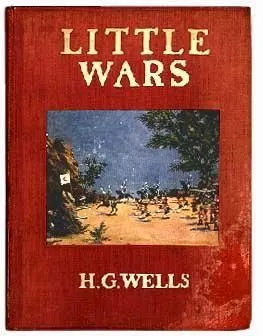
1913
Aide aux règles de Little Wars
Des explications claires des tours, effets de cartes et situations litigieuses, avec des références aux sources officielles et un historique des questions sauvegardé.
Pour 2 joueurs
Que voulez-vous savoir ?
Les réponses viennent du livret officiel, avec la page à vérifier.
Little Wars est un jeu de société sorti en 1913 pour 2 à 4 joueurs, avec des parties de 90 à 180 minutes et à partir de 12 ans. Il a été conçu par H. G. Wells et ses principales mécaniques sont Simulation et Measurement Movement.



En anglais
Little Wars was first published in 1913, but has been published many times since then, including editions from MacMillan publishing and Dover Press. The rules portion of the book can be read for free online. The full book includes a fairly extensive history of the game and socio-political discussion of wargaming. Wells (the famous historian and science fiction writer) was a pacifist, and the book makes for interesting reading, as wargaming was his favorite hobby. He considered the generals he played with to be reckless buffoons, and was worried for his country should war break out. (WWI broke out the year after the book was published, and given the massive casualties of WWI, he seems justified in his opinions.) The rules themselves are fairly simple, as miniatures games go. There are rules for movement, ranged combat, melee combat, terrain setup, prisoners, etc. There are three types of units: cavalry, infantry and artillery. The toy soldiers of Wells' day were fairly large, so the movement factors are also large, and it's made to be played on a floor. Ranged combat results are entertaining, but hard to recreate in today's world. In Wells' time, toy cannons fired little pellets and were actually tooled to be quite accurate. The game calls for aiming the cannons and firing them, and any figures you knock over are casualties! The best recreation I've seen was at a convention where we used toy pistols that fired plastic disks: the player had to place the butt of the pistol on the floor next to his artillery and fire from there. Melee combat does not use a randomizer. (In the book Wells discusses how he started with a coin flip but was turned against it when one soldier won over twenty battles!) Instead, compare sizes of units, add in "supporting" units (within a certain distance), and each side takes casualties proportionately. The remaining smaller force is then taken prisoner and may be escorted to the rear lines - or freed on the way by a rescue attempt. Although modern miniatures rules are more complex and realistic, this is still a very fun game to play, and is a big hit at conventions. It's also free online! It is best played on a floor with one-foot tiles for ease of measurement. Stand alone expansion of Floor Games BGG Microbadge --
Selon le catalogue, Little Wars se joue de 2 à 4 personnes. Cette fourchette correspond au nombre de joueurs indiqué par l’éditeur : le jeu s’installe donc pour toute taille de groupe dans cette limite. La mise en place, certaines règles et le décompte peuvent varier selon l’effectif ; vérifiez la configuration exacte dans la règle de votre édition.
La durée indiquée pour Little Wars est de 90 à 180 minutes, selon l’estimation de l’éditeur pour une partie complète. La durée réelle dépend du groupe, de l’effectif et de la connaissance des règles : les premières parties sont plus longues, les groupes expérimentés terminent plus vite. Mise en place et explication des règles ne sont pas comprises.
Le catalogue indique Little Wars à partir de 12 ans. C’est la recommandation de l’éditeur ; elle tient compte de la lecture nécessaire, de la complexité des règles et des petits composants, pas seulement du thème. Les plus jeunes peuvent souvent participer avec l’aide d’un adulte : vérifiez l’âge indiqué sur votre édition et tenez compte de l’expérience de votre groupe.
Little Wars obtient une note de complexité de 2,3 sur 5 auprès des joueurs de BoardGameGeek, ce qui en fait un jeu plutôt léger. Cette note reflète la quantité de règles, de planification et de décisions qu’exige une partie typique. Prévoyez une explication plus longue pour les jeux exigeants et utilisez un guide de préparation avant la soirée.
Little Wars appartient à ces catégories : Wargame, Action / Dexterity et Miniatures. Ses principales mécaniques sont Simulation et Measurement Movement. Les catégories décrivent le thème et l’univers d’un jeu, tandis que les mécaniques décrivent ce que les joueurs font réellement pendant leur tour. Chaque mécanique mène à une page du catalogue avec des jeux similaires.
Les auteurs crédités pour Little Wars sont : H. G. Wells. Ces crédits proviennent des données publiées du jeu et désignent les personnes responsables de sa conception, et non les illustrateurs ou les éditeurs. Les pages d’auteurs sur MeepleRules regroupent les autres titres des mêmes auteurs, ce qui est utile lorsqu’un jeu vous plaît et que vous en cherchez de similaires.
Le catalogue présente Little Wars comme un jeu de base. Il se joue seul avec le matériel contenu dans la boîte et ne nécessite aucun autre titre. Les extensions, s’il en existe, y ajoutent du contenu ou des règles et sont répertoriées séparément dans le catalogue, avec un lien vers ce jeu de base.