
- Rang BGG
- BGG #9 900
- Note BGG
- 6,8
Complots 2
- 2–8 joueurs
- 15 min
- Complexité 2,0/5
- 2016
2014
Aide aux règles de Melee
Des explications claires des tours, effets de cartes et situations litigieuses, avec des références aux sources officielles et un historique des questions sauvegardé.
Pour 2 joueurs
Que voulez-vous savoir ?
Les réponses viennent du livret officiel, avec la page à vérifier.
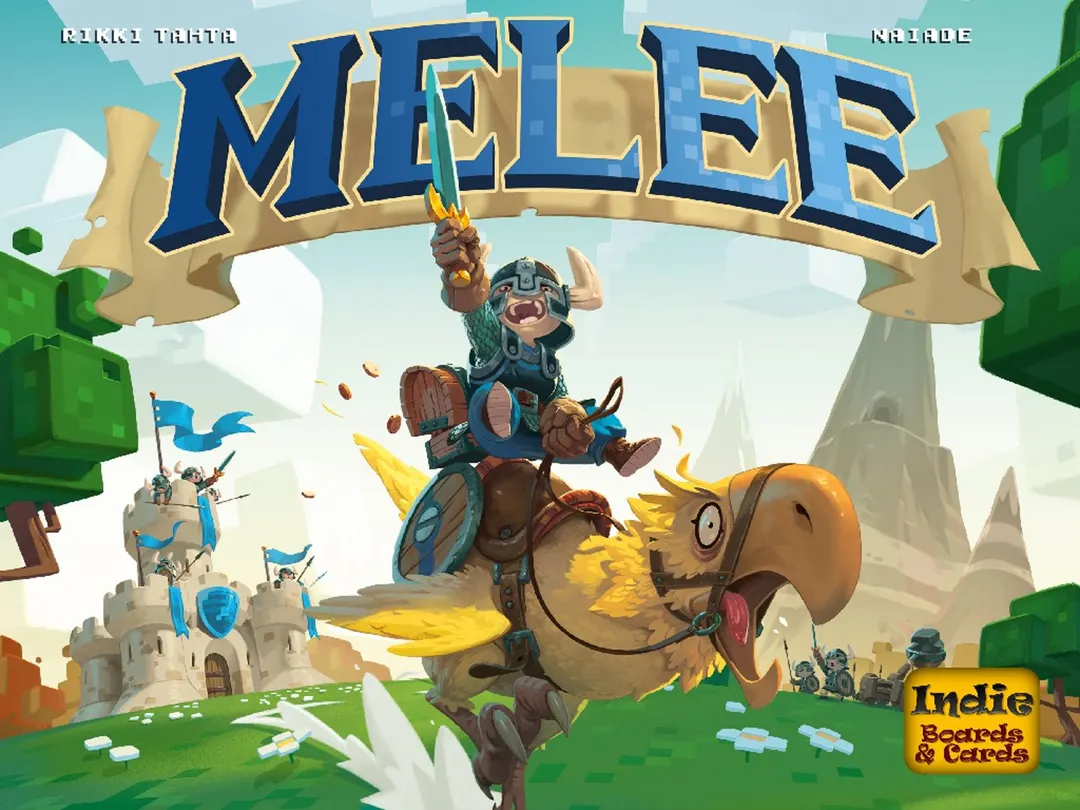
Melee est un jeu de société sorti en 2014 pour 2 à 4 joueurs, avec des parties de 20 minutes et à partir de 10 ans. Il a été conçu par Rikki Tahta et ses principales mécaniques sont Variable Player Powers, Take That et Auction / Bidding.

En anglais
It is the dawn of a new year. The old king has just died childless, and the new succession must be decided before the end of this year. You are a local baron or countess with as good a claim as anyone else, so now is the time to grab the throne. Your peers understand only force, and your subjects understand only gold. Gather your men, pay your knights, and assert your claim. Everyone will recognize the strongest and richest as the rightful monarch. In Melee you want to be the first person to capture an opposing castle (at which point the game ends immediately) or to have the most land and gold at the end of the year. Money is tight, and gold is used in the game both to build new units and to attack. The more gold you have and spend on your troops, the more motivated they will be and the higher your probability of success. Each player starts the game with a Castle, one unit of foot soldiers, and 15 gold coins. The game begins with a drafting session in which you purchase units (soldiers, knights, camps and catapults) and bid on special abilities that will enhance your income, attack, or other options in the game. The game is then played over four turns (seasons), and in each turn players simultaneously choose one of three potential actions: (a) tax, (b) build new units, or (c) move and attack. Each turn ends with players collecting income. To attack, you move your unit into an occupied area, then secretly decide how much gold you will spend to motivate your troops. The defender then has to guess how much you have spent. If the defender guesses wrong, the attack succeeds; if the defender is correct, the attack fails and you lose your unit. Regardless of success you have spent your gold, so the tight trade-off that players have to assess is whether to be cheap with your men so that you can conserve gold for future builds and attacks, or be generous to increase your chances now but limit future options. The different abilities available in each game make for varied strategies and strong replayability as no two games are alike. After the initial strategic planning stage, Melee is fast and highly interactive. Beware as the game can end suddenly with a bold attack on an inadequately defended castle, making for a game that can be very nasty, brutish and short.
Selon le catalogue, Melee se joue de 2 à 4 personnes. Cette fourchette correspond au nombre de joueurs indiqué par l’éditeur : le jeu s’installe donc pour toute taille de groupe dans cette limite. La mise en place, certaines règles et le décompte peuvent varier selon l’effectif ; vérifiez la configuration exacte dans la règle de votre édition.
La durée indiquée pour Melee est de 20 minutes, selon l’estimation de l’éditeur pour une partie complète. La durée réelle dépend du groupe, de l’effectif et de la connaissance des règles : les premières parties sont plus longues, les groupes expérimentés terminent plus vite. Mise en place et explication des règles ne sont pas comprises.
Le catalogue indique Melee à partir de 10 ans. C’est la recommandation de l’éditeur ; elle tient compte de la lecture nécessaire, de la complexité des règles et des petits composants, pas seulement du thème. Les plus jeunes peuvent souvent participer avec l’aide d’un adulte : vérifiez l’âge indiqué sur votre édition et tenez compte de l’expérience de votre groupe.
Melee obtient une note de complexité de 1,7 sur 5 auprès des joueurs de BoardGameGeek, ce qui en fait un jeu léger. Cette note reflète la quantité de règles, de planification et de décisions qu’exige une partie typique. Prévoyez une explication plus longue pour les jeux exigeants et utilisez un guide de préparation avant la soirée.
Melee appartient à ces catégories : Wargame, Territory Building et Bluffing. Ses principales mécaniques sont Variable Player Powers, Take That et Auction / Bidding. Les catégories décrivent le thème et l’univers d’un jeu, tandis que les mécaniques décrivent ce que les joueurs font réellement pendant leur tour. Chaque mécanique mène à une page du catalogue avec des jeux similaires.
Les auteurs crédités pour Melee sont : Rikki Tahta. Ces crédits proviennent des données publiées du jeu et désignent les personnes responsables de sa conception, et non les illustrateurs ou les éditeurs. Les pages d’auteurs sur MeepleRules regroupent les autres titres des mêmes auteurs, ce qui est utile lorsqu’un jeu vous plaît et que vous en cherchez de similaires.
Le catalogue présente Melee comme un jeu de base. Il se joue seul avec le matériel contenu dans la boîte et ne nécessite aucun autre titre. Les extensions, s’il en existe, y ajoutent du contenu ou des règles et sont répertoriées séparément dans le catalogue, avec un lien vers ce jeu de base.