
- Rang BGG
- BGG #4 340
- Note BGG
- 6,6
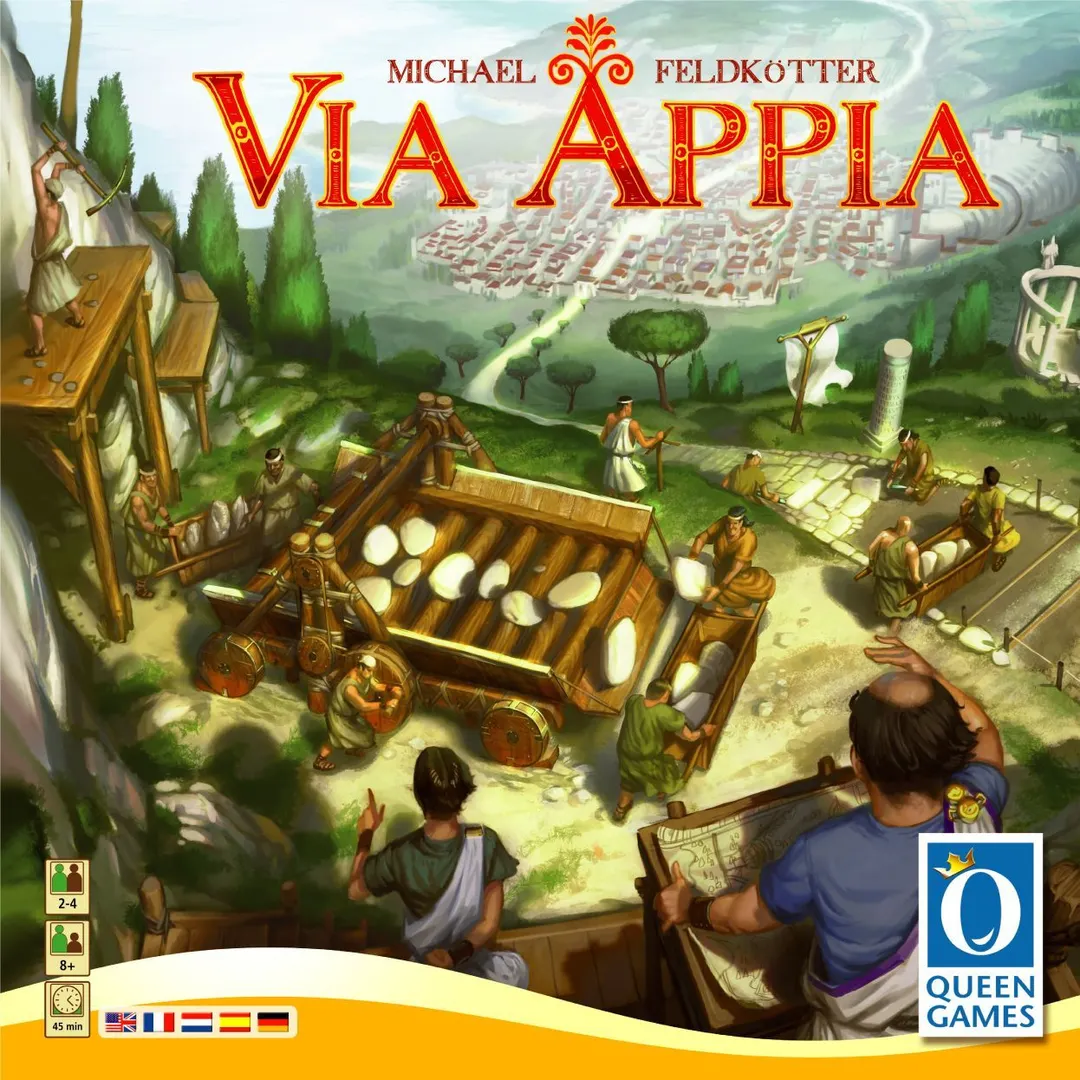
Via Appia
- 2–4 joueurs
- 45 min
- Complexité 2,0/5
- 2013
2009
Aide aux règles de Montego Bay
Des explications claires des tours, effets de cartes et situations litigieuses, avec des références aux sources officielles et un historique des questions sauvegardé.
Pour 2 joueurs
Que voulez-vous savoir ?
Les réponses viennent du livret officiel, avec la page à vérifier.
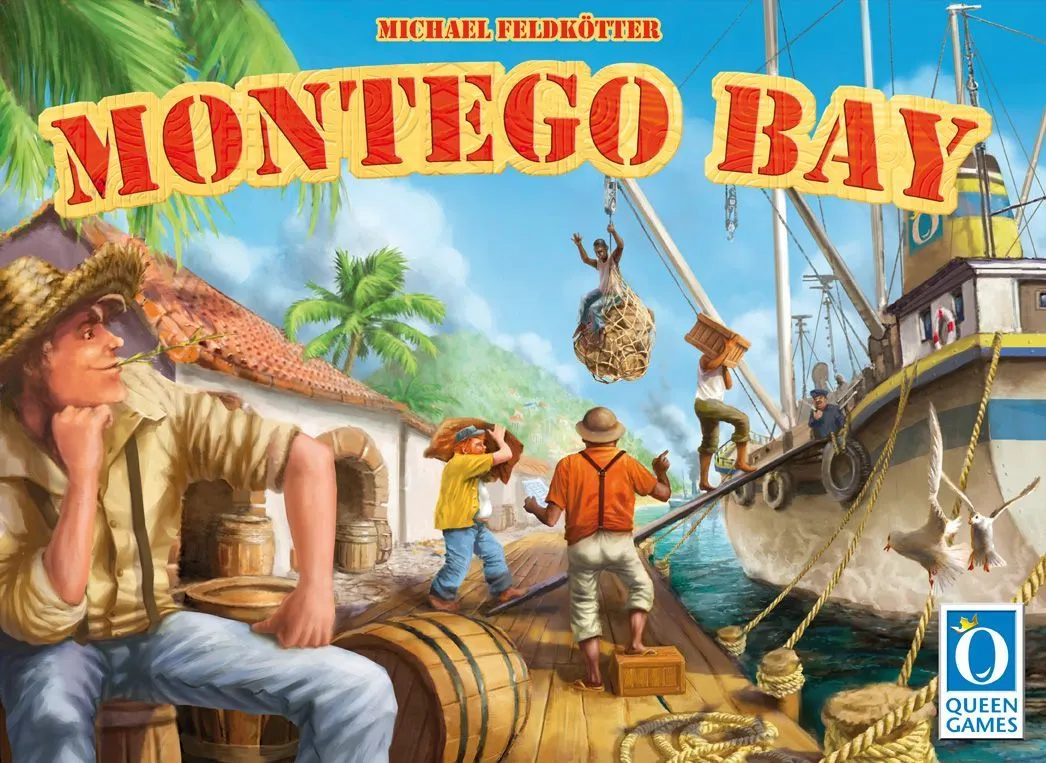
Montego Bay est un jeu de société sorti en 2009 pour 2 à 4 joueurs, avec des parties de 45 à 60 minutes et à partir de 8 ans. Il a été conçu par Michael Feldkötter et ses principales mécaniques sont Simultaneous Action Selection et Pick-up and Deliver.




En anglais
Players have to transport drums and load them on ships. For this, they have two workers, a large one and a smaller one, and a set of 5 cards for each worker to move them. There is a scale with counters (for each worker 1 counter) depicting which worker moves first, second and so on). In a turn, all players secretly choose one of the numbered cards from each of their card sets. For the worker which is the first to move, the player revealed the appropriate card and moves his worker the amount of spaces as stated by his card. When one of the workers land on an occupied space, the (passive) worker is pushed to the opposite side of the warehouse. When this place is already occupied the (passive) worker won't move. The (active) worker will be moved back to the next unoccupied place. When all players have made their moves, the warehouses are checked if there is a worker next to a chamber. Players take as many drums in their colour as barrels in the room they are next to. The barrels are placed in one or more of the ships in the harbour (4 ships); players may decide freely. When a worker is next to a room where broken barrels are, the player must take as many drums in his colour from any of the ships. When a worker is next to a room depicting also a silver coin, the player gets a silver piece from the common stock. Majorities with barrels on ships are important for scoring points. When a ship is fully loaded, or if it is the leftmost ship, loaded or not, it gets scored at the end of the round after which it is taken away (barrels/drums goes back to the players stock); the other ships move left accordingly and a new ship is taken from a blind stack of ships tiles. There are scores for first, second and third positions (the latter in a game of 3 or 4 players) on the ship. For the next round the last worker (in play order) will become first worker (shifting the counter on the scale). For three silver coins an extra worker for the current round can be bought, but this worker always must be the first to move in a round. This worker gets no penalty if his move ends near a room with broken barrels. The configuration of the warehouse cards each game is different, as these are loose tiles. When the stack is depleted, the game ends. Game Summary The board shows a randomly ordered group of 7/8 (3er/4er) warehouses, each with 2 rooms containing 0-4 good barrels or 0-2 broken barrels, and 0-1 coin. This is surrounded by a looped movement path with stops in front of each storeroom. Players each have 2 dock workers (Big and Little) which start at opposite ends of the board (off the path initially), and 2 sets of movement cards numbered 1-5 (one set per worker). There are 4 piers, each with a random boat with room for 3 or more barrels. At the start, pier 1 has a "pilot" boat -- occupies space but cannot load goods. Finally, token movement order is set randomly at the beginning of the game: chits corresponding to all workers are placed in a row in random order. Each round, players first have the option to pay 3 coins to hire Lazy Jack for this turn (if several want to hire him, priority goes to player with fewer VP). Place the Lazy Jack token with one of your workers. Then, everyone selects and simultaneously reveals a movement card for each worker. If you hired Lazy Jack, play an additional card of the same type (Big/Little) as whoever you placed Lazy Jack with. The workers than all move in token movement order, with Lazy Jack moving first. If they land on another worker, they shift that worker to the opposite side of the movement path, unless that space is already occupied; in that case, the moving worker moves backwards to the first empty space on the path. After all tokens have moved, resolve the warehouses in order from one side of the board to the other. If a coin is present, take one from the bank. If there are good barrels in the storeroom, take as many from your stock and load them onto any boat(s). If you take the last open spot, score 1VP and the boat sails: players with barrels on board score VP based on majority (last place scores nothing; ties will score average of sum of ranks, rounding up). Immediately move other boats forward in the pier track, and place a new boat at the last pier. If there are broken barrels in the storeroom, remove as many of your barrels from the boats (exception: Lazy Jack does not unload). If there are now 3 or fewer boats in the piers, the game will end -- score all boats and most VP wins. If not, the boat at pier 1 scores, then sails away (immediately advance all boats and draw a new one). Finally, if you had dipped into the last 6 boats this turn, randomize the token movement order. Otherwise, the token last in movement order moves up to 1st position. Return Lazy Jack to supply, and start another round.
Selon le catalogue, Montego Bay se joue de 2 à 4 personnes. Cette fourchette correspond au nombre de joueurs indiqué par l’éditeur : le jeu s’installe donc pour toute taille de groupe dans cette limite. La mise en place, certaines règles et le décompte peuvent varier selon l’effectif ; vérifiez la configuration exacte dans la règle de votre édition.
La durée indiquée pour Montego Bay est de 45 à 60 minutes, selon l’estimation de l’éditeur pour une partie complète. La durée réelle dépend du groupe, de l’effectif et de la connaissance des règles : les premières parties sont plus longues, les groupes expérimentés terminent plus vite. Mise en place et explication des règles ne sont pas comprises.
Le catalogue indique Montego Bay à partir de 8 ans. C’est la recommandation de l’éditeur ; elle tient compte de la lecture nécessaire, de la complexité des règles et des petits composants, pas seulement du thème. Les plus jeunes peuvent souvent participer avec l’aide d’un adulte : vérifiez l’âge indiqué sur votre édition et tenez compte de l’expérience de votre groupe.
Montego Bay obtient une note de complexité de 1,8 sur 5 auprès des joueurs de BoardGameGeek, ce qui en fait un jeu léger. Cette note reflète la quantité de règles, de planification et de décisions qu’exige une partie typique. Prévoyez une explication plus longue pour les jeux exigeants et utilisez un guide de préparation avant la soirée.
Montego Bay appartient à ces catégories : Transportation. Ses principales mécaniques sont Simultaneous Action Selection et Pick-up and Deliver. Les catégories décrivent le thème et l’univers d’un jeu, tandis que les mécaniques décrivent ce que les joueurs font réellement pendant leur tour. Chaque mécanique mène à une page du catalogue avec des jeux similaires.
Les auteurs crédités pour Montego Bay sont : Michael Feldkötter. Ces crédits proviennent des données publiées du jeu et désignent les personnes responsables de sa conception, et non les illustrateurs ou les éditeurs. Les pages d’auteurs sur MeepleRules regroupent les autres titres des mêmes auteurs, ce qui est utile lorsqu’un jeu vous plaît et que vous en cherchez de similaires.
Le catalogue présente Montego Bay comme un jeu de base. Il se joue seul avec le matériel contenu dans la boîte et ne nécessite aucun autre titre. Les extensions, s’il en existe, y ajoutent du contenu ou des règles et sont répertoriées séparément dans le catalogue, avec un lien vers ce jeu de base.