

- Rang BGG
- BGG #664
- Note BGG
- 7,9
Star Wars: Battle of Hoth
- 2–4 joueurs
- 30 min
- Complexité 1,9/5
- 2025
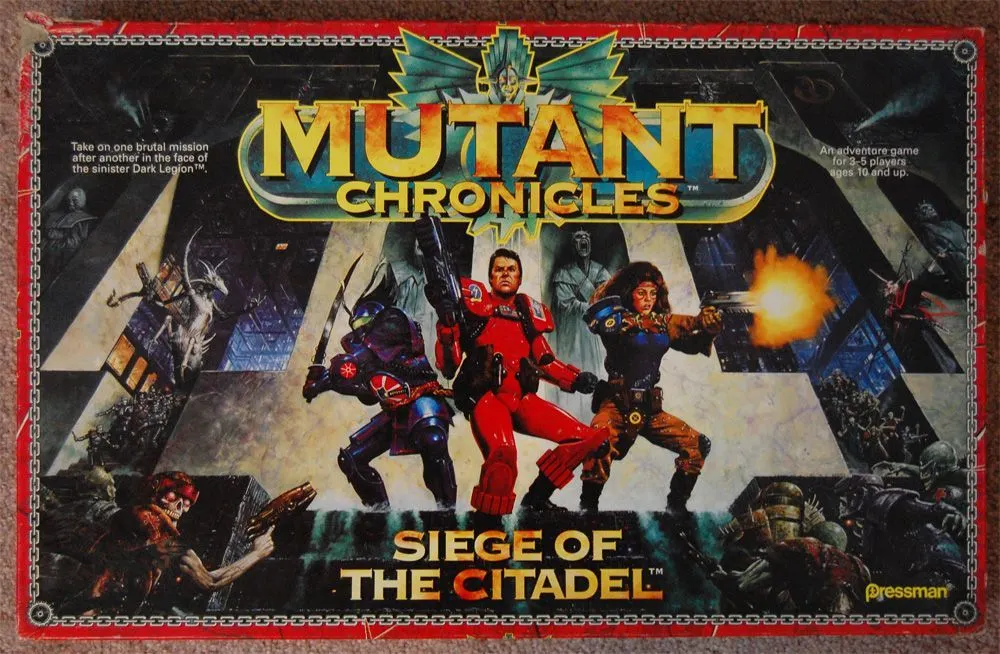
1993
Aide aux règles de Mutant Chronicles: Siege of the Citadel
Des explications claires des tours, effets de cartes et situations litigieuses, avec des références aux sources officielles et un historique des questions sauvegardé.
Pour 3 joueurs
Que voulez-vous savoir ?
Les réponses viennent du livret officiel, avec la page à vérifier.
Mutant Chronicles: Siege of the Citadel est un jeu de société sorti en 1993 pour 3 à 5 joueurs, avec des parties de 120 minutes et à partir de 10 ans. Il a été conçu par Richard Borg et ses principales mécaniques sont Variable Player Powers, Grid Movement et Modular Board.





En anglais
Precursor of the Mutant Chronicles miniatures Game and a kissing cousin of Heroquest stands Mutant Chronicles: The Siege of the Citadel Setting: In Mutant Chronicles, players control one of five corporations: Imperial, Cybertronic, Mishima, Capitol, or Bauhaus. Each player begins with two of their own unique Doomtroopers imbued their Corporation's special ability. They make decisions and plan strategies to prevent the Dark Legion and its leader, the vile Nepharite, Alakhai, from conquering the solar system. Each successful mission brings a new one with the modular Citadel and events that can help or hinder you in battle. Each promotion gives credits to access more powerful weaponry! Grab a Punisher Shortsword and Plasma Carbine to make your mark in the Mutant Chronicles! Gameplay: The game begins by choosing which of the 5 players will be the Dark Legion Player for the current mission. A player fulfills this role by setting their Doomtroopers aside for the current mission and controlling the enemies. The Dark Legion player can earn promotion points for their inactive Doomtroopers by wounding the other player's Doomtroopers. Thus, taking a turn as the baddies is not totally thankless. 10 different scenarios are included with the game. The Corporation players take their Player tray and 2 Doomtrooper miniatures, two Doomtrooper cards and a Secondary Mission card if specified by mission (these allow extra points if the requirements of the card can be met). The Dark Legion Player sets up the current mission's Citadel layout with the modular boards and gathers his mission specified Force Cards. The Force cards are deployed in rooms face-down and are revealed when a Doomtrooper enters and the corresponding Dark Legion miniatures are placed on board. All miniatures may move 3 squares per move action and most figures get 2 actions per turn. A figure can do one of the following: Move then Attack, Attack then Move, Attack twice or Move twice. Corporation Players go first. Order is determined by flipping over a face-down Corporation token. The revealed player (Doomtrooper or Legion) takes their turn and the next Corporation token is flipped. Play is semi-cooperative for the Corporation players as they compete for points, but want the overall mission to succeed. The weapon card the Doomtrooper has equipped determines whether he can attack long range, close combat or both. There are various miscellaneous equipment that can be equipped in addition to the weapon (healing kits, laser targeting, Grenade launcher etc...). Attacks are carried out by rolling dice and comparing the number of hits to the armor value of the target. If the number of hits exceeds the armor value of the creature it is eliminated. In addition Doomtroopers can use a Doomtrooper card to affect the game in some way. These cards list two effects but only one can be used per card and are then discarded. The possible effects range from modification of combat or movement to messing with your opponents (jamming their gun for example). The Dark Legion(DL) Player at the start of his turn draws the top event card, reads it out loud and follows the instructions. The DL player then receives the reinforcements listed on the card and places them on the board. The DL player then looks to see if any Force cards are still face-down. If there are, the player reveals one and places the revealed units in the same room the card was in. The DL player then takes his actions with all of his creatures. Play continues in this way until mission is successful or the time runs out and it fails. Game End: Successful Doomtroopers receive promotion points for the creatures killed in battle and credits specified for the mission. If they gain rank Doomtroopers improve the combat dice they use and gain extra actions. With their credits Doomtroopers can purchase improved weaponry and gadgets (Gehenna Puker, Nimrod Autocannon). The Dark Legion player's inactive Doomtroopers gain 1 promotion point per point of damage inflicted upon the opposing players' Doomtroopers by creatures. A rare poster-magazine called "Sinkadus" 41# & 42# that was produced by Target Games AB only in Sweden, added an expansion to Siege of the Citadel. It added to the base game Brotherhood Characters (Inquisitor Nicodemus and Mortificator Sebastian Crenshaw), new equipment, spells, and two new baddies: the Pretorian Stalkers. All the minis were given their own stats and paper models for representation.
Selon le catalogue, Mutant Chronicles: Siege of the Citadel se joue de 3 à 5 personnes. Cette fourchette correspond au nombre de joueurs indiqué par l’éditeur : le jeu s’installe donc pour toute taille de groupe dans cette limite. La mise en place, certaines règles et le décompte peuvent varier selon l’effectif ; vérifiez la configuration exacte dans la règle de votre édition.
La durée indiquée pour Mutant Chronicles: Siege of the Citadel est de 120 minutes, selon l’estimation de l’éditeur pour une partie complète. La durée réelle dépend du groupe, de l’effectif et de la connaissance des règles : les premières parties sont plus longues, les groupes expérimentés terminent plus vite. Mise en place et explication des règles ne sont pas comprises.
Le catalogue indique Mutant Chronicles: Siege of the Citadel à partir de 10 ans. C’est la recommandation de l’éditeur ; elle tient compte de la lecture nécessaire, de la complexité des règles et des petits composants, pas seulement du thème. Les plus jeunes peuvent souvent participer avec l’aide d’un adulte : vérifiez l’âge indiqué sur votre édition et tenez compte de l’expérience de votre groupe.
Mutant Chronicles: Siege of the Citadel obtient une note de complexité de 2,2 sur 5 auprès des joueurs de BoardGameGeek, ce qui en fait un jeu plutôt léger. Cette note reflète la quantité de règles, de planification et de décisions qu’exige une partie typique. Prévoyez une explication plus longue pour les jeux exigeants et utilisez un guide de préparation avant la soirée.
Mutant Chronicles: Siege of the Citadel appartient à ces catégories : Wargame et Science Fiction. Ses principales mécaniques sont Variable Player Powers, Grid Movement et Modular Board. Les catégories décrivent le thème et l’univers d’un jeu, tandis que les mécaniques décrivent ce que les joueurs font réellement pendant leur tour. Chaque mécanique mène à une page du catalogue avec des jeux similaires.
Les auteurs crédités pour Mutant Chronicles: Siege of the Citadel sont : Richard Borg. Ces crédits proviennent des données publiées du jeu et désignent les personnes responsables de sa conception, et non les illustrateurs ou les éditeurs. Les pages d’auteurs sur MeepleRules regroupent les autres titres des mêmes auteurs, ce qui est utile lorsqu’un jeu vous plaît et que vous en cherchez de similaires.
Le catalogue présente Mutant Chronicles: Siege of the Citadel comme un jeu de base. Il se joue seul avec le matériel contenu dans la boîte et ne nécessite aucun autre titre. Les extensions, s’il en existe, y ajoutent du contenu ou des règles et sont répertoriées séparément dans le catalogue, avec un lien vers ce jeu de base.