
- Note BGG
- 7,8
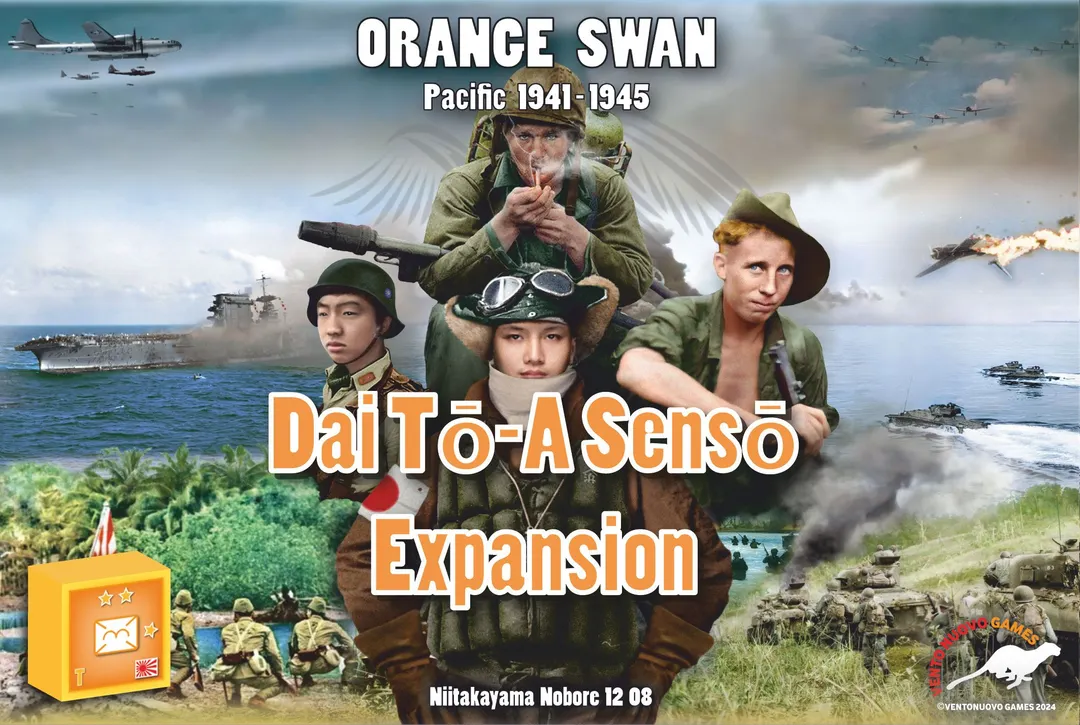
Orange Swan: Dai Tō-A Sensō
- 1–5 joueurs
- 90 min
- 2024
2022
Aide aux règles de Orange Swan
Des explications claires des tours, effets de cartes et situations litigieuses, avec des références aux sources officielles et un historique des questions sauvegardé.
Pour 1 joueur
Que voulez-vous savoir ?
Les réponses viennent du livret officiel, avec la page à vérifier.
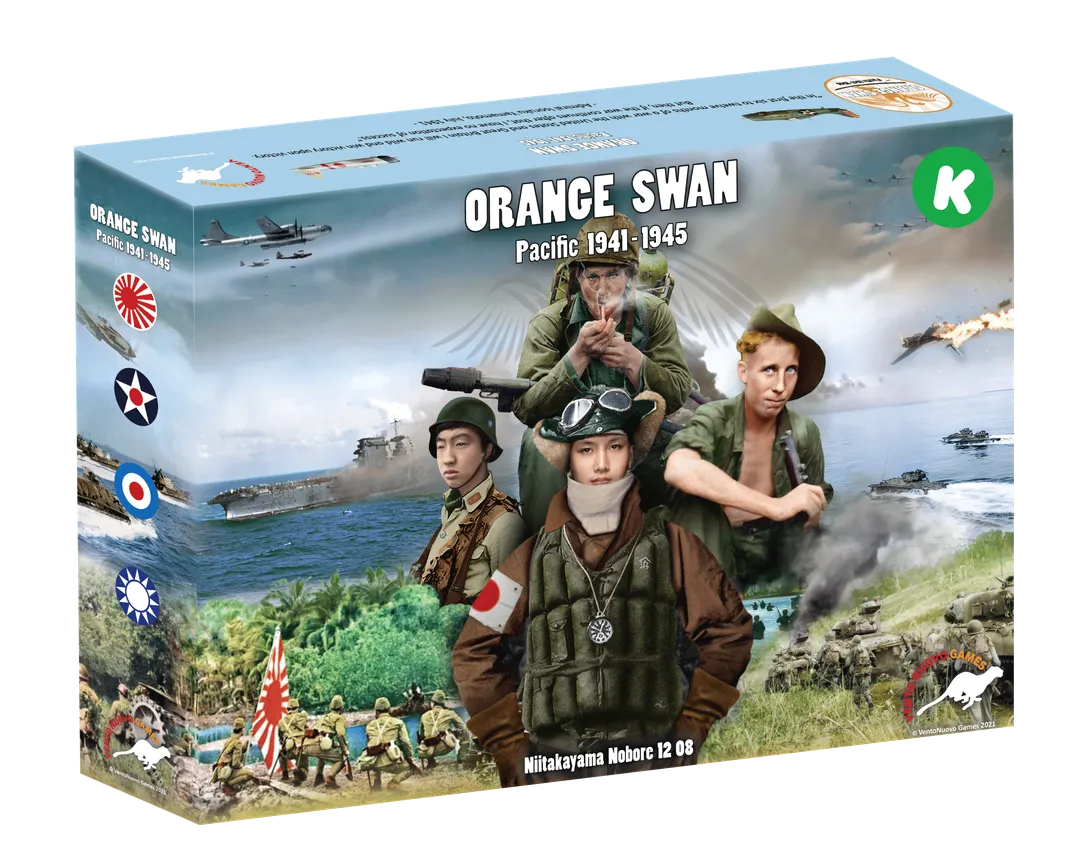
Orange Swan est un jeu de société sorti en 2022 pour 1 à 4 joueurs, avec des parties de 60 à 500 minutes et à partir de 12 ans. Il a été conçu par Emanuele Santandrea et ses principales mécaniques sont Area Movement, Dice Rolling et Area Majority / Influence.


En anglais
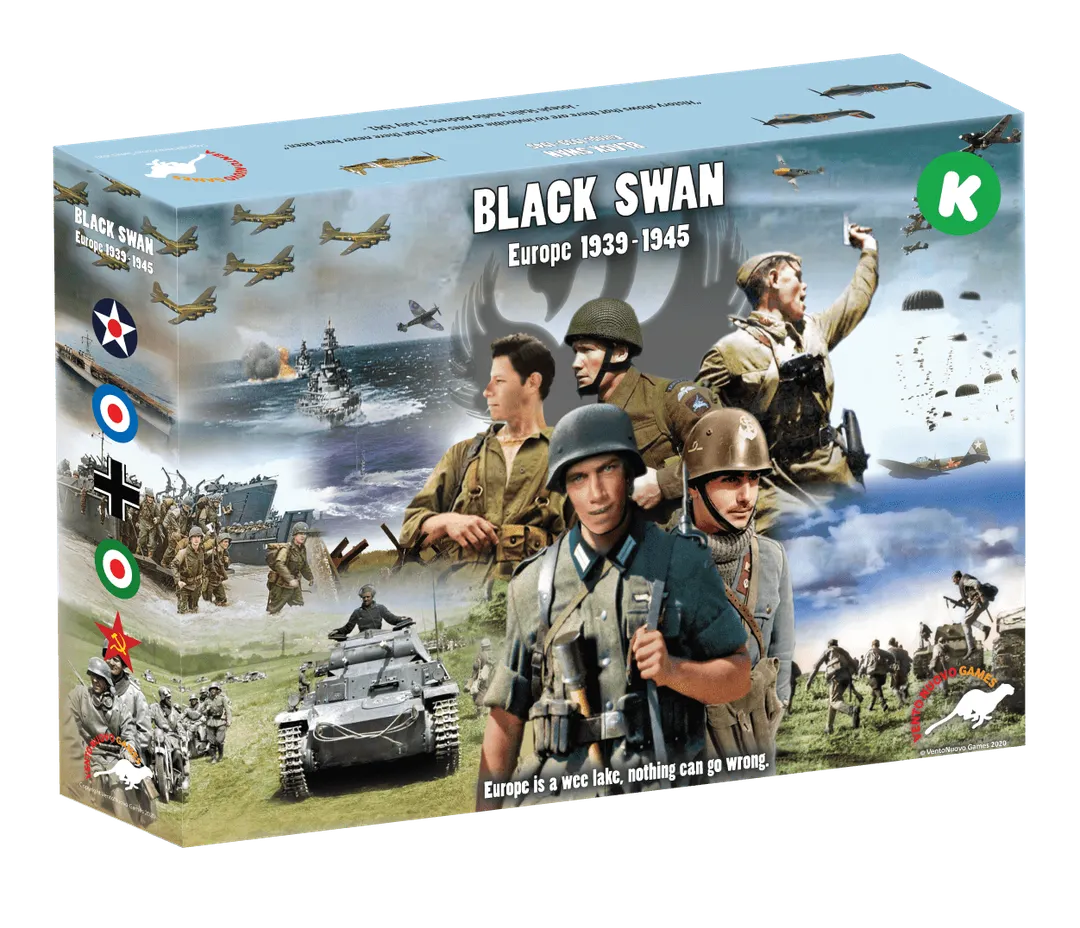
Orange Swan is a strategic game that recreates the war in the Pacific. Orange Swan may be combined with Black Swan and Orange Swan: Dai Tō-A Sensō or both! The Call of The Orange Swan Japan, on the eve of its entry into World War Two, is looking in two different directions. It sees opportunity and it fears defeat. It clamours for modernity and yet it will not, cannot, forsake a history of staid traditions and the rituals of self-slaughter. Admiral Yamamoto, at the head of a powerful navy, is being driven towards a decision that is not of his making. Those who truly desire war will relinquish neither their swords nor the ethos with which they are imbued, and so even while the likes of Hideki Tojo make their case for the fulfilment of destiny, for the acquisition of empire and the control of an abundance of natural resources, Yamamoto is painfully aware that their contempt for any and all likely enemies, their belief in the cult of the warrior, their very dreams of battle and conquest, belong to an age that is already dead. Yamamoto sees only one chance – Japan must strike quickly and with overwhelming and decisive force. If the enemy, first and foremost the United States, is given any pause, any form of reprieve, Japan will almost certainly be crushed. Chance and mischance play out their themes at Pearl Harbor. Japan wins and loses all in the same instant. The US carriers are not there, and while Japan will conquer for a while, bringing much of the Pacific and SE Asia under its control, it cannot hold what it has gained. The oft-repeated commands to fight to the death are each an admission that they have already lost. It is only a matter of time…and of blood. The culmination is at Hiroshima. What good swords at such a time, against such a vast and blinding and terrible fire? Those who hungered for war have no answer. They have never had an answer. Science and industry do not sit well with emperor worship or with archaic notions of sacrifice. Could it have been different? Chance and mischance are the ultimate reality of every course that every war has ever followed. Orange Swan is your means to experience this. ORANGE SWAN is a block wargame covering WWII in the Pacific from 1941 to 1945. As in all other block games, both the Fog of War and Unit strength reduction/increase by rotation, drive the gameplay in ORANGE SWAN, as a player cannot know the identity or the strength of an enemy block until it is revealed in combat. ORANGE SWAN is a historical game with some fixed starting points, but the outcome is completely unpredictable and, despite the historical result, the Axis Side (Japan) can defeat the Allied Side (China, Commonwealth and US). During any Victory Check (two per each Season, one at the end of the Axis Turn and one at the end of the Allied Turn), the game immediately ends with a Total Victory if either the following conditions are met: a. Tokyo is enemy Controlled; b. Atomic Bomb Event; c. Japan controls 7 Strategic Land Areas or Japan has a Production of 75. Additionally, a special Victory Check is made at the end of the each year of the Campaign game, or at the end of a Scenario. Game Introduction ORANGE SWAN is a historical game that covers WWII in the Pacific from 1941 to 1945. Its name reflects that of its older sibling Black Swan, a game that covers WWII’s European Theatre, but also that of the United States’ plan for fighting Japan, developed long before Pearl Harbor, called War Plan Orange. Orange Swan uses many of the same game mechanics as Black Swan but with greater focus on the innovative, and mechanically simple, naval systems that were universally praised. One revision that entirely changes the feel of the game is the addition of the Seaborne Blitz phase. Similar to Black Swan’s land based Blitz double turns that made the Eastern Front so dynamic, Orange Swan translates that idea to a double naval turn. The results are highly satisfying from both a gameplay and historical perspective. Similar to other block games, Fog of War is a core element in ORANGE SWAN, as a player cannot know the identity or the strength of an enemy unit until it is revealed in combat. While Orange Swan’s campaigns and scenarios feature historical starting points, the outcome is completely unpredictable and, despite the historical result, the Axis Side (Japan) can defeat the Allied Side (the United States, the Commonwealth, and China). The Allied Side can cooperate, so they can stack together, or trace supply accross either a Sea Zone or a Land Area Controlled by an Allied Nation. (Note: Chinese Communists stack only with themselves). Japan, the United States (US), the Commonwealth (CW), and China are Major Nations. The Philippines and Dutch East Indies (DEI) are Minor Nations controlled by the US and CW respectively. No Side can enter Land Areas belonging to the Soviet Union or any of the Absolute Neutrals, identified with a white border: Nepal and Butan. Each Major Nation has its own units (in a specific color), Force Pool, Economic and Strategic Power. The Force Pool of a Nation is made up of all units of that Nation that are not deployed on the mapboard and are available to be built (that is, purchased during the Production Phase). Note that some units have a colored circled number (2, 3, or 4) in one corner, indicating the year when the unit is added to the respective Force Pool. Thus, in 1943 it is not possible to build a Unit marked with a circled “4", as it will be added to the proper Nation's Force Pool in Winter 1944. Elite Units are designated with a darker color background. Nations of the same Side maintain their own Supply Source (their National Capital) but they can trace Supply using any of their Side’s Naval Units, Controlled Land Areas, or Controlled Sea Zones. They can freely enter any Land Area of, and be transported by, the Naval Units of their Side. They can stack, move, and attack together, but each Nation keeps its own Force Pool, Economic and Strategic Power. China has two kinds of forces: Nationalists and Communists. Both Chinese Nationalists and Chinese Communists are always supplied and therefore do not need to trace any supply. Chinese Communist Units can only stack with other Chinese Communists. They can, obviously, attack any Axis Side Units. Chinese Nationalists can stack (and move/attack) freely with units of the Allied Side. All Chinese units are restricted to Continental Asia and Hainan and can never be Sea Transported. National Capitals: Nations have the following Capitals, which also act as Supply Sources: 1. Japan: Tokyo 2. US: San Diego 3. CW: New Delhi and Sidney 4. Philippines: Manila 5. Dutch East Indies: Batavia Nation’s have their own blocks of the following color: 1. Japan: orange 2. US: green 3. CW: blue 4. China: purple 5. Philippines: light green 6. Dutch East Indies (DEI): light blue Minor Nations do not have their own Economic or Strategic Power, nor a dedicated Force Pool. They are controlled by the Major Power they are allied to, which treats them as if they were CW (for the DEI) or US (for the Philippines) units for all game effects. When destroyed, Minor Nations units are eliminated from the game, so they will never go into any Force Pool. -description from designer
Selon le catalogue, Orange Swan se joue de 1 à 4 personnes. Cette fourchette correspond au nombre de joueurs indiqué par l’éditeur : le jeu s’installe donc pour toute taille de groupe dans cette limite. La mise en place, certaines règles et le décompte peuvent varier selon l’effectif ; vérifiez la configuration exacte dans la règle de votre édition.
La durée indiquée pour Orange Swan est de 60 à 500 minutes, selon l’estimation de l’éditeur pour une partie complète. La durée réelle dépend du groupe, de l’effectif et de la connaissance des règles : les premières parties sont plus longues, les groupes expérimentés terminent plus vite. Mise en place et explication des règles ne sont pas comprises.
Le catalogue indique Orange Swan à partir de 12 ans. C’est la recommandation de l’éditeur ; elle tient compte de la lecture nécessaire, de la complexité des règles et des petits composants, pas seulement du thème. Les plus jeunes peuvent souvent participer avec l’aide d’un adulte : vérifiez l’âge indiqué sur votre édition et tenez compte de l’expérience de votre groupe.
Orange Swan obtient une note de complexité de 3,0 sur 5 auprès des joueurs de BoardGameGeek, ce qui en fait un jeu de complexité moyenne. Cette note reflète la quantité de règles, de planification et de décisions qu’exige une partie typique. Prévoyez une explication plus longue pour les jeux exigeants et utilisez un guide de préparation avant la soirée.
Orange Swan appartient à ces catégories : Wargame et World War II. Ses principales mécaniques sont Area Movement, Dice Rolling et Area Majority / Influence. Les catégories décrivent le thème et l’univers d’un jeu, tandis que les mécaniques décrivent ce que les joueurs font réellement pendant leur tour. Chaque mécanique mène à une page du catalogue avec des jeux similaires.
Les auteurs crédités pour Orange Swan sont : Emanuele Santandrea. Ces crédits proviennent des données publiées du jeu et désignent les personnes responsables de sa conception, et non les illustrateurs ou les éditeurs. Les pages d’auteurs sur MeepleRules regroupent les autres titres des mêmes auteurs, ce qui est utile lorsqu’un jeu vous plaît et que vous en cherchez de similaires.
Le catalogue présente Orange Swan comme un jeu de base. Il se joue seul avec le matériel contenu dans la boîte et ne nécessite aucun autre titre. Les extensions, s’il en existe, y ajoutent du contenu ou des règles et sont répertoriées séparément dans le catalogue, avec un lien vers ce jeu de base.