
- Rang BGG
- BGG #1 440
- Note BGG
- 7,8
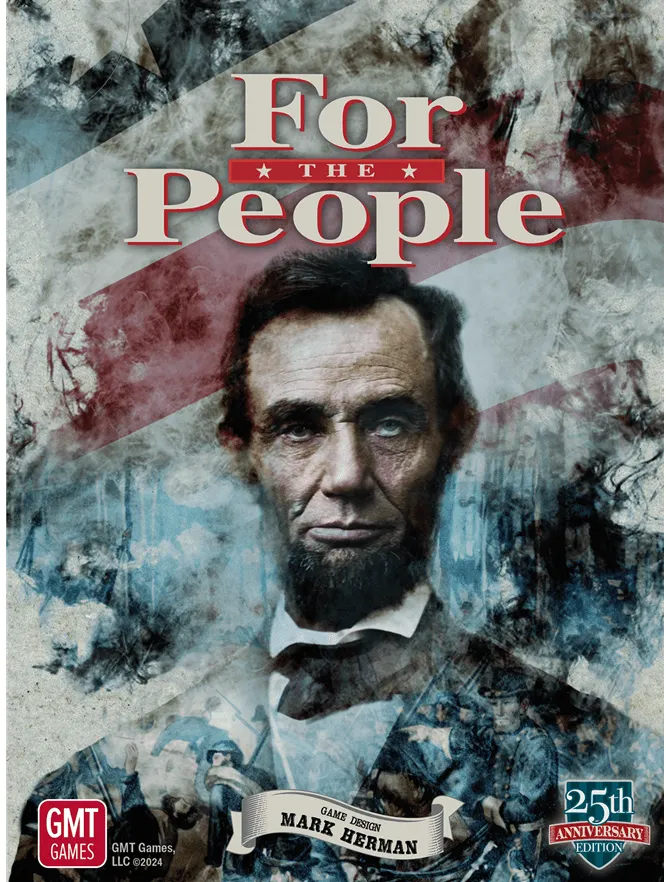
For the People
- 2 joueurs
- 360 min
- Complexité 3,7/5
- 1998
1991
Aide aux règles de Rebel Yell!
Des explications claires des tours, effets de cartes et situations litigieuses, avec des références aux sources officielles et un historique des questions sauvegardé.
Pour 2 joueurs
Que voulez-vous savoir ?
Les réponses viennent du livret officiel, avec la page à vérifier.
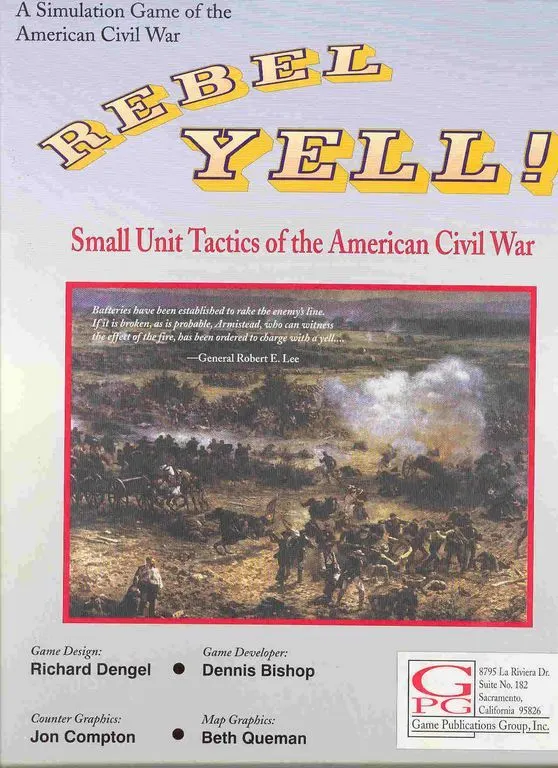
Rebel Yell! est un jeu de société sorti en 1991 pour 2 joueurs et avec des parties de 240 minutes. Il a été conçu par Richard A. Dengel et ses principales mécaniques sont Dice Rolling.
En anglais
Rebel Yell is a simulation of American Civil War small-unit tactics. The playing pieces in the game represent companies of infantry and cavalry or sections of artillery Each infantry and cavalry unit has one strength point and is equivalent to between 45 and 100 men, depending upon the scenario. Each artillery unit has two strength points and equals two guns. The players of Rebel Yell assume the roles of divisional commanders. Each game turn is broken down into segments. During an action segment, the units of a particular player may conduct a single action. In the beginning modules these actions are: Move, Fire, Assault, and Rally. During any Small Arms segment, the units of a particular player may only fire. There are no movement phases, fire phases, etc., as there are in other Civil War games. This absence, in addition to the fact that player segments are structured reciprocally, produces a feel of simultaneity uncommon to other designs. One of the most difficult problems faced by the Civil War tactician was the “problem of approach,”—in other words, how he should maneuver his unit to some objective while keeping his casualties and disorganization at a minimum. A commander who did not pay heed to the destructiveness of “modern” weaponry would find his formation damaged up to three hundred yards from the enemy. Rebel Yell addresses this problem. Within restrictions, defending units may fire at the enemy as he advances. Like a real-life commander, a player can no longer be certain that when he initiates an advance, his units will reach their objective. Players may find that even one or two companies Standing to Fire will be difficult to dislodge by frontal assault. Although Rebel Yell is a complex design, it is not out of the reach of the novice gamer. The rules are programmed, allowing small portions to be digested first and getting players into the game quickly. Provisions are made for such factors as infantry line formations (Standing to Maneuver, Standing to Fire, Skirmishers, and Cover), volley effects, leader quality, morale, and regimental flags. The rules for cavalry and artillery are also extensive. Once players have learned all the rules (or even before), they can design their own scenarios. The game includes six geomorphic maps. Because the maps can be aligned in a variety of ways, the players can recreate a “microscopic” examination of virtually any Civil War engagement. Although an excellent multi-player game, Rebel Yell accommodates the solitaire player, Likewise it can be played in a physically limited area. Rebel Yell is “big’ only in the sense that it is detailed.
Selon le catalogue, Rebel Yell! se joue à 2 personnes. C’est le nombre de joueurs indiqué par l’éditeur : le jeu est donc conçu pour exactement ce nombre de participants. Les variantes pour d’autres tailles de groupe, s’il en existe, sont décrites dans la règle de votre édition ; consultez-la avant d’installer une autre configuration.
La durée indiquée pour Rebel Yell! est de 240 minutes, selon l’estimation de l’éditeur pour une partie complète. La durée réelle dépend du groupe, de l’effectif et de la connaissance des règles : les premières parties sont plus longues, les groupes expérimentés terminent plus vite. Mise en place et explication des règles ne sont pas comprises.
Rebel Yell! obtient une note de complexité de 3,0 sur 5 auprès des joueurs de BoardGameGeek, ce qui en fait un jeu de complexité moyenne. Cette note reflète la quantité de règles, de planification et de décisions qu’exige une partie typique. Prévoyez une explication plus longue pour les jeux exigeants et utilisez un guide de préparation avant la soirée.
Rebel Yell! appartient à ces catégories : Wargame et American Civil War. Ses principales mécaniques sont Dice Rolling. Les catégories décrivent le thème et l’univers d’un jeu, tandis que les mécaniques décrivent ce que les joueurs font réellement pendant leur tour. Chaque mécanique mène à une page du catalogue avec des jeux similaires.
Les auteurs crédités pour Rebel Yell! sont : Richard A. Dengel. Ces crédits proviennent des données publiées du jeu et désignent les personnes responsables de sa conception, et non les illustrateurs ou les éditeurs. Les pages d’auteurs sur MeepleRules regroupent les autres titres des mêmes auteurs, ce qui est utile lorsqu’un jeu vous plaît et que vous en cherchez de similaires.
Le catalogue présente Rebel Yell! comme un jeu de base. Il se joue seul avec le matériel contenu dans la boîte et ne nécessite aucun autre titre. Les extensions, s’il en existe, y ajoutent du contenu ou des règles et sont répertoriées séparément dans le catalogue, avec un lien vers ce jeu de base.