

- Rang BGG
- BGG #10 675
- Note BGG
- 6,1
Master Builder
- 2–4 joueurs
- 60 min
- Complexité 2,0/5
- 2008
1998
Aide aux règles de Ritter ohne Furcht und Tadel
Des explications claires des tours, effets de cartes et situations litigieuses, avec des références aux sources officielles et un historique des questions sauvegardé.
Que voulez-vous savoir ?
Les réponses viennent du livret officiel, avec la page à vérifier.
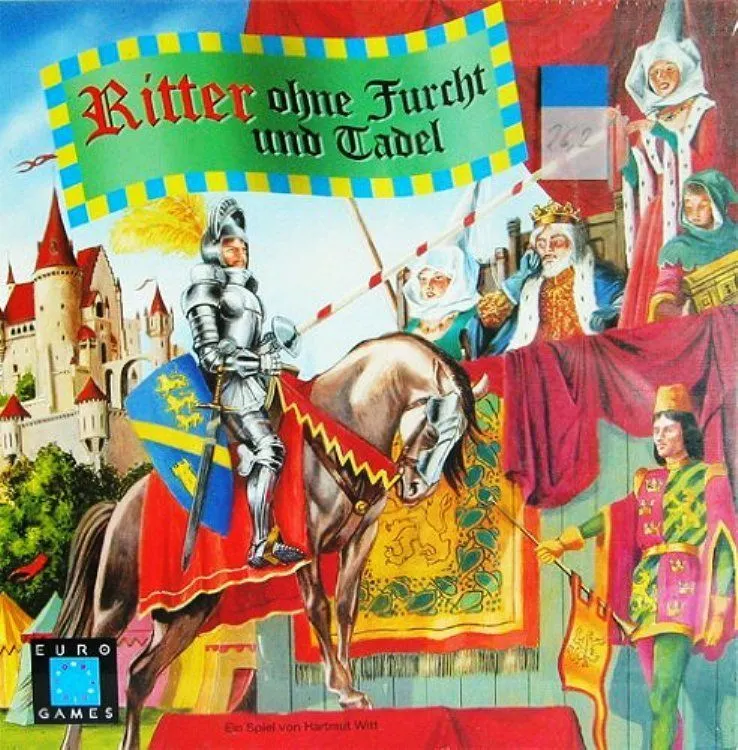
Ritter ohne Furcht und Tadel est un jeu de société sorti en 1998 pour 2 à 10 joueurs, avec des parties de 45 minutes et à partir de 12 ans. Il a été conçu par Hartmut Witt et ses principales mécaniques sont Betting and Bluffing.

En anglais
Depending upon the number of players, each player receives 1 or 2 knights. Each of these knights lists a series of dice pips on the card, some of which are red in color. These red numbers are the knights defensive abilities, and he will block these numbers if rolled by an opponent during a competition. For instance, Upollonius Wolkenburg has a 1, 2 and 3 in red. Thus, he will block one of each of these numbers each time dice are rolled by an opponent in a competition. Some knights have less numbers in red, but they usually have a greater attack strength, meaning they can roll more dice in combat. This mechanism borrows very heavily from many role playing and fantasy games. In addition to these 'defense' numbers and the attack dice chart, each knight card also has charts for prizes won (1 - 15) and damage points (1 - 10). There are also nice illustrations on each card ... about the only kind thing I can say about the game. Each player also receives a 'lady' card. Each lady possesses a number of characteristics, including hair color, build, height and personality. When granting her favor to a knight (which is indicated by placing a corresponding token onto a knight card), the idea is to seek out a knight who desires similar characteristics in a lady. The start player challenges an opposing knight with one of his knights. A challenge cannot be refused. These two enter battle, which involves each player tossing a number of dice equal to their attack strength into the tournament field. In mounted combat, any 1's, 2's or 3's thrown strike a blow, unless these are blocked by the opponent. If any of these dice strike, the knight falls from his horse and the knight suffers hit points equal to the number of blows which were landed. If only one knight is struck and falls from his horse, the opponent wins and earns a prize for himself and for his lady. If both knights fall from their horse, then the match continues on foot. This involves more dice rolling, but 4's, 5's and 6's now strike. This continues until one knight concedes or reaches 10 damage points, at which time he is out of the tournament (and out of the game). The next player in turn order then challenges a knight. This process is repeated until there is only one healthy knight remaining. The round then ends and victory points are doled out to the knight and lady who won the most prizes. There are also potential bonuses which add to the players' scores.
Selon le catalogue, Ritter ohne Furcht und Tadel se joue de 2 à 10 personnes. Cette fourchette correspond au nombre de joueurs indiqué par l’éditeur : le jeu s’installe donc pour toute taille de groupe dans cette limite. La mise en place, certaines règles et le décompte peuvent varier selon l’effectif ; vérifiez la configuration exacte dans la règle de votre édition.
La durée indiquée pour Ritter ohne Furcht und Tadel est de 45 minutes, selon l’estimation de l’éditeur pour une partie complète. La durée réelle dépend du groupe, de l’effectif et de la connaissance des règles : les premières parties sont plus longues, les groupes expérimentés terminent plus vite. Mise en place et explication des règles ne sont pas comprises.
Le catalogue indique Ritter ohne Furcht und Tadel à partir de 12 ans. C’est la recommandation de l’éditeur ; elle tient compte de la lecture nécessaire, de la complexité des règles et des petits composants, pas seulement du thème. Les plus jeunes peuvent souvent participer avec l’aide d’un adulte : vérifiez l’âge indiqué sur votre édition et tenez compte de l’expérience de votre groupe.
Ritter ohne Furcht und Tadel obtient une note de complexité de 1,6 sur 5 auprès des joueurs de BoardGameGeek, ce qui en fait un jeu léger. Cette note reflète la quantité de règles, de planification et de décisions qu’exige une partie typique. Prévoyez une explication plus longue pour les jeux exigeants et utilisez un guide de préparation avant la soirée.
Ritter ohne Furcht und Tadel appartient à ces catégories : Fighting, Dice et Medieval. Ses principales mécaniques sont Betting and Bluffing. Les catégories décrivent le thème et l’univers d’un jeu, tandis que les mécaniques décrivent ce que les joueurs font réellement pendant leur tour. Chaque mécanique mène à une page du catalogue avec des jeux similaires.
Les auteurs crédités pour Ritter ohne Furcht und Tadel sont : Hartmut Witt. Ces crédits proviennent des données publiées du jeu et désignent les personnes responsables de sa conception, et non les illustrateurs ou les éditeurs. Les pages d’auteurs sur MeepleRules regroupent les autres titres des mêmes auteurs, ce qui est utile lorsqu’un jeu vous plaît et que vous en cherchez de similaires.
Le catalogue présente Ritter ohne Furcht und Tadel comme un jeu de base. Il se joue seul avec le matériel contenu dans la boîte et ne nécessite aucun autre titre. Les extensions, s’il en existe, y ajoutent du contenu ou des règles et sont répertoriées séparément dans le catalogue, avec un lien vers ce jeu de base.