
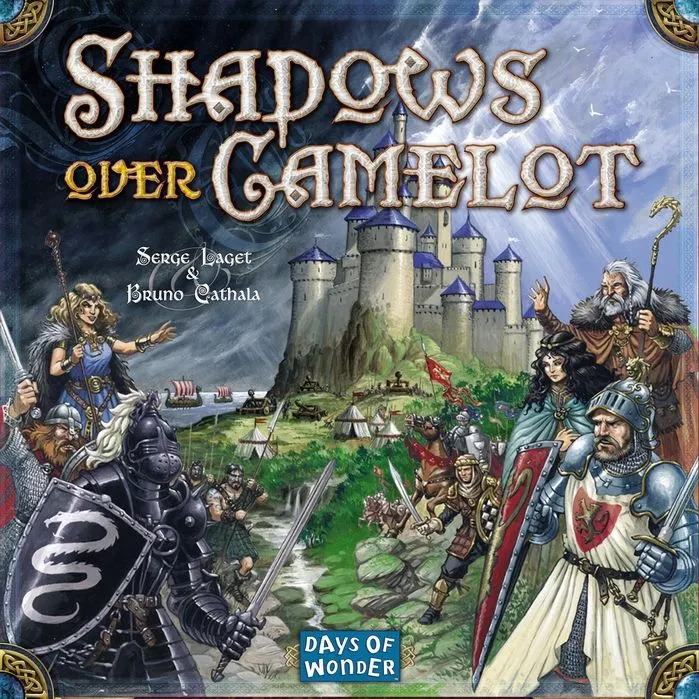
- Rang BGG
- BGG #603
- Note BGG
- 7,1
Shadows over Camelot
- 3–7 joueurs
- 60–90 min
- Complexité 2,6/5
- 2005
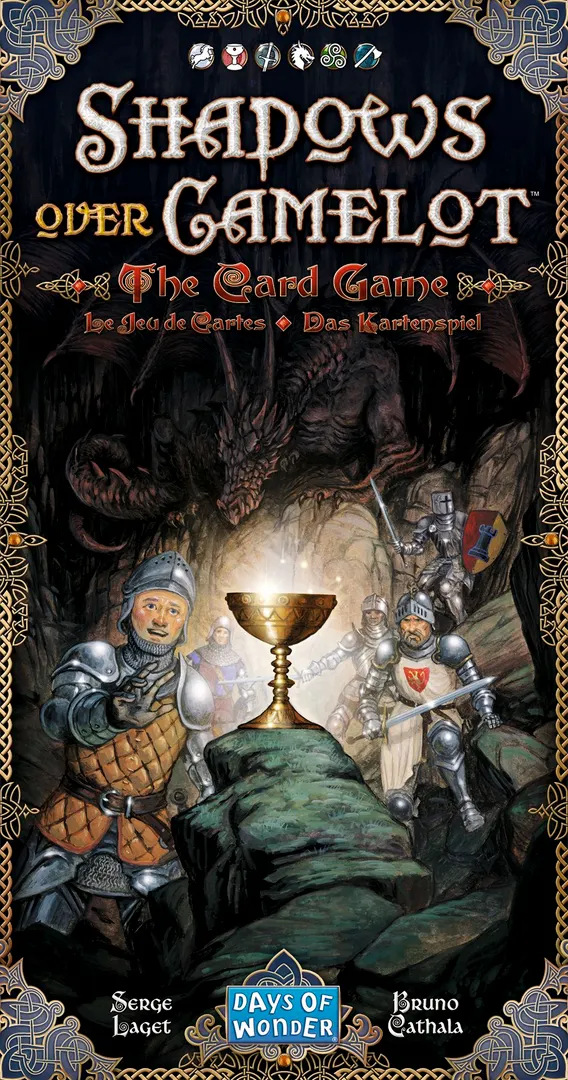
2012
Aide aux règles de Shadows over Camelot: The Card Game
Des explications claires des tours, effets de cartes et situations litigieuses, avec des références aux sources officielles et un historique des questions sauvegardé.
Que voulez-vous savoir ?
Les réponses viennent du livret officiel, avec la page à vérifier.
Shadows over Camelot: The Card Game est un jeu de société sorti en 2012 pour 1 à 7 joueurs, avec des parties de 20 minutes et à partir de 8 ans. Il a été conçu par Bruno Cathala et Serge Laget et ses principales mécaniques sont Memory, Cooperative Game et Team-Based Game.




En anglais
The Knights of the Round Table must assemble once again to protect King Arthur's kingdom from numerous threats. But wait – these aren't the knights of old, but rather their children. Can these newcomer knights prove up to the task of tracking the dangers out there and putting a stop to them before it's too late? In Shadows over Camelot: The Card Game, the players (mostly) work together to complete quests before the danger level of a quest gets too high. In game terms, the quests are represented by five types of cards, with each card showing 1-3 swords, as well as a number from 2 to 5 or a question mark. These cards are shuffled together with Morgan le Fay cards (which curse the players when they appear) and Merlin cards (which remove some aspects of the curse) to form the rumor deck. Each player receives a secret loyalty card at the start of the game, with at most one person being a traitor to the cause. On a turn a player either: Reveals a rumor card. Attempts a quest. Accuses a knight. To reveal a rumor card, the player flips it onto the top of the revealed stack of cards. If it's a quest card, players try to keep track of the total value of cards from that quest, with ?s each worth as many points as the number of ?s revealed of that quest. If a Morgan le Fay is revealed, players can no longer speak to one another; in addition, Morgan twists the values of some cards or removes some from play. Merlin allows players to speak once again. Players are trying to stop quests when the total value is 11, 12 or 13. Any lower, and they arrived too soon, wasting time; any higher, and they arrived too late. To attempt a quest, the player points to the top quest card and says, "It's time." The player then reveals all cards in the deck. If the sum of that quest is 11-13, then the players receive 1-3 white swords, as shown on the quest cards. If lower, they receive one black sword; if higher, 1-3 black swords. All other quests are checked to see whether the players were too late, then the stack resets. A failed quest rewards the attempter with a special bonus card for later use. Once three swords have been claimed, whatever the color, a player can choose to accuse another player of being traitorous to the cause, winning a reward if correct and a penalty otherwise. If the players collect seven white swords, they have stopped Morgan's forces and win. If, however, they collect seven black swords first, then Arthur's kingdom falls. Reimplements Shadows over Camelot
Selon le catalogue, Shadows over Camelot: The Card Game se joue de 1 à 7 personnes. Cette fourchette correspond au nombre de joueurs indiqué par l’éditeur : le jeu s’installe donc pour toute taille de groupe dans cette limite. La mise en place, certaines règles et le décompte peuvent varier selon l’effectif ; vérifiez la configuration exacte dans la règle de votre édition.
La durée indiquée pour Shadows over Camelot: The Card Game est de 20 minutes, selon l’estimation de l’éditeur pour une partie complète. La durée réelle dépend du groupe, de l’effectif et de la connaissance des règles : les premières parties sont plus longues, les groupes expérimentés terminent plus vite. Mise en place et explication des règles ne sont pas comprises.
Le catalogue indique Shadows over Camelot: The Card Game à partir de 8 ans. C’est la recommandation de l’éditeur ; elle tient compte de la lecture nécessaire, de la complexité des règles et des petits composants, pas seulement du thème. Les plus jeunes peuvent souvent participer avec l’aide d’un adulte : vérifiez l’âge indiqué sur votre édition et tenez compte de l’expérience de votre groupe.
Shadows over Camelot: The Card Game obtient une note de complexité de 1,9 sur 5 auprès des joueurs de BoardGameGeek, ce qui en fait un jeu léger. Cette note reflète la quantité de règles, de planification et de décisions qu’exige une partie typique. Prévoyez une explication plus longue pour les jeux exigeants et utilisez un guide de préparation avant la soirée.
Shadows over Camelot: The Card Game appartient à ces catégories : Card Game, Fantasy et Deduction. Ses principales mécaniques sont Memory, Cooperative Game et Team-Based Game. Les catégories décrivent le thème et l’univers d’un jeu, tandis que les mécaniques décrivent ce que les joueurs font réellement pendant leur tour. Chaque mécanique mène à une page du catalogue avec des jeux similaires.
Les auteurs crédités pour Shadows over Camelot: The Card Game sont : Bruno Cathala et Serge Laget. Ces crédits proviennent des données publiées du jeu et désignent les personnes responsables de sa conception, et non les illustrateurs ou les éditeurs. Les pages d’auteurs sur MeepleRules regroupent les autres titres des mêmes auteurs, ce qui est utile lorsqu’un jeu vous plaît et que vous en cherchez de similaires.
Le catalogue présente Shadows over Camelot: The Card Game comme un jeu de base. Il se joue seul avec le matériel contenu dans la boîte et ne nécessite aucun autre titre. Les extensions, s’il en existe, y ajoutent du contenu ou des règles et sont répertoriées séparément dans le catalogue, avec un lien vers ce jeu de base.