
- Rang BGG
- BGG #23
- Note BGG
- 8,4
Eclipse: Second Dawn for the Galaxy
- 2–6 joueurs
- 60–200 min
- Complexité 3,7/5
- 2020
2023
Aide aux règles de Storm Over Jerusalem: The Roman Siege
Des explications claires des tours, effets de cartes et situations litigieuses, avec des références aux sources officielles et un historique des questions sauvegardé.
Pour 2 joueurs
Que voulez-vous savoir ?
Les réponses viennent du livret officiel, avec la page à vérifier.
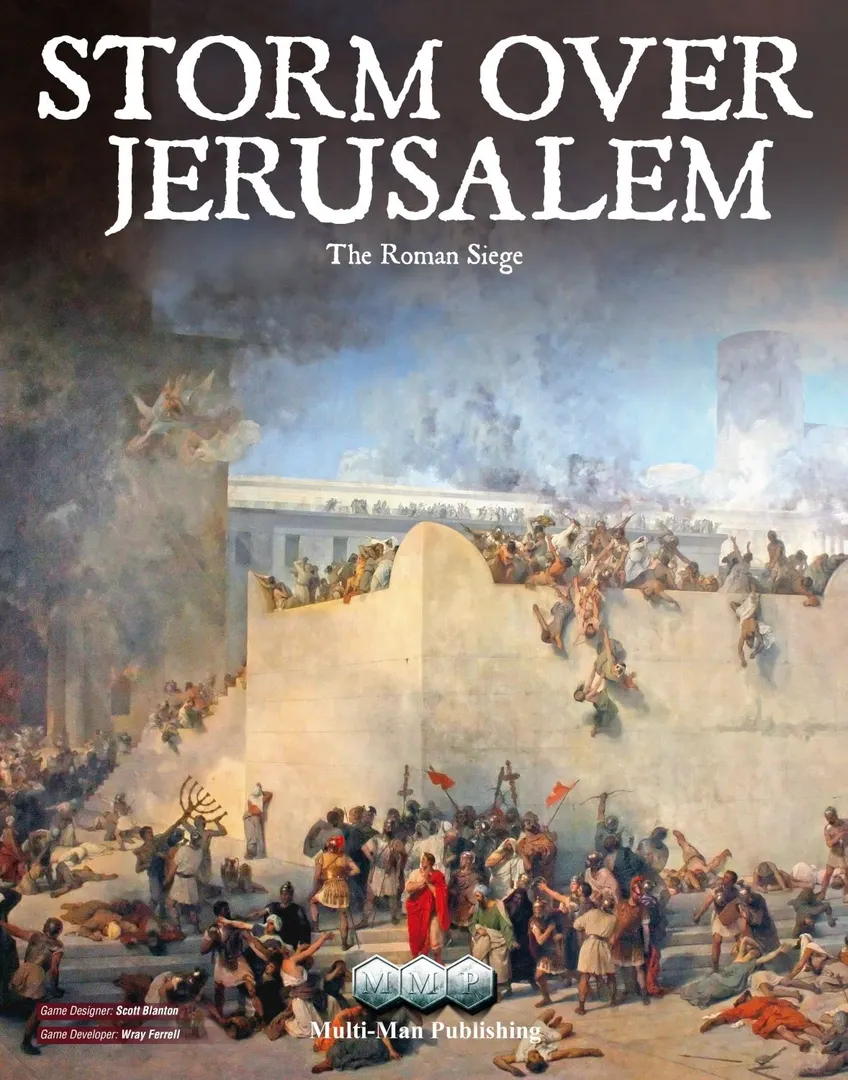
Storm Over Jerusalem: The Roman Siege est un jeu de société sorti en 2023 pour 2 joueurs, avec des parties de 120 à 180 minutes et à partir de 12 ans. Il a été conçu par Scott Blanton et ses principales mécaniques sont Area-Impulse.



En anglais
By the year 70 of the Common Era (CE), the province of Judea had been in revolt against Rome for nearly 4 years. The protests and riots that began in 66 CE had quickly turned into open rebellion. The standard Roman punitive force under Syrian legate Cestius Gallus, having failed to capture Jerusalem, was wiped out at Beth Horon. General Vespasian was given command of the Roman army in the region and ordered to crush the rebellion and restore order. Turmoil in Rome, however, saw Vespasian recalled to become Emperor. In early 70 CE, Emperor Vespasian dispatched his son Titus (a future Emperor) along with four legions to end the rebellion in this important province. Titus arrived in Jerusalem in April to find the city still at war with itself. Throughout the rebellion, differing Judean factions had fought a bitter internecine war among themselves. The primary factions fighting each other in Jerusalem at this time were controlled by Simon bar Giora and John of Gischala. With the arrival of Titus and his legions, however, they were now faced with a common threat to their immediate survival. The brutal siege of Jerusalem lasted nearly five months. During the siege, city walls were breached one-by-one, much of the city devastated, and the Temple—central to both the Jewish religion and the defense of the city—destroyed and burned. With the capture of Jerusalem, Titus had effectively ended the Judean revolt, with the last of the rebels finally cornered and eliminated in the legendary siege of Masada in 73 CE. Storm Over Jerusalem: The Roman Siege is a 2-player wargame simulating the Siege of Jerusalem in 70AD. One player controls the Roman forces, and the other player controls the Judean forces. Using the Area Move system redefined in Storm Over Stalingrad and Storm Over Dien Bien Phu, the game features the use of tactical cards to augment game play, adding to the tension experienced by both sides. The rules are similar in length to those seen in previous Storm Over games, and are of the same level of complexity, with additions made for the situations encountered in this battle. Additional rules added to the game include Siege Towers, the Walls of Jerusalem, and Judean leaders. In addition to these new rules, new cards have been created in order to represent events encountered during the battle. These include “Battering Rams”, “Famine”, “Rigging the Colonnades”, and “Escape the Siege”. Game Scale: Game Turn: approximately 10 - 14 days Area: approximately 1" = 300ft / 91 meters Units: Legions Game Inventory: One 22 x 34" full color mapsheet One dual-side printed countersheet (108 3/4" counters w/ 1 blank) One dual-side printed countersheet (54 3/4" & 88 5/8" counters w/ 17 blanks) One 12-page full color rulebook Two dual-side printed player aid cards One deck of 55 tactical playing cards Four 6 sided dice (2 red & 2 blue) Solitaire Playability: Low Complexity Level: Low Players: 2 (or more) Playing Time: 2-3 hours
Selon le catalogue, Storm Over Jerusalem: The Roman Siege se joue à 2 personnes. C’est le nombre de joueurs indiqué par l’éditeur : le jeu est donc conçu pour exactement ce nombre de participants. Les variantes pour d’autres tailles de groupe, s’il en existe, sont décrites dans la règle de votre édition ; consultez-la avant d’installer une autre configuration.
La durée indiquée pour Storm Over Jerusalem: The Roman Siege est de 120 à 180 minutes, selon l’estimation de l’éditeur pour une partie complète. La durée réelle dépend du groupe, de l’effectif et de la connaissance des règles : les premières parties sont plus longues, les groupes expérimentés terminent plus vite. Mise en place et explication des règles ne sont pas comprises.
Le catalogue indique Storm Over Jerusalem: The Roman Siege à partir de 12 ans. C’est la recommandation de l’éditeur ; elle tient compte de la lecture nécessaire, de la complexité des règles et des petits composants, pas seulement du thème. Les plus jeunes peuvent souvent participer avec l’aide d’un adulte : vérifiez l’âge indiqué sur votre édition et tenez compte de l’expérience de votre groupe.
Storm Over Jerusalem: The Roman Siege obtient une note de complexité de 2,6 sur 5 auprès des joueurs de BoardGameGeek, ce qui en fait un jeu plutôt léger. Cette note reflète la quantité de règles, de planification et de décisions qu’exige une partie typique. Prévoyez une explication plus longue pour les jeux exigeants et utilisez un guide de préparation avant la soirée.
Storm Over Jerusalem: The Roman Siege appartient à ces catégories : Wargame et Ancient. Ses principales mécaniques sont Area-Impulse. Les catégories décrivent le thème et l’univers d’un jeu, tandis que les mécaniques décrivent ce que les joueurs font réellement pendant leur tour. Chaque mécanique mène à une page du catalogue avec des jeux similaires.
Les auteurs crédités pour Storm Over Jerusalem: The Roman Siege sont : Scott Blanton. Ces crédits proviennent des données publiées du jeu et désignent les personnes responsables de sa conception, et non les illustrateurs ou les éditeurs. Les pages d’auteurs sur MeepleRules regroupent les autres titres des mêmes auteurs, ce qui est utile lorsqu’un jeu vous plaît et que vous en cherchez de similaires.
Le catalogue présente Storm Over Jerusalem: The Roman Siege comme un jeu de base. Il se joue seul avec le matériel contenu dans la boîte et ne nécessite aucun autre titre. Les extensions, s’il en existe, y ajoutent du contenu ou des règles et sont répertoriées séparément dans le catalogue, avec un lien vers ce jeu de base.