
- Note BGG
- 7,3
Tekhenu: Obelisk of the Sun – Foundations of Karnak
- 1–4 joueurs
- 60–120 min
- Complexité 3,0/5
- 2020
2020
Aide aux règles de Tekhenu: Obelisk of the Sun
Des explications claires des tours, effets de cartes et situations litigieuses, avec des références aux sources officielles et un historique des questions sauvegardé.
Pour 1 joueur
Que voulez-vous savoir ?
Les réponses viennent du livret officiel, avec la page à vérifier.
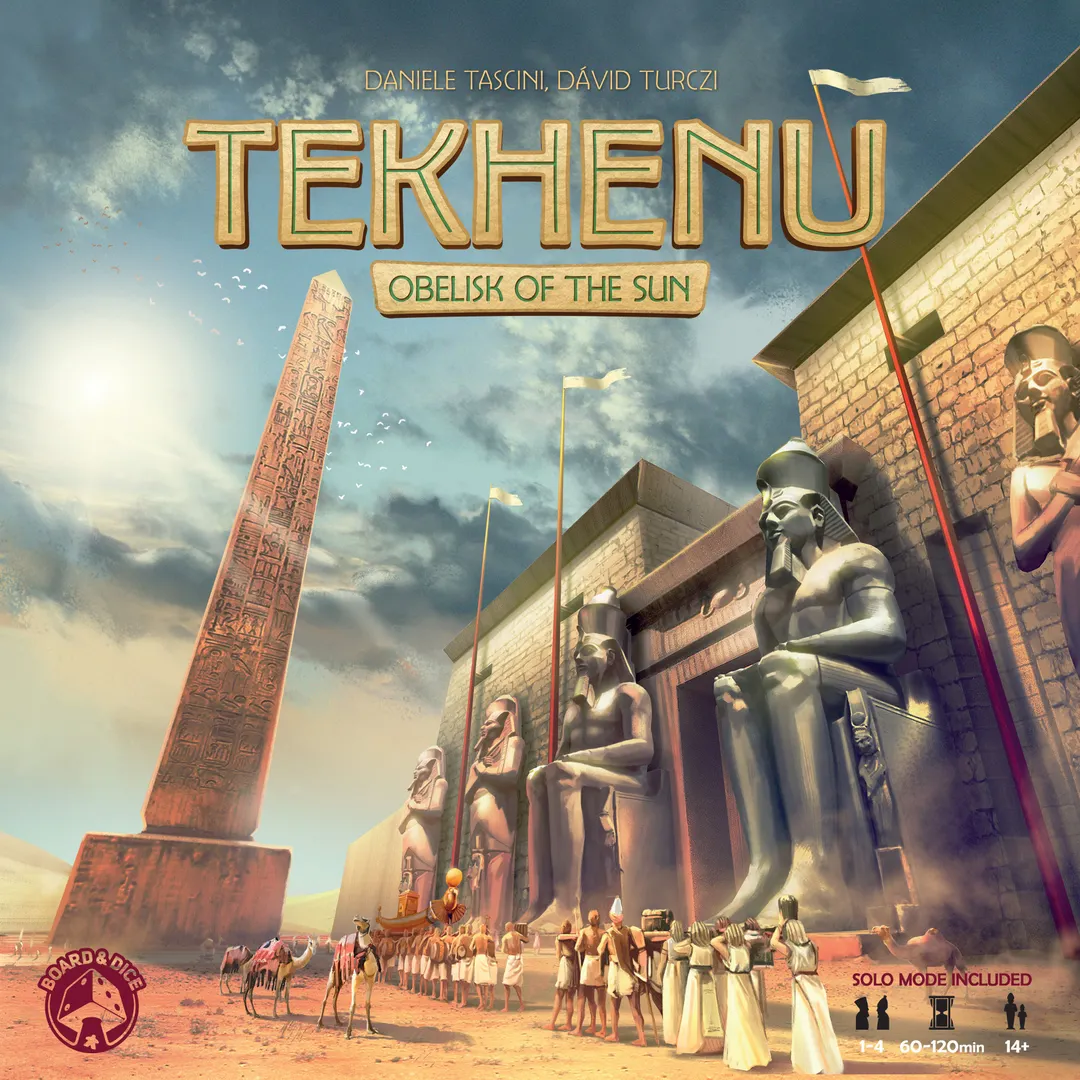
Tekhenu: Obelisk of the Sun est un jeu de société sorti en 2020 pour 1 à 4 joueurs, avec des parties de 60 à 120 minutes et à partir de 14 ans. Il a été conçu par Dávid Turczi et Daniele Tascini et ses principales mécaniques sont Income, Variable Set-up et Pattern Building.


En anglais
Four millennia ago on the eastern bank of the Nile river was laid the foundation of the Temple of Amun-Ra. Over the course of two thousand years, the temple complex was gradually expanded and became widely known as "The Most Select of Places" (Ipet-Isut), boasting the largest religious building in the world. Today, the site is known as Karnak, located at Luxor in modern-day Egypt. Join ancient Pharaohs in creating and growing one of the most impressive sites the world has seen, honoring the Egyptian gods Horus, Ra, Hathor, Bastet, Thoth, and Osiris. You must carefully manage the balance of your actions, preparing for the reckoning by the goddess Maat. The game board in Tekhenu: Obelisk of the Sun is divided into six sections, each associated with an Egyptian god: Horus, Ra, Hathor, Bastet, Thoth, and Osiris. In the center stands an impressive obelisk (Tekhenu) that casts its shadow onto different parts of the board. As a result, the area around the obelisk is divided into sunny, shaded, and dark sections, depending on how the obelisk casts its shadow at that particular moment. As the game progresses, the sun's rotation alters which sections are sunny, shaded, or dark. The game takes place over multiple rounds. Each round, players draft dice and perform actions associated with the value of the die and the section from which the die was drafted. Dice come in five colors, and each die is considered Pure, Tainted, or Forbidden depending on the color of the die and the position of the obelisk's shadow. While you may never draft Forbidden dice, you are free to draft any other die, whether Pure or Tainted. As you draft the dice, you must consider not only the general availability of dice — if no dice are available in a given section, then you cannot readily perform the action associated with that section — but also which value die to draft. You must also consider the purity of the dice to draft, as you must balance your Pure and Tainted actions if you want to have a more favorable position in turn order. When you draft a die, you can perform an action depending on the section you took the die from. Each of the actions corresponds to a different Egyptian god: Horus, Ra, Hathor, Bastet, Thoth and Osiris. Instead of a god action, you can choose to produce, generating resources based on the color and value of the die, but beware of producing in excess of your production capacity, as this is Greed and adds Taint to your balance! Two scoring phases occur during the game, during which players earn victory points based on the workshops, quarries, buildings, statues and pillars they have built, as well as the happiness of their people and production capacity of their resources. However, players must also keep a healthy amount of resources around to sustain their population or they suffer negative consequences.
Selon le catalogue, Tekhenu: Obelisk of the Sun se joue de 1 à 4 personnes. Cette fourchette correspond au nombre de joueurs indiqué par l’éditeur : le jeu s’installe donc pour toute taille de groupe dans cette limite. La mise en place, certaines règles et le décompte peuvent varier selon l’effectif ; vérifiez la configuration exacte dans la règle de votre édition.
La durée indiquée pour Tekhenu: Obelisk of the Sun est de 60 à 120 minutes, selon l’estimation de l’éditeur pour une partie complète. La durée réelle dépend du groupe, de l’effectif et de la connaissance des règles : les premières parties sont plus longues, les groupes expérimentés terminent plus vite. Mise en place et explication des règles ne sont pas comprises.
Le catalogue indique Tekhenu: Obelisk of the Sun à partir de 14 ans. C’est la recommandation de l’éditeur ; elle tient compte de la lecture nécessaire, de la complexité des règles et des petits composants, pas seulement du thème. Les plus jeunes peuvent souvent participer avec l’aide d’un adulte : vérifiez l’âge indiqué sur votre édition et tenez compte de l’expérience de votre groupe.
Tekhenu: Obelisk of the Sun obtient une note de complexité de 4,1 sur 5 auprès des joueurs de BoardGameGeek, ce qui en fait un jeu exigeant. Cette note reflète la quantité de règles, de planification et de décisions qu’exige une partie typique. Prévoyez une explication plus longue pour les jeux exigeants et utilisez un guide de préparation avant la soirée.
Tekhenu: Obelisk of the Sun appartient à ces catégories : Dice, Ancient et Mythology. Ses principales mécaniques sont Income, Variable Set-up et Pattern Building. Les catégories décrivent le thème et l’univers d’un jeu, tandis que les mécaniques décrivent ce que les joueurs font réellement pendant leur tour. Chaque mécanique mène à une page du catalogue avec des jeux similaires.
Les auteurs crédités pour Tekhenu: Obelisk of the Sun sont : Dávid Turczi et Daniele Tascini. Ces crédits proviennent des données publiées du jeu et désignent les personnes responsables de sa conception, et non les illustrateurs ou les éditeurs. Les pages d’auteurs sur MeepleRules regroupent les autres titres des mêmes auteurs, ce qui est utile lorsqu’un jeu vous plaît et que vous en cherchez de similaires.
Le catalogue présente Tekhenu: Obelisk of the Sun comme un jeu de base. Il se joue seul avec le matériel contenu dans la boîte et ne nécessite aucun autre titre. Les extensions, s’il en existe, y ajoutent du contenu ou des règles et sont répertoriées séparément dans le catalogue, avec un lien vers ce jeu de base.