
- Rang BGG
- BGG #682
- Note BGG
- 7,5
DVONN
- 2 joueurs
- 30 min
- Complexité 2,7/5
- 2001
2007
Aide aux règles de TZAAR
Des explications claires des tours, effets de cartes et situations litigieuses, avec des références aux sources officielles et un historique des questions sauvegardé.
Pour 2 joueurs
Que voulez-vous savoir ?
Les réponses viennent du livret officiel, avec la page à vérifier.
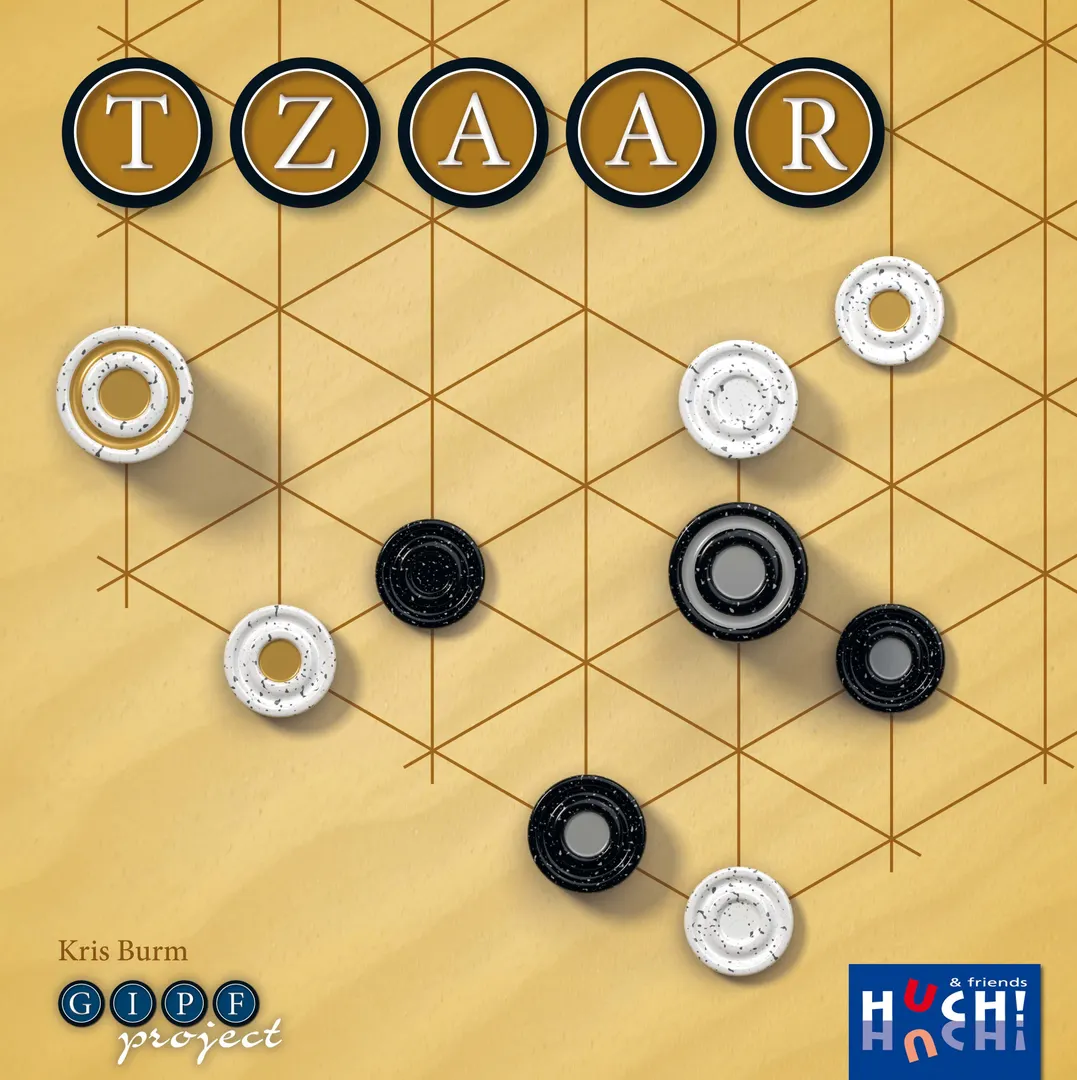
TZAAR est un jeu de société sorti en 2007 pour 2 joueurs, avec des parties de 30 à 60 minutes et à partir de 13 ans. Il a été conçu par Kris Burm et ses principales mécaniques sont Grid Movement et Map Reduction.


En anglais
TZAAR is a game about making choices. Both players have 30 pieces, divided in three types: 6 Tzaars, 9 Tzarras and 15 Totts. The three types of pieces form a trinity: They cannot exist without each other. The aim is either to make the opponent run out of one of the three types of pieces or to put him in a position in which he cannot capture any more. The tricky question the players will have to ask themselves on each of their turns is: “Shall I make myself stronger or my opponent weaker?” Meaning: Will you capture an opponent’s piece and make him weaker, or will you jump on top of one of your own pieces and make yourself stronger? If you choose to jump on top of your own pieces too often, you will probably leave your opponent with too many pieces on the board. On the other hand, if you capture too often, you may end up with pieces that are not strong enough at the end of the game. What to do? Up to you to decide! TZAAR replaced TAMSK as part of project GIPF, which was felt to not quite fit in with the others due to its use of sand timers.
Selon le catalogue, TZAAR se joue à 2 personnes. C’est le nombre de joueurs indiqué par l’éditeur : le jeu est donc conçu pour exactement ce nombre de participants. Les variantes pour d’autres tailles de groupe, s’il en existe, sont décrites dans la règle de votre édition ; consultez-la avant d’installer une autre configuration.
La durée indiquée pour TZAAR est de 30 à 60 minutes, selon l’estimation de l’éditeur pour une partie complète. La durée réelle dépend du groupe, de l’effectif et de la connaissance des règles : les premières parties sont plus longues, les groupes expérimentés terminent plus vite. Mise en place et explication des règles ne sont pas comprises.
Le catalogue indique TZAAR à partir de 13 ans. C’est la recommandation de l’éditeur ; elle tient compte de la lecture nécessaire, de la complexité des règles et des petits composants, pas seulement du thème. Les plus jeunes peuvent souvent participer avec l’aide d’un adulte : vérifiez l’âge indiqué sur votre édition et tenez compte de l’expérience de votre groupe.
TZAAR obtient une note de complexité de 2,5 sur 5 auprès des joueurs de BoardGameGeek, ce qui en fait un jeu plutôt léger. Cette note reflète la quantité de règles, de planification et de décisions qu’exige une partie typique. Prévoyez une explication plus longue pour les jeux exigeants et utilisez un guide de préparation avant la soirée.
TZAAR appartient à ces catégories : Abstract Strategy. Ses principales mécaniques sont Grid Movement et Map Reduction. Les catégories décrivent le thème et l’univers d’un jeu, tandis que les mécaniques décrivent ce que les joueurs font réellement pendant leur tour. Chaque mécanique mène à une page du catalogue avec des jeux similaires.
Les auteurs crédités pour TZAAR sont : Kris Burm. Ces crédits proviennent des données publiées du jeu et désignent les personnes responsables de sa conception, et non les illustrateurs ou les éditeurs. Les pages d’auteurs sur MeepleRules regroupent les autres titres des mêmes auteurs, ce qui est utile lorsqu’un jeu vous plaît et que vous en cherchez de similaires.
Le catalogue présente TZAAR comme un jeu de base. Il se joue seul avec le matériel contenu dans la boîte et ne nécessite aucun autre titre. Les extensions, s’il en existe, y ajoutent du contenu ou des règles et sont répertoriées séparément dans le catalogue, avec un lien vers ce jeu de base.