
- Rang BGG
- BGG #4 448
- Note BGG
- 6,3
Khronos
- 2–5 joueurs
- 90 min
- Complexité 3,6/5
- 2006
2007
Aide aux règles de Utopia
Des explications claires des tours, effets de cartes et situations litigieuses, avec des références aux sources officielles et un historique des questions sauvegardé.
Pour 2 joueurs
Que voulez-vous savoir ?
Les réponses viennent du livret officiel, avec la page à vérifier.
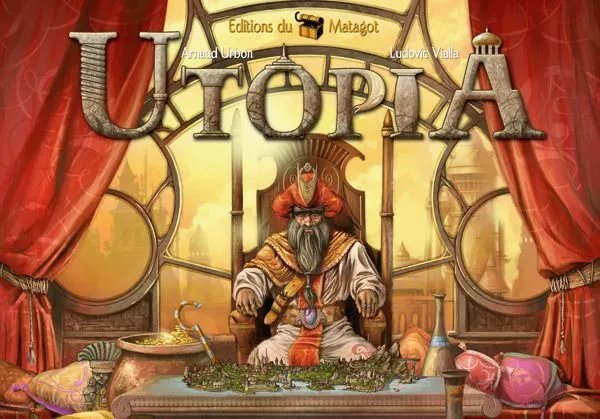
Utopia est un jeu de société sorti en 2007 pour 2 à 5 joueurs, avec des parties de 60 minutes et à partir de 12 ans. Il a été conçu par Ludovic Vialla et Arnaud Urbon et ses principales mécaniques sont Area Movement et Area Majority / Influence.


En anglais
The king of Utopia has invited princes of the greatest civilizations of antiquity to come and live within the walls of his city, welcoming in doing so, the architectural wealth of their far-away cities. As the King’s Minister, your Sovereign has given you the mission to welcome and accompany these princes and princesses who will present themselves at the gates of the city. Every development added to the city made by your guests increases your prestige. Online play Jeux sur un Plateau (turn-based) Components: 40 Monument Figures: 8 for each of the 5 civilizations (Mayan, Persian, Egyptian, Greek and Chinese) 4 Wonder Figures 5 Minister Figures: 1 of each color (used for Score Track) 200 Prince Tokens: 40 of each color 40 Bases: 8 of each color 10 Privilege tokens: 2 of each color 40 Guest tokens: 2 per civilization for each of the four islands on the board 50 Action Cards: 10 for each civilization 5 Rule Summary Cards: 1 per player 1 Bag Basic Game play: Turn order (after the first player) is derived from who has the highest score on the perimtere score track yet has not had a turn. Each game turn is broken down into three phases: Phase 1: Welcoming the Princes Phase 2: Development of the City Phase 3: Calculation of Prestige Points Phase 1: Welcoming the Princes In the first phase, Guest tokens are placed on the board near ship icons but corresponding to the symbol on each token. These guest tokens are then replaced with Prince tokens that is their own color, or of the same civilization as the chosen Guest or in any District of the island indicated by the Guest or any combination of these. This is repeated three times until all Guest tokens have been removed from the board. While this is happening, players may Build a Wonder or Take Control of a District. At any point during their turn, if a player has one prince of each of the 5 civilizations on one island (regardless of which Districts they are in), he may immediately construct a Wonder and receives 6 Prestige Points. There may only be one Wonder per island and a player does not have to construct Wonders. At any point during their turn, if a player possesses 3 princes of the same civilization in the same District, and that District is not already controlled by another player, he may decide to take control of the District by placing a Monument on that District. There can only be one Monument per District, and this space, once acquired, cannot be retaken. For taking control of a District the player gains Prestige Points during Phase 3: Calculation of Prestige Points. Also, if the District belongs to an island where a Wonder has been constructed, the owner of the Wonder immediately scores the number of Prestige Points indicated on the District. Phase 2: Development of the City Each player receives 5 Action cards and discards based on their score in the score track. The person in the lead discards two cards, the last player doesn't discard any and all other players discard one. Four types of actions are possible and occur multiple times in a player's turn: 1) Move one or two princes: If a player decides to move two princes with a single action card, these two princes must be within the same District and make the same movement. LAND MOVEMENT: By discarding an action card, a player may move one or two princes of that civilization to an adjacent District (Districts are separated by alleys or bridges). SEA MOVEMENT: By discarding an action card, a player may move one or two princes of that civilization from one maritime District (showing a ship) to another maritime District. These two Districts must be in the same maritime sector or in two adjacent maritime sectors. (The division of the maritime sectors is indicated by the dotted lines originating from the 3 lighthouses of the city). 2) Add a prince: By discarding an Action Card, a player may place a prince in a District occupied by a Monument of that civilization. 3) Remove a Prince: If the player possesses a prince in a District occupied by a Monument of that civilization, regardless of the player who controls the District, that player may, with an Action Card of that civilization, remove the Prince from the board. For this action the player immediately gains 2 Prestige Points. Th e player’s Minister figure is moved up two places on the Score Track. or 4) Influence the King (altering the Prestige Scale): If the player possesses a prince in a District occupied by a Monument of that civilization, regardless of the player who controls the District, that player may, with an Action Card of that civilization, remove the Prince from the board. For this action the player immediately gains 2 Prestige Points. The player’s Minister figure is moved up two places on the Score Track. The value of each civilization, indicated on the Prestige Scale, determines the point value of the districts controlled by each player at the end of the turn. By discarding an Action Card, a player may increase the value of a civilization by 1. The Value figure of the civilization changes places with the figure directly above it. With two Action cards, a player may reduce the value of a civilization to 1. All the other figures are moved up accordingly. At the end of their turn a player can only have a maximum of 5 Action Cards. Phase 3: Calculation of Prestige Points Once all the players have carried out their actions, the points for the round are calculated. Each player, in turn order, gains points for each District that they control. The value of each civilization is indicated on the Prestige Scale. The players’ Minister figures are moved up the Score Track. If one or more players have reached at least 50 Prestige Points at the end of this phase, the game ends. The player with the most points wins.
Selon le catalogue, Utopia se joue de 2 à 5 personnes. Cette fourchette correspond au nombre de joueurs indiqué par l’éditeur : le jeu s’installe donc pour toute taille de groupe dans cette limite. La mise en place, certaines règles et le décompte peuvent varier selon l’effectif ; vérifiez la configuration exacte dans la règle de votre édition.
La durée indiquée pour Utopia est de 60 minutes, selon l’estimation de l’éditeur pour une partie complète. La durée réelle dépend du groupe, de l’effectif et de la connaissance des règles : les premières parties sont plus longues, les groupes expérimentés terminent plus vite. Mise en place et explication des règles ne sont pas comprises.
Le catalogue indique Utopia à partir de 12 ans. C’est la recommandation de l’éditeur ; elle tient compte de la lecture nécessaire, de la complexité des règles et des petits composants, pas seulement du thème. Les plus jeunes peuvent souvent participer avec l’aide d’un adulte : vérifiez l’âge indiqué sur votre édition et tenez compte de l’expérience de votre groupe.
Utopia obtient une note de complexité de 2,7 sur 5 auprès des joueurs de BoardGameGeek, ce qui en fait un jeu plutôt léger. Cette note reflète la quantité de règles, de planification et de décisions qu’exige une partie typique. Prévoyez une explication plus longue pour les jeux exigeants et utilisez un guide de préparation avant la soirée.
Utopia appartient à ces catégories : City Building. Ses principales mécaniques sont Area Movement et Area Majority / Influence. Les catégories décrivent le thème et l’univers d’un jeu, tandis que les mécaniques décrivent ce que les joueurs font réellement pendant leur tour. Chaque mécanique mène à une page du catalogue avec des jeux similaires.
Les auteurs crédités pour Utopia sont : Ludovic Vialla et Arnaud Urbon. Ces crédits proviennent des données publiées du jeu et désignent les personnes responsables de sa conception, et non les illustrateurs ou les éditeurs. Les pages d’auteurs sur MeepleRules regroupent les autres titres des mêmes auteurs, ce qui est utile lorsqu’un jeu vous plaît et que vous en cherchez de similaires.
Le catalogue présente Utopia comme un jeu de base. Il se joue seul avec le matériel contenu dans la boîte et ne nécessite aucun autre titre. Les extensions, s’il en existe, y ajoutent du contenu ou des règles et sont répertoriées séparément dans le catalogue, avec un lien vers ce jeu de base.