

- Rang BGG
- BGG #11 796
- Note BGG
- 8,4
SEEKRIEG 5
- 2–10 joueurs
- 120 min
- Complexité 4,1/5
- 2004
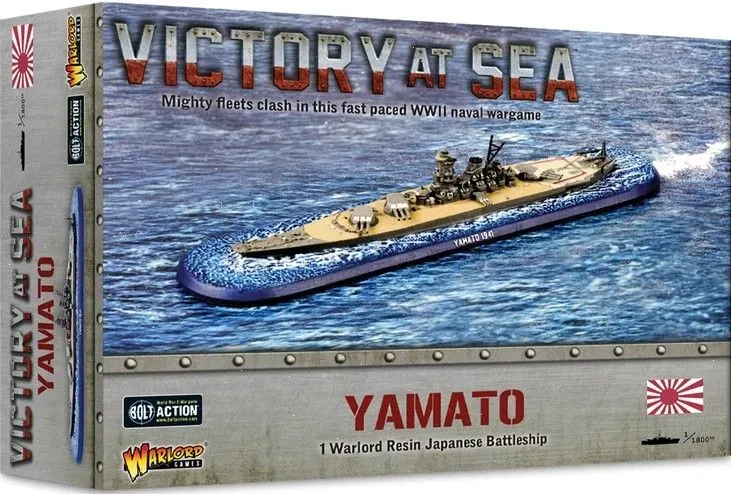
Aide aux règles de Victory at Sea: Yamato
Des explications claires des tours, effets de cartes et situations litigieuses, avec des références aux sources officielles et un historique des questions sauvegardé.
Que voulez-vous savoir ?
Les réponses viennent du livret officiel, avec la page à vérifier.
Victory at Sea: Yamato est une extension de Victory at Sea: Battle for the Pacific sortie en 2020 pour 2 joueurs et à partir de 10 ans. Ses principales mécaniques sont Dice Rolling, Simulation et Measurement Movement.


En anglais
Yamato (大和, "Great Harmony") and her sister ship, Musashi, were constructed shortly before the outbreak of World War II. They were the heaviest and most powerfully armed battleships ever constructed; armed with nine 18.1” Type 94 main guns – the largest guns ever mounted on a warship. The battleship’s design was an answer to the numerically dominant US Navy – Imperial Japan’s primary threat in the Pacific. Though laid down in 1937 the battleship was not actually commissioned until late 1941, a week after fated attack on Pearl Harbour. She served as the flagship of the Combined Fleet. It was from her bridge that Admiral Isoroku Yamamoto directed the fleet at Midway in June 1942, though this proved a disastrous defeat for the Japanese. She was thereafter replaced by the Musashi as flagship and spent the larger part of 1943 and 44 moving between ports in a responsive role. October 1944 was the only occasion on which Yamato fired her main guns in anger, at the Battle of Leyte Gulf. Yamato had been tasked with repelling American forces invading the Phillipines. Though success lay within Japanese grasp, such was the ferocity of a counterattack of a light escort carrier group of the U.S. Navy’s Task Force 77 that the Japanese enacted a retreat, falsely believing they faced a much larger carrier force. By early in 1945, Naval superiority in the Pacific belonged firmly to the US Navy. In an effort to delay the Allies’ advance, Yamato was dispatched to Okinawa in April 1945, with no expectation to ever return. Her orders were to beach herself and fight until destroyed. This was not allowed to occur when, on 7 April 1945 when she was sunk by US carrier-based bombers and torpedo bombers, with the loss of the majority of her complement. Contents: 1 Model Ship ‣ Yamato 1 Ship Card Damage Sliders —description from the publisher
Selon le catalogue, Victory at Sea: Yamato se joue à 2 personnes. C’est le nombre de joueurs indiqué par l’éditeur : le jeu est donc conçu pour exactement ce nombre de participants. Les variantes pour d’autres tailles de groupe, s’il en existe, sont décrites dans la règle de votre édition ; consultez-la avant d’installer une autre configuration.
Le catalogue indique Victory at Sea: Yamato à partir de 10 ans. C’est la recommandation de l’éditeur ; elle tient compte de la lecture nécessaire, de la complexité des règles et des petits composants, pas seulement du thème. Les plus jeunes peuvent souvent participer avec l’aide d’un adulte : vérifiez l’âge indiqué sur votre édition et tenez compte de l’expérience de votre groupe.
Victory at Sea: Yamato appartient à ces catégories : Wargame, Miniatures et Nautical. Ses principales mécaniques sont Dice Rolling, Simulation et Measurement Movement. Les catégories décrivent le thème et l’univers d’un jeu, tandis que les mécaniques décrivent ce que les joueurs font réellement pendant leur tour. Chaque mécanique mène à une page du catalogue avec des jeux similaires.
Le catalogue présente Victory at Sea: Yamato comme une extension de Victory at Sea: Battle for the Pacific. Les extensions ajoutent du contenu, des règles ou des scénarios au jeu de base et ne se jouent généralement pas seules : il vous faut donc Victory at Sea: Battle for the Pacific pour l’utiliser. Vérifiez que votre édition de Victory at Sea: Battle for the Pacific est compatible, car certaines extensions ont été révisées d’une édition à l’autre.