
- Rang BGG
- BGG #5 638
- Note BGG
- 7,0
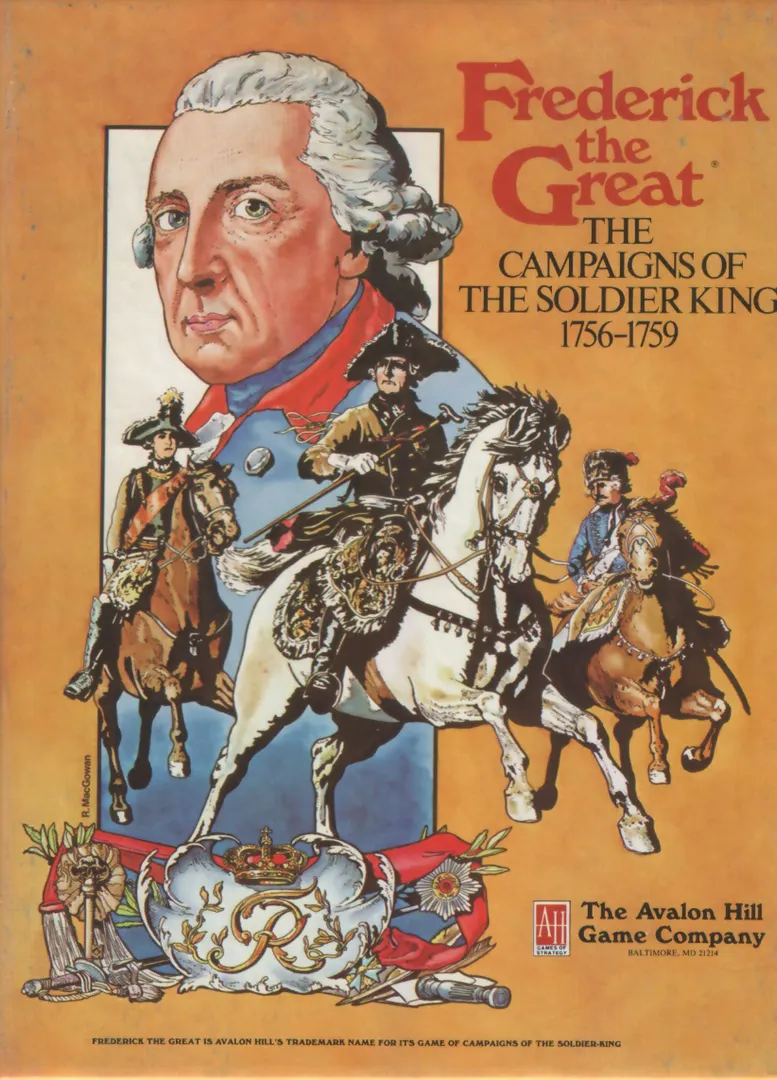
Frederick the Great: The Campaigns of The Soldier King 1756-1759
- 2–4 joueurs
- 180–240 min
- Complexité 2,7/5
- 1975
1976
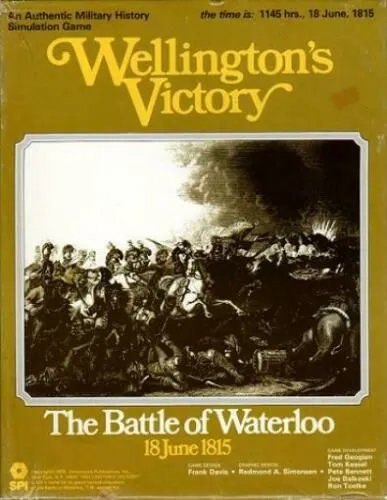
Aide aux règles de Wellington's Victory: Battle of Waterloo Game – June 18th, 1815
Des explications claires des tours, effets de cartes et situations litigieuses, avec des références aux sources officielles et un historique des questions sauvegardé.
Pour 2 joueurs
Que voulez-vous savoir ?
Les réponses viennent du livret officiel, avec la page à vérifier.
Wellington's Victory: Battle of Waterloo Game – June 18th, 1815 est un jeu de société sorti en 1976 pour 2 joueurs, avec des parties de 240 minutes et à partir de 12 ans. Il a été conçu par Frank Davis et ses principales mécaniques sont Dice Rolling, Hexagon Grid et Ratio / Combat Results Table.






En anglais
[from the back of the flatpack edition] Wellington's Victory : The Battle of Waterloo - Four-color 68” x 44” contour map in four sections - Innovative Fire and Shock Combat mechanics - Line, Column, Square, Skirmish and Cavalry formations - Hougomont, La Haye Sainte and Plancenoit Scenarios - 40 Game-Turn Grand Battle Scenario Wellington's Victory is a grand tactical simulation of the Battle of Waterloo which occurred on June 18, 1815, at a minor crossroads south of Brussels, Belgium. The battle marked the first and only encounter of history's two most renowned generals, Sir Arthur Wellesley, Duke of Wellington, and Napoleon Bonaparte, Emperor of France. A brutal day-long French assault against the British held ridge brought Wellington's army to the brink of defeat. By later afternoon, however, the arrival of Wellington's allies tipped the odds decisively against the French; Napoleon chose to stake his empire on the outcome of a final attack by his most trusted troops – the Imperial Guard. Wellington's Victory is played on an innovative game map composed of four 34” x 22” map sections on which significant differences in ground contours are differentiated by color. There are five distinct contour levels depicted on the map as well as an extremely accurate survey of all battle field terrain features including Hougomont, La Haye Sainte, and almost every other farm and dwelling, woods and orchards, streams and ponds, and raised and sunken roads. Each of more than 500 French, Prussian and Anglo-Dutch combat and command units are fully identified by battalion, regiment, brigade, division and corps designations as well as numerical game values which differentiate each unit's strength, effectiveness, and mobility. The game utilizes a fifteen minute Game-Turn. Each mapsheet hex represents a distance of 100 yards. Each Strength Point represents 100 infantry or cavalry troops or one gun or howitzer within an artillery battery. Each Game-Turn employs a unique, asymmetrical, sequence of play in which Players alternately participate in a series of Phases covering activities which include the execution of chain of command mechanics (such as activating and committing reserve formations and initiating cavalry charges), rallying disordered and routed units, executing facing and formation changes (including a repertoire of infantry formations such as column, line, square and open order or skirmish formation), regular and grand tactical movement, and finally executing artillery and small arms fire as well as infantry and cavalry shock command. The Fire and Shock Combat mechanics which decide the battle were also designed to yield realistic results without sacrificing playability. Fire resolution requires no arithmetic calculation since each unit fires separately. The Relative Firepower Table used to resolve Fire Combat is a new type of CRT which directly interrelates the strength, formation and quality of the firing unit with the formation and terrain cover employed by the defending unit. The Shock Combat Table is also unique in that it employs an “odds” comparison to account for Troop strength differences between the attacker and defender and a “differential” comparison to account for any qualitative difference between the opposing forces. Losses, which are recorded directly on the map by placing a Strength marker under the unit suffering casualties, may result from either Fire or Shock combat. In general, however, Shock Combat is depicted as a “morale showdown” more useful for gaining ground than inflicting casualties. Morale, which Napoleon deemed to be three times as important as numerical strength on the battlefield, is accurately accounted for in the Effectiveness Rating assigned to every infantry battalion, cavalry regiment and artillery battery crew. Buyer's Guide for WELLINGTON'S VICTORY The following ratings are based on at least 100 player-replies to surveys conducted through Strategy & Tactics Magazine. Ratings are on a 1 (worst) to 9 (best) scale. Average ratings (for over 60 historical games in print) are: Acceptability-6.00, Complexity-5.00. Acceptability Rating: New Game Complexity Rating: (est.) 7.8 Avg. Playing Time [hrs.] (est.) 6.0 “Acceptability” depends a lot on which historical period interests you the most. “Complexity” ratings for other games are, for example, Monopoly – 2.34; Afrika Korps – 3.48; Diplomacy – 4.51; France, 1940 – 5.78; PanzerBlitz – 7.01. Most games average 2-3 hours playing time.
Selon le catalogue, Wellington's Victory: Battle of Waterloo Game – June 18th, 1815 se joue à 2 personnes. C’est le nombre de joueurs indiqué par l’éditeur : le jeu est donc conçu pour exactement ce nombre de participants. Les variantes pour d’autres tailles de groupe, s’il en existe, sont décrites dans la règle de votre édition ; consultez-la avant d’installer une autre configuration.
La durée indiquée pour Wellington's Victory: Battle of Waterloo Game – June 18th, 1815 est de 240 minutes, selon l’estimation de l’éditeur pour une partie complète. La durée réelle dépend du groupe, de l’effectif et de la connaissance des règles : les premières parties sont plus longues, les groupes expérimentés terminent plus vite. Mise en place et explication des règles ne sont pas comprises.
Le catalogue indique Wellington's Victory: Battle of Waterloo Game – June 18th, 1815 à partir de 12 ans. C’est la recommandation de l’éditeur ; elle tient compte de la lecture nécessaire, de la complexité des règles et des petits composants, pas seulement du thème. Les plus jeunes peuvent souvent participer avec l’aide d’un adulte : vérifiez l’âge indiqué sur votre édition et tenez compte de l’expérience de votre groupe.
Wellington's Victory: Battle of Waterloo Game – June 18th, 1815 obtient une note de complexité de 4,2 sur 5 auprès des joueurs de BoardGameGeek, ce qui en fait un jeu exigeant. Cette note reflète la quantité de règles, de planification et de décisions qu’exige une partie typique. Prévoyez une explication plus longue pour les jeux exigeants et utilisez un guide de préparation avant la soirée.
Wellington's Victory: Battle of Waterloo Game – June 18th, 1815 appartient à ces catégories : Wargame et Napoleonic. Ses principales mécaniques sont Dice Rolling, Hexagon Grid et Ratio / Combat Results Table. Les catégories décrivent le thème et l’univers d’un jeu, tandis que les mécaniques décrivent ce que les joueurs font réellement pendant leur tour. Chaque mécanique mène à une page du catalogue avec des jeux similaires.
Les auteurs crédités pour Wellington's Victory: Battle of Waterloo Game – June 18th, 1815 sont : Frank Davis. Ces crédits proviennent des données publiées du jeu et désignent les personnes responsables de sa conception, et non les illustrateurs ou les éditeurs. Les pages d’auteurs sur MeepleRules regroupent les autres titres des mêmes auteurs, ce qui est utile lorsqu’un jeu vous plaît et que vous en cherchez de similaires.
Le catalogue présente Wellington's Victory: Battle of Waterloo Game – June 18th, 1815 comme un jeu de base. Il se joue seul avec le matériel contenu dans la boîte et ne nécessite aucun autre titre. Les extensions, s’il en existe, y ajoutent du contenu ou des règles et sont répertoriées séparément dans le catalogue, avec un lien vers ce jeu de base.