

- Posizione BGG
- BGG #2362
- Valutazione BGG
- 8,0
SPQR (Deluxe Edition)
- 1–4 giocatori
- 240 min
- Complessità 3,9/5
- 2008
2008
Aiuto con le regole di Chandragupta: Great Battles of the Mauryan Empire – India, 319-261 BC
Spiegazioni chiare di turni, effetti delle carte e situazioni dubbie, con riferimenti alle fonti ufficiali e cronologia delle domande salvata.
Per 2 giocatori
Cosa vuoi sapere?
Le risposte vengono dal regolamento ufficiale, con la pagina da verificare.
Chandragupta: Great Battles of the Mauryan Empire – India, 319-261 BC è un gioco da tavolo pubblicato nel 2008 per 2 giocatori, con partite da 240 minuti e dai 12 anni in su. È stato ideato da Richard H. Berg, Mark Herman, Alan J. Ray e Stephen R. Welch e le sue meccaniche principali sono Dice Rolling e Hexagon Grid.










In inglese
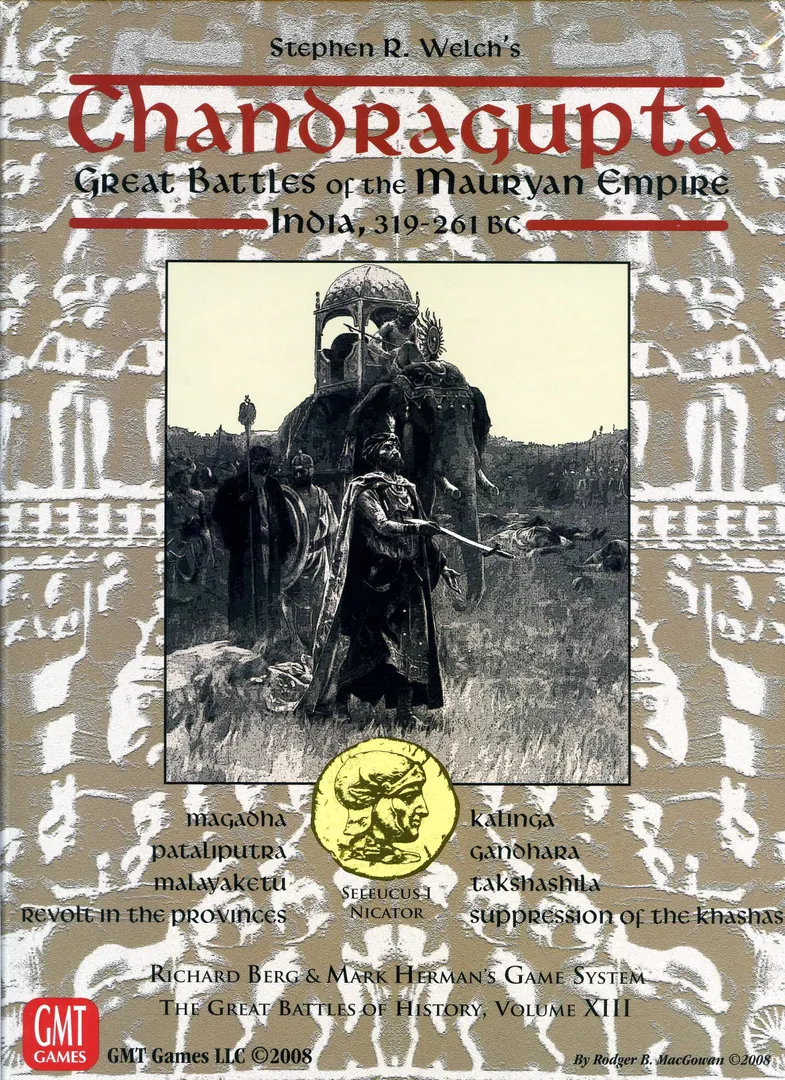
Chandragupta brings the art of war in ancient India to GMT’s “Great Battles of History” Series. Beginning with Chandragupta Maurya’s victories over the Nanda clan, the game follows the brief but rapid rise of the Mauryan dynasty, from Chandragupta’s expulsion of Seleucus from the Indus river valley to the conquest of the last independent kingdom on the subcontinent, Kalinga, by his grandson Ashoka. The Mauryan empire became the largest and most powerful in India’s history – a distinction that would remain unchallenged until the arrival of the Mughals some 1,700 years later. Chandragupta simulates the traditional “four-fold” division of the Indian military system, with the elephant corps reigning supreme, and the hordes of light infantry regarded as little more than fodder for chariots’ wheels and trampling pachyderms. Chariots still play a prominent role on the Indian battlefield of the era, but the cavalry, with its versatility and endurance, is a potent competitor. In Chandragupta, victory goes to the commander who can master the unique aspects of the differing Indian military “classes” – the professional, lifelong soldiers called Maulas, the mercenary levies, unpredictable tribal allies, and the militias of the powerful trade guilds. While Maulas and mercenaries are commanded under a single hierarchical command structure, the tribals and the trade guilds are led by independent chiefs. Units include cataphracted elephants, “heavy” four- (and sometimes eight-!) wheeled chariots, and even an “elCH” unit – yes, elephant-pulled chariots. Rules include Combined Chariot/Infantry and Elephant/Infantry lines, Dharmayudda or “just” warfare, Guild enmity, and Tribal loyalty. EL units can even breach camp walls and pull down city gates (if they don’t rampage first). Fans of GBoH will appreciate the exciting variety in Chandragupta’s scenarios, from huge set-piece battles on flat plains, to tribal suppressions, a night assault on a military camp, and street fighting in the city of Takshashila. Chandragupta is the 13th volume in the series. Battles: Pataliputra (319 BC) – Chandragupta’s mentor, the Brahmin Chanakya, brashly challenges the Nanda dynasty with a cadre of mercenaries. Maghada (317 BC) – Chandragupta again confronts the Nandas, who are this time led by the formidable general Bhadrasala. Mayalaketu (317 BC) – Chanakya attacks the turncoat general Mayalaketu and his rebel army in camp. Takshashila (316 BC) – the Thracian general Eudamus, allied to Indian king Ambhi, defends the city of Takshashila against Chandragupta’s assault. Gandhara (304 BC) – former officer of Alexander the Great, now “Master of Babylonia,” Seleucus I Nicator crosses the Indus river to invade Gandhara, and is confronted by the Mauryan army at the river’s banks. Revolt in the Provinces (275 BC) – Chandragupta’s grandson, Ashoka, brings a relief force to lift a rebel siege of Takshashila and rescue the aging Chanakya who is holed up in the city’s palace. Khashas (274 BC) – Chandragupta’s son, Bhindusara, puts down a confederation of the independent Khasha kings with an attack on their mountain strongholds. Kalinga (261 BC) – the most famous battle of the Mauryan era, Ashoka’s army attacks the kingdom of Kalinga in a huge – and bloody -- set-piece battle.
Secondo il catalogo, Chandragupta: Great Battles of the Mauryan Empire – India, 319-261 BC supporta 2 giocatori. È il numero di giocatori indicato dall’editore, quindi il gioco è pensato esattamente per quel numero di partecipanti. Le varianti per gruppi di altre dimensioni, se esistono, sono descritte nel regolamento della tua edizione: consultalo prima di preparare una configurazione diversa.
La durata indicata per Chandragupta: Great Battles of the Mauryan Empire – India, 319-261 BC è di 240 minuti, la stima dell’editore per una partita completa. La durata effettiva dipende dal gruppo, dal numero di giocatori e dalla conoscenza delle regole: le prime partite durano di più, i gruppi esperti finiscono prima. Preparazione e spiegazione delle regole non sono comprese nella stima.
Il catalogo indica Chandragupta: Great Battles of the Mauryan Empire – India, 319-261 BC dai 12 anni in su. È la raccomandazione dell’editore e tiene conto della lettura richiesta, della complessità delle regole e dei componenti piccoli, non solo del tema. I più giovani spesso possono giocare con l’aiuto di un adulto: controlla l’età consigliata sulla tua edizione e l’esperienza del tuo gruppo con i giochi da tavolo.
Chandragupta: Great Battles of the Mauryan Empire – India, 319-261 BC ha un punteggio di complessità di 3,8 su 5 secondo i giocatori di BoardGameGeek, il che lo rende un gioco impegnativo. Il punteggio riflette quanta conoscenza delle regole, pianificazione e decisioni richiede una partita tipica. I giochi impegnativi richiedono una prima spiegazione più lunga, quindi conviene usare una guida di preparazione.
Chandragupta: Great Battles of the Mauryan Empire – India, 319-261 BC appartiene a queste categorie: Wargame e Ancient. Le sue meccaniche principali sono Dice Rolling e Hexagon Grid. Le categorie descrivono il tema e l’ambientazione di un gioco, mentre le meccaniche descrivono ciò che i giocatori fanno davvero nel proprio turno. Ogni meccanica porta a una pagina del catalogo con giochi simili.
Gli autori accreditati di Chandragupta: Great Battles of the Mauryan Empire – India, 319-261 BC sono: Richard H. Berg, Mark Herman, Alan J. Ray e Stephen R. Welch. Questi crediti provengono dai dati pubblicati del gioco e indicano le persone responsabili della sua progettazione, non gli illustratori o gli editori. Le pagine degli autori su MeepleRules raccolgono altri titoli degli stessi autori, utili quando un gioco ti piace e ne cerchi di simili.
Il catalogo classifica Chandragupta: Great Battles of the Mauryan Empire – India, 319-261 BC come gioco base. Si gioca da solo con i componenti presenti nella scatola e non richiede altri titoli. Le espansioni, se esistono, aggiungono nuovo contenuto o nuove regole e sono elencate separatamente nel catalogo con un collegamento a questo gioco base.