
- Posizione BGG
- BGG #15.829
- Valutazione BGG
- 7,6
Rolling Deep
- 1 giocatore
- 45 min
- Complessità 2,3/5
- 2027
2026
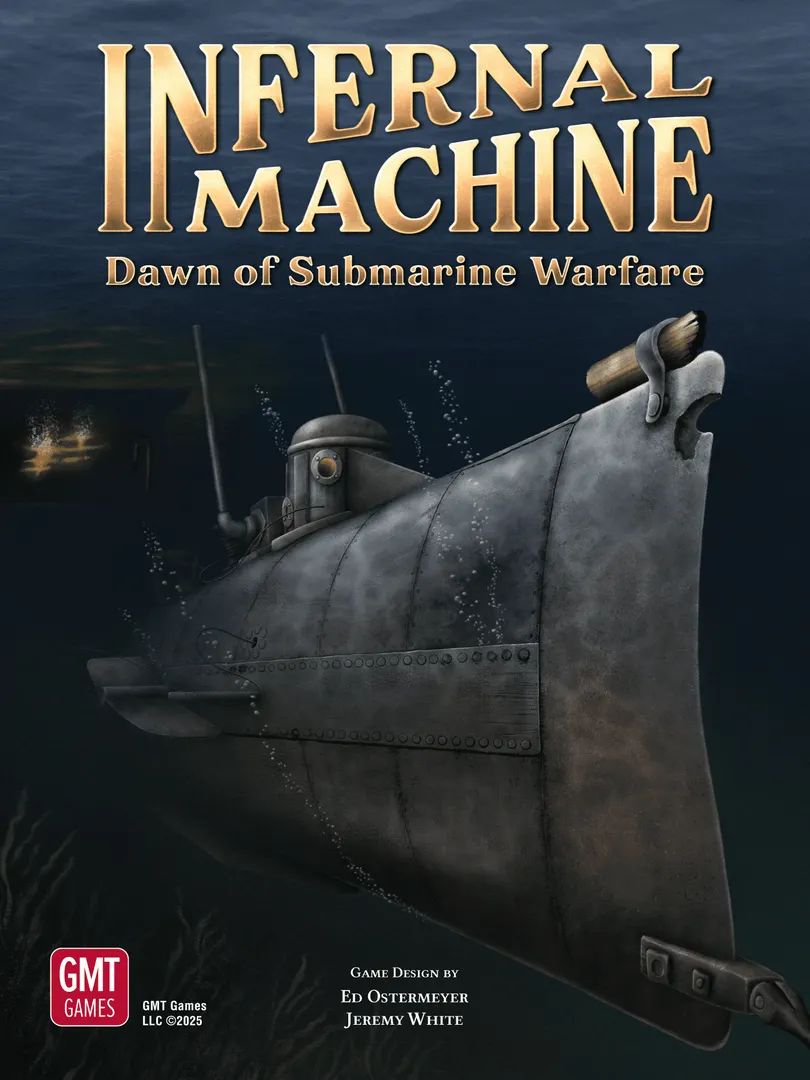
Aiuto con le regole di Infernal Machine: Dawn of Submarine Warfare
Spiegazioni chiare di turni, effetti delle carte e situazioni dubbie, con riferimenti alle fonti ufficiali e cronologia delle domande salvata.
Per 1 giocatore
Cosa vuoi sapere?
Le risposte vengono dal regolamento ufficiale, con la pagina da verificare.
Infernal Machine: Dawn of Submarine Warfare è un gioco da tavolo pubblicato nel 2026 per 1 giocatore, con partite da 30 a 90 minuti e dai 14 anni in su. È stato ideato da Jeremy White e Ed Ostermeyer e le sue meccaniche principali sono Push Your Luck, Track Movement e Dice Rolling.







In inglese
The time: late evening The date: 17 February 1864 The Place: Breach Inlet, South Carolina Standing in the submarine’s forward hatch, Lieutenant George E. Dixon pulled his cap down and tightened up his oilskin watch coat. The February sea cut through to his bones. This was the third night he ventured from behind Battery Marshall on Sullivan’s Island, and his seven-man crew was grumpy from having had no luck spotting, let alone attacking even one of the Yankee warships blockading Charleston harbor. Dixon fingered the dented $20 gold piece in his trouser pocket. It was a gift from Queenie, his sweetheart, a keepsake that already earned its place aboard ship. A few months earlier at a wooded tangle of a place called Shiloh, the coin stopped a minie ball from shattering his leg. The dent reminded him how fickle fate and fortune are in this war, and it reminded him of home. He had that coin engraved “Shiloh April 6th, 1862. My life Preserver” and added his initials “G.E.D.”, so sure was he of the coin’s power. Well, tonight that power was napping. Frustrated and cold, Dixon took one last look to the southeast through his telescope. The weather wasn’t likely to improve and he hoped that this would be the night he and the crew of the “CSS Hunley” would strike a blow against the Yankee blockade. Here now… was that a light? There! And once again, low and to the south-southeast. A light! He rapped the coin against the hull to startle the men. “Look sharp,” he muttered. Then, in a voice low and tense, he said “Look sharp and prepare to crank!” Game Overview Infernal Machine: Dawn of Submarine Warfare is a solitaire board game that casts the player in the role of inventor/entrepreneur in mid-19th century America. The game is set during a historical moment when the business environment has gotten rather dynamic – it is the tumultuous landscape of the American Civil War. The player’s task is to design, build, and put to use a submarine during that war. Infernal Machine can be played either in scenario form or campaign. In a campaign, you can choose the city or port where the project’s machine shop will be located. Since construction materials and labor costs money, your role as entrepreneur comes into play as you seek out Investors to join your team; their cash will provide the funds that help your Fishboat take shape. As Inventor, your design gives form and substance to the size and shape of your submarine, and to its capabilities. Will it carry a snorkel? Will its prow be an armored ram? Will it have dive planes? Will it push a spar torpedo? Will it be powered by the muscle strength of a crew cranking the propeller or will you install a boiler engine? To bring blueprints to life, you will need to hire Mechanics, whose engineering expertise keeps the machine’s construction on schedule. Once assembly is complete, your Mechanics can join the crew, using their repair capability to keep the machinery and the vessel running smoothly. Journeymen can also lend a hand on the shop floor and inside the Fishboat, while Sailors bring nautical know-how as well as sheer brawn. While that machine shop is busy with the submarine’s construction, the game reminds you that the war drags on and it is an unstable business environment. Prices for materials and labor fluctuate. Current events can affect your construction schedule and your machine shop’s performance. Public, and even personal circumstances may force your hand. You may decide to push your Fishboat into the water before you feel it is optimal, or push your crew into battle with little training. In this game you assign crew, taking their characteristics into consideration, such as morale, strength, engineering expertise. Your first mission will most likely be a simple affair, propelling the infernal machine forward, submerging, turning about, and returning to the surface. It will garner valuable experience that improves your crew’s Training Level. But even that simple affair could prove treacherous. Will the Fishboat drift? Will it sink and become irretrievable? Will your crew panic in the dark as they breathe in the exhalation of their comrades in that cramped machine? Will you be forced to evacuate the crew and salvage the Fishboat later? Will the crew survive the ordeal? Later missions will be directed at the enemy. In this game, you may play either side, Union or Confederate. There are a variety of missions and targets. Will your Fishboat be aimed at the Federal blockade? Will it pull a mine at the end of a rope, or push a torpedo at the end of a spar? Will the crew survive contact with the enemy? Will they survive their own weapon’s detonation? Perhaps the nature of the mission will be quite different. Will you carry a spy into enemy territory? Will your Fishboat unload a raiding party? Secrecy is vital. Will you send your machine out under a moonless sky? That will help conceal crew and machine but it will make navigation difficult. Will you limit the number of machinists and investors, thereby reducing the chance of rumor or gossip leaking out? Too few and you compromise your machine’s capabilities. Your Fishboat’s chances are much better if that machine is kept a secret, but it is a cantankerous machine that will punish mistakes. A successful mission means your coffers will be filled with prize money. This is a capitalist’s war, and the War Department is offering juicy bounties. In contrast, there are many ways to fail. Coming back without making contact with the enemy is one way, but it could be far worse. Will you add the names of your crew to the Rolls of the Missing? Scenarios and Campaign Historical scenarios use only part of the rules to present such events as the CSS Hunley’s successful attack outside Charleston Harbor in 1864. It was the first time a submarine sank its target, a landmark event in military history. The heart of the game is the campaign, which allows you to design and build your Infernal Machine, select a crew, train that crew, and perform missions against the enemy. You manage funds and personnel, and navigate the fortunes of war as well as the waterways in enemy territory. A scenario will take approximately two hours to play while a campaign can last several gaming sessions as it spans the calendar from 1861 to the end of the war in 1865. Sequence of Play Each monthly turn gives you an opportunity to recruit personnel (Investors, Mechanics, Journeymen, or Sailors), each represented by a deck of cards. Each recruit comes with one or more benefits as well as costs or drawbacks. An Investor, for example, may be a generous provider of funds, but he may insist on being the captain of the ship. Does he know what he’s doing?! A Sailor may prove to be strong and cool under pressure, but he may be clumsy. Will that clumsiness jeopardize his crewmates? Each turn also provides you an opportunity to work on your Fishboat. You purchase Bulkheads and other major sections of the submarine, each represented by tiles. They cost funds and require engineering expertise to incorporate into a seaworthy vessel. You also purchase a variety of mechanisms as you make decisions about the capability of your Fishboat. Recruitment and Building is followed by the passage of time when the Month marker is moved forward on the calendar. Debts must be paid, if you have any, and you must check the Fortunes of War table to see if something unexpected happens that month. Will prices rise? Will one of your Journeymen get engaged and leave your shop? Will the enemy shell the wharf where your Fishboat is waiting to go into action? Will you get an offer to use your machine shop to make parts for the War Department, giving you a contract and additional funds? Will the enemy capture the town, forcing you to move to another location? Each month has its own table of random events, and there is one set used when playing Union and another when playing Confederate. This adds to the feel of the historical experience while also increasing replayability. The Confederate experience is quite different from playing the Union. The latter is an industrial business environment while the Confederacy’s economy gradually spirals into oblivion. Each month you have the option to finish the turn by taking your seaworthy Fishboat into action. There are four Action Boards in the box, each providing its own unique historical and nautical conditions (Charleston, Mobile, New Orleans, and the James River from City Point to Richmond). You setup a mission by establishing meteorological conditions on the Action Board (drift direction, drift intensity, visibility, and weather), and assign each crewman a position inside your Fishboat. Will you call off the mission because the current is too strong? Will you wait for a better opportunity, or will you push ahead despite the risk? Your submarine will move from one space to the next as it executes its mission. During a mission you assign jobs to each crewman (crank, repair, rally, or operating a mechanism). This is new technology and the submarine is an untried machine, so malfunctions are likely and you will assign crew to manage and hopefully repair them. In many cases, just getting out there and locating a target is a victory of sorts, and getting the crew back home can feel like a triumph. Of course, your mandate is to do more than make contact with the enemy and survive. To gain prize money, you will have to prove your machine’s efficacy against the enemy. It’s an old story: higher the risk, greater the reward. If you manage to navigate your machine and crew to make contact with its target, action shifts to the Tactical Board. There, the Fishboat closes in and you hope conditions are right so that it remains concealed. Decisions you made leading up to this tense moment have put your crew in a good position, or maybe in a bad one. In either case, history is watching. Game Components 4 Actions Boards (12” x 18”), 1 Mechanics Board (8” x 18”), 1 Tactical Board (8.5” x 11”), 3 Countersheets (including boat tiles), 3 Card Decks (Recruits, Navigation, Discovery), 2 d10 dice Booklets and Player Aids -description from publisher's website
Secondo il catalogo, Infernal Machine: Dawn of Submarine Warfare supporta 1 giocatore. È il numero di giocatori indicato dall’editore, quindi il gioco è pensato esattamente per quel numero di partecipanti. Le varianti per gruppi di altre dimensioni, se esistono, sono descritte nel regolamento della tua edizione: consultalo prima di preparare una configurazione diversa.
La durata indicata per Infernal Machine: Dawn of Submarine Warfare è di 30–90 minuti, la stima dell’editore per una partita completa. La durata effettiva dipende dal gruppo, dal numero di giocatori e dalla conoscenza delle regole: le prime partite durano di più, i gruppi esperti finiscono prima. Preparazione e spiegazione delle regole non sono comprese nella stima.
Il catalogo indica Infernal Machine: Dawn of Submarine Warfare dai 14 anni in su. È la raccomandazione dell’editore e tiene conto della lettura richiesta, della complessità delle regole e dei componenti piccoli, non solo del tema. I più giovani spesso possono giocare con l’aiuto di un adulto: controlla l’età consigliata sulla tua edizione e l’esperienza del tuo gruppo con i giochi da tavolo.
Infernal Machine: Dawn of Submarine Warfare ha un punteggio di complessità di 3,2 su 5 secondo i giocatori di BoardGameGeek, il che lo rende un gioco di media complessità. Il punteggio riflette quanta conoscenza delle regole, pianificazione e decisioni richiede una partita tipica. I giochi impegnativi richiedono una prima spiegazione più lunga, quindi conviene usare una guida di preparazione.
Infernal Machine: Dawn of Submarine Warfare appartiene a queste categorie: Wargame, Dice e Nautical. Le sue meccaniche principali sono Push Your Luck, Track Movement e Dice Rolling. Le categorie descrivono il tema e l’ambientazione di un gioco, mentre le meccaniche descrivono ciò che i giocatori fanno davvero nel proprio turno. Ogni meccanica porta a una pagina del catalogo con giochi simili.
Gli autori accreditati di Infernal Machine: Dawn of Submarine Warfare sono: Jeremy White e Ed Ostermeyer. Questi crediti provengono dai dati pubblicati del gioco e indicano le persone responsabili della sua progettazione, non gli illustratori o gli editori. Le pagine degli autori su MeepleRules raccolgono altri titoli degli stessi autori, utili quando un gioco ti piace e ne cerchi di simili.
Il catalogo classifica Infernal Machine: Dawn of Submarine Warfare come gioco base. Si gioca da solo con i componenti presenti nella scatola e non richiede altri titoli. Le espansioni, se esistono, aggiungono nuovo contenuto o nuove regole e sono elencate separatamente nel catalogo con un collegamento a questo gioco base.