
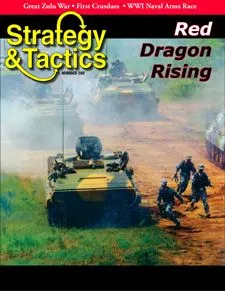
- Posizione BGG
- BGG #10.475
- Valutazione BGG
- 7,2
Red Dragon Rising: The Coming War With China
- 1–2 giocatori
- 180 min
- Complessità 2,9/5
- 2008

2012
Aiuto con le regole di Red Dragon / Green Crescent
Spiegazioni chiare di turni, effetti delle carte e situazioni dubbie, con riferimenti alle fonti ufficiali e cronologia delle domande salvata.
Cosa vuoi sapere?
Le risposte vengono dal regolamento ufficiale, con la pagina da verificare.
Red Dragon / Green Crescent è un gioco da tavolo pubblicato nel 2012 per 1–2 giocatori, con partite da 180 minuti e dai 14 anni in su. È stato ideato da Bruce Costello e le sue meccaniche principali sono Area Movement e Dice Rolling.




In inglese
Red Dragon/Green Crescent (RDGC) is a strategic-level, intermediate-complexity wargame, with operational undertones, covering hypothetical future conflicts around the southern and eastern peripheries of Asia. The timeframe is the near future, between 2013 and 2021. The game has been designed using the CSR Award winning system that first appeared in Strategy & Tactics no. 250. It’s adaptable for two player, multi-player and solitaire play. RDGC expands the original game into a two-mapper covering the Indian Ocean and Middle East, areas strategic to both the US and its allies and the Peoples Republic of China and its allies. In the game, Chinese forces that may be initially deployed into the Indian Ocean area are few, but they also have one solid ally at start: Myanmar. Besides Myanmar, there are other question marks for US planners. For instance, would Pakistan stand idly by if India allied with the US, given the existential threat they perceive of a US-Indian victory in a war with China? And what about Iran: if that country is ever to make a move to achieve dominance in the Persian Gulf, what better time than during a major war while its winners aren’t yet clear? There’s also the rest of the troubled Middle East (Egypt-Syria-Lebanon-Israel). That collective totality makes for a wonderfully varied gaming situation. Besides the main scenarios, there are numerous variants and options, adding new dimensions and giving literally hundreds of new possibilities for play. Most of the ground units in RDGC represent brigades (“brigade combat teams” or “BCT” for the US). The exceptions are the Singaporean, Malaysian, Taiwanese, Philippine, and Yemeni armies. There is additionally one new corps of marines for the PRC. Aircraft are mostly represented by mixed-type combat-wings, though only one aircraft type is shown on each counter. Long-range bombers have their own mono-type units that can’t combine operations with the other ‘tactical’ air wings. Ship units mostly represent mission-oriented groups of vessels such as SAGs, subrons or individual capital ships. Game turns represent varied amounts of “real time,” depending on the “operation” presently being conducted, from one to three days. An entire match encompasses the first month of the wars being examined. Scenarios include partial and two-map games, some centered on the Korean peninsula, others on the Indo-Pakistan area, and others taking in the entire, huge, arcing region from the Red Sea to Alaska.
Secondo il catalogo, Red Dragon / Green Crescent supporta da 1 a 2 giocatori. L’intervallo corrisponde al numero di giocatori indicato dall’editore, quindi il gioco si può preparare per qualsiasi gruppo entro quei limiti. Preparazione, alcune regole e punteggio possono comunque variare in base al numero di giocatori: controlla la configurazione esatta nel regolamento della tua edizione.
La durata indicata per Red Dragon / Green Crescent è di 180 minuti, la stima dell’editore per una partita completa. La durata effettiva dipende dal gruppo, dal numero di giocatori e dalla conoscenza delle regole: le prime partite durano di più, i gruppi esperti finiscono prima. Preparazione e spiegazione delle regole non sono comprese nella stima.
Il catalogo indica Red Dragon / Green Crescent dai 14 anni in su. È la raccomandazione dell’editore e tiene conto della lettura richiesta, della complessità delle regole e dei componenti piccoli, non solo del tema. I più giovani spesso possono giocare con l’aiuto di un adulto: controlla l’età consigliata sulla tua edizione e l’esperienza del tuo gruppo con i giochi da tavolo.
Red Dragon / Green Crescent ha un punteggio di complessità di 2,3 su 5 secondo i giocatori di BoardGameGeek, il che lo rende un gioco piuttosto leggero. Il punteggio riflette quanta conoscenza delle regole, pianificazione e decisioni richiede una partita tipica. I giochi impegnativi richiedono una prima spiegazione più lunga, quindi conviene usare una guida di preparazione.
Red Dragon / Green Crescent appartiene a queste categorie: Wargame e Modern Warfare. Le sue meccaniche principali sono Area Movement e Dice Rolling. Le categorie descrivono il tema e l’ambientazione di un gioco, mentre le meccaniche descrivono ciò che i giocatori fanno davvero nel proprio turno. Ogni meccanica porta a una pagina del catalogo con giochi simili.
Gli autori accreditati di Red Dragon / Green Crescent sono: Bruce Costello. Questi crediti provengono dai dati pubblicati del gioco e indicano le persone responsabili della sua progettazione, non gli illustratori o gli editori. Le pagine degli autori su MeepleRules raccolgono altri titoli degli stessi autori, utili quando un gioco ti piace e ne cerchi di simili.
Il catalogo classifica Red Dragon / Green Crescent come gioco base. Si gioca da solo con i componenti presenti nella scatola e non richiede altri titoli. Le espansioni, se esistono, aggiungono nuovo contenuto o nuove regole e sono elencate separatamente nel catalogo con un collegamento a questo gioco base.